
Recap of findings from the Ocala Gazette’s investigation into the Marion County Jail
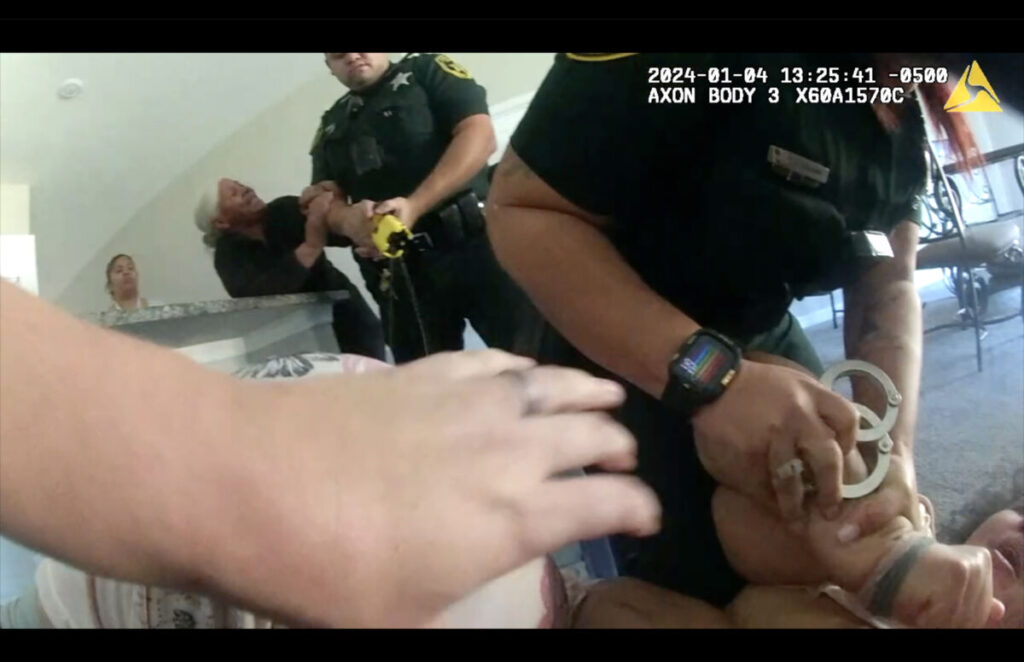
Shown in this still image from the Marion County Sheriff’s Office bodycam video, Mariluz Mateo, the mother of Paula Diaz, pleads with the deputy to stop tasing her daughter when they were struggling to gain her compliance on Jan. 4, 2024. [MCSO Bodycam Video].
|
Getting your Trinity Audio player ready...
|
By Jennifer Hunt
Editor’s Note: Readers can click through underlined text to read original reporting.
Over the past several years, the “Ocala Gazette” has examined reports of unusual deaths, negligent medical care and questionable use-of-force incidents at the Marion County Jail. These news stories are the result of careful examinations of public records, court filings, inmate medical records, jail incident reports and interviews with inmates’ families and government officials.
In response to new questions about how this investigation has come about, the “Gazette” has compiled this recap to better explain the process and thoroughness of our reporting.
Rather than address the concerns raised by the news reporting, Marion County Sheriff Billy Woods has been making the rounds on local radio stations and at public meetings and through his agency’s social media channels telling the public to discount the “Gazette’’ findings.
While Woods has repeatedly and publicly denigrated the “Gazette’s” reporting, he has yet to specify any factual errors in any of the news stories or ask for any corrections. Instead, he merely derides as sensationalism the conclusions drawn from the records reviewed by the newspaper.
The sheriff and Major Charles McIntosh, who oversees the jail, have denied repeated requests for interviews to understand what changes are being made at the jail to address concerns raised by the “Gazette.”
The beginning
The reporting began with the November 2022 death of Scott Whitley, a man diagnosed with schizophrenia who died while in custody at the jail. The District 5 Medical Examiner ruled Whitley’s death a homicide; no one, however, has been charged.
After the Marion County Sheriff’s Office denied access to records related to the incident, the “Gazette” filed suit to obtain the public records. A judge outside Marion County later ruled the records should be released for review.
What “Gazette” reporters learned during that reporting influenced further inquiries over the last few years, which have expanded to include other deaths and medical conditions inside the jail.
Here is some of what has been uncovered: The MCSO omitted or misstated critical facts and details in their reports of Whitley’s death.
The Florida Department of Law Enforcement and the State Attorney provided no accountability for the jail detention officers attacked Whitley the day he died. This included hitting him with a Taser 27 times; one officer held the Taser around Whitley’s groin area while another did the same around his neck while simultaneously beating him.
Federal reporting requirements & sheriff’s defense
Our reporting identified deaths that did not appear to have been reported under the Federal Death in Custody Reporting Act, which requires states to report deaths of individuals held by law enforcement agencies.
The “Gazette” compiled its own database of deaths using jail incident reports, medical examiner records and other public documents.
We compared the database to the in-custody death data for other county jails in Florida and reported that Marion County is either at the top of the list for deaths, or a close second compared to other county jails.
Woods has said that the FDLE and State Attorney William Gladson’s office have independently cleared MCSO of any criminal wrongdoing in the cases.
However, the FDLE has only investigated five of the 40 inmate deaths we’ve reported. The State Attorney’s office has not provided any independent investigative records, instead relying solely on the FDLE’s findings.
Medical care concerns
Several of the deaths examined by the “Gazette” involve questions about the quality of medical care provided inside the jail.
Heart of Florida Health Centers, a nonprofit organization, holds the contract to provide inmate medical care. The contract increased from approximately $8 million annually to about $14 million beginning in 2023.
IRS filings show the organization’s revenue increased from $28.5 million in 2021 to $45.8 million in 2023 as it expanded jail contracts in Marion and Sumter counties.
The “Gazette” reviewed jail medical records and internal reporting related to compliance with Florida Model Jail Standards.
A nurse employed by the MCSO had been responsible for monitoring whether Heart of Florida complied with the standards and contractual staffing requirements. Her reports documented instances in which the contractor did not meet those standards. In response, the MCSO fired her in 2024. No compliance reports have been produced since then.
No explanation was provided for her firing or for how this dismissal would improve conditions at the facility.
Case law related to the Eighth amendment prohibiting “cruel and unusual punishment” and the 14th amendment of the U.S. Constitution,, which holds that no state shall “deprive any person of life, liberty, or property, without due process of law; nor deny to any person within its jurisdiction the equal protection of the laws,” clearly require more than just medical malpractice or negligence. An element that must be established is, “knowing disregard.”
In the landmark opinion “Estelle v. Gamble,” the Supreme Court concluded “deliberate indifference to serious medical needs of prisoners constitutes the ‘unnecessary and wanton infliction of pain,’ Gregg v. Georgia, supra, at 182-183, 96 S.Ct. at 2925 (joint opinion), proscribed by the Eighth Amendment. This is true whether the indifference is manifested by prison doctors in their response to the prisoner’s needs or by prison guards in intentionally denying or delaying access to medical care or intentionally interfering with the treatment once prescribed. Regardless of how evidenced, deliberate indifference to a prisoner’s serious illness or injury states a cause of action under § 1983.”
Woods’ response was to fire the whistleblower and do away with the oversight position.
Newly installed Major Charles McIntosh, who oversees the jail, wrote in an email to the “Gazette” that detention officers would ensure that inmates were receiving the medical care they required.
Inmates request medical care by submitting written medical request forms through detention staff. Florida jail standards require that such requests trigger a timeline for care. Inmates interviewed by the “Gazette” said they sometimes had to submit multiple requests before being seen by medical staff.
The whistleblower’s internal reporting indicated that HOF was regularly not in compliance with responding to those inquiries pursuant to Florida model jail standards.
In order to verify the claims of inmates and the whistleblower, the “Gazette” looked at the financial records of the inmate commissary accounts, since inmates are charged for medication and doctor’s visits. When the “Gazette” compared the number of request forms reported by the medical provider with charges posted to inmates’ commissary accounts for medical visits and medications it further supported the discrepancies noted by the whistleblower.
The number of billed calls did not equal the number of patient visits by even half.
Additionally, we looked at the total in hospital bills paid by HOF as reported through its tax filings for inmate care and noticed it was very low. We asked the jail for emergency room statistics and noticed that HOF had dropped the number of emergency room visits after booking to less than half of what they were historically.
Individual cases examined
“Gazette” reporting examined multiple deaths in custody through medical records, incident reports and other documentation. Here is a sampling:
• Jacob Oakie, a 39-year-old Ocala man who died in July 2024 after developing pneumococcal meningitis. Medical records obtained by the “Gazette” raised questions about delays in treatment and the use of force by guards before he was transported to a hospital.
• Dennis DiGenova, a 73-year-old veteran who died in July 2023 after suffering a cervical spine fracture while in custody. The death was ruled a homicide, though no criminal charges were filed.
• Darrell Davidson, who died in custody in October 2023 after being booked into the jail on a misdemeanor charge. Reporting compared incident reports with photographic evidence and other records obtained by the “Gazette” and found excessive use of force by detention officers. Despite his pleas for medical help, Davidson died.
• Mayra Ramirez, who died in September 2023 after repeatedly requesting medical care while incarcerated. Records show Ramirez filed numerous requests for medical help before her death. Disability Rights Florida informed her family that her death may be due to medical malpractice at the jail.
Use-of-force reports
The “Gazette” also reviewed use-of-force incident reports at the jail unrelated to deaths at the jail. Those records showed numerous injuries occurring during encounters between detention staff and inmates, particularly in booking when the arrested person was told to strip for a search. Several of the cases involved inmates whose court records indicated they had mental health concerns or competency issues.
The “Gazette” has also examined numerous use-of-force reports.
One case involved Zachary Altom, a veteran diagnosed with mental illness. MCSO records did not report that detention deputies struck him while he was being booked into the jail. Instead, the records said the guards used pepper spray on Altom and that he hit his head in the decontamination shower. However, body footage from Ocala Police Department officers who brought Altom to the jail indicated he was in a psychosis state and was nonverbal and unable to follow commands. The video contains sounds of detention officers repeatedly striking Altom.
Neither the OPD officers nor other detention workers interceded on behalf of Altom.
Altom’s treatment raises concerns that law enforcement continues to struggle to police itself and have become indifferent to the suffering of the mentally ill.
According to its annual $14 million contract with Marion County, Heart of Florida Health Centers must provide sufficient staffing to administer health care services. This specifically includes the following mental health personnel: One full-time Behavioral Health Director, two full-time Psychiatric Advanced Practice Registered Nurses (APRNs), four full-time Licensed Clinical Social Workers (LCSWs) or licensed mental health counselors (LMHCs); and one part-time (0.2 FTE) psychiatrist.
If the contract is being adhered to, it calls into question why are these mental health professionals not being utilized when there is obvious and overwhelming evidence that someone entering the jail may be having a medical crisis or suffering from dementia.
Disability Rights Florida investigation
Disability Rights Florida, a federally designated protection and advocacy organization, has opened investigations related to jail conditions and inmate deaths. The organization has requested changes to the jail’s grievance process, which led the MCSO to install secured grievance drop boxes in housing units so inmates could submit complaints without relying on staff to distribute the forms.
It’s been nearly a year since the boxes were installed. In response to a public records request for the grievances, the MCSO has told the “Gazette” there is no data to provide.
The challenge of dealing with the mentally ill
Based on the conditions and limitations at the jail, the “Gazette” has questioned public officials about the decisions being made by officers and deputies to arrest someone who is clearly compromised mentally for minor offenses such as trespassing or petty theft rather than looking for another remedy.
An example of which was 29 year old Maniesa Fletcher, who was arrested for petty theft at a convenience store while she was in the midst of a mental episode. Fletcher, who had extensive medical issues including a brain implant stimulator, did not receive the medical care she needed and was found dead in her cell.
Another example we reported on last year involved Paula Ruiz-Rodriguez. Her family called MCSO to help take Ruiz-Rodriguez, who was mentally unstable, to a hospital. Body camera footage from MCSO deputies showed that about 10 minutes after arriving at the home, the deputies grabbed the woman’s hands, and she began to panic. Three deputies wrestled her to the floor of the family’s living room, and another started deploying a Taser on her, in front of her mother, Ruiz-Rodriguez’ son, sister and brother-in-law.
Her family can be heard in the background yelling prayers for Ruiz-Rodriguez .
Instead of taking her to the hospital, Ruiz-Rodriguez was arrested and charged with battery on the officers who grabbed her hands. After spending months in jail, she was found incompetent, and not likely to return to competency and released back to her family who have moved from the area following the experience.

Support community journalism
The first goal of the Ocala Gazette is to deliver trustworthy local journalism so corruption, misinformation and abuse are not hidden from the public or unchallenged.