
Praying for Paula
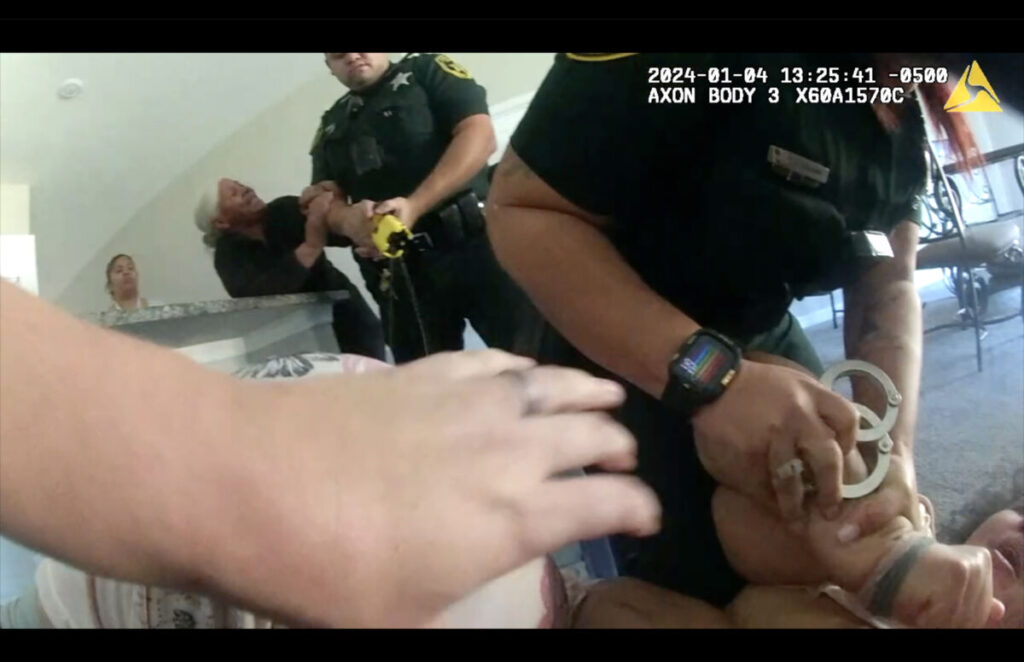
Shown in this still image from the Marion County Sheriff’s Office bodycam video, Mariluz Mateo, the mother of Paula Diaz, pleads with the deputy to stop tasing her daughter when they were struggling to gain her compliance on Jan. 4, 2024. [MCSO Bodycam Video].
Paula Diaz’s family will tell you they’ve had to reach out to law enforcement for help many times over the 23 years they cared for Paula, who has been troubled ever since being diagnosed with paranoid schizophrenia in 2004.
Most of the time, the experiences have been positive.
“Some law enforcement (members) have talked to her gently and convinced her to go with them to the hospital,” said Paula’s sister Khelva Ruiz-Rodriguez.
Their first call for help after moving to Marion County from Orange County on Jan. 3,2024, however, has resulted in a year-and-a-half ordeal they wish no other family has to endure.
Paula, 44, has been held without bond at the Marion County jail since Jan. 4, 2025 on two counts of battery on a law enforcement officer, a third-degree felony; and one first-degree misdemeanor count of battery.
Yet, sitting in court watching other hearings pertaining to those who are incarcerated and clearly mentally ill makes them concerned about the lack of resources to help families like their own.
On June 9, during a monthly status conference hearing for Paula, who is still awaiting trial, her mother, Mariluz Mateo, and Ruiz-Rodriguez cried as Circuit Judge Barbara Kissner Kwatkosky asked the state about dismissing the case against Paula.
“When I was reviewing the statute, if someone is not competent and not restorable usually that results in a dismissal,” the judge said.
Barbara Jean Harris, Assistant State Attorney, responded, “After a period of time, though.”
Kwatkosky pressed Harris. “If they are restorable, but not competent, after a period of time they are not restorable, I think it gets dismissed?” she asked.
“The state can get another expert to evaluate whether the person is restorable or not,” Kwatoksky added.
Paula has been found incompetent numerous times, according to records provided by the family and more recently in a report by Dr. Harry Krop, a psychologist, dated April 7, 2025.
That determination reiterated the findings from a report by Dr. Scot Machlus a year earlier, who noted “Ms. Diaz was incompetent to proceed” and recommended “that she receive competency training and continue her psychiatric treatment in the community, as she did not present as a danger to herself or others.”
Harris, however, said she did not have a release plan from the court’s health care provider, Meridian Healthcare, Inc., and would need to do more research before agreeing to release Paula.
Patrick Fortunato of Meridian told the family after the hearing that the release plan was the same as the one issued last year and expressed concern that Paula remained in jail only “due to legal reasons.”
The company had filed a letter days before the status hearing reaffirming their position that Paula continued to be incompetent to proceed in her legal case.
The family says they were unable to see or talk to Paula the first six weeks she was incarcerated because she was in “confinement.”
“My daughter keeps asking why I can’t come see her and that she wants to come home,” said Mateo. “She doesn’t understand why she’s in the jail and that I’m not allowed to come to her.”
They say they have tried to talk with Paula every day and visit frequently. Mateo said, however, sometimes the visitation machines are broken.
The family describes Paula as childlike when she’s not in “crisis,” the word they use to describe episodes when Paula can’t communicate and turns to destructive behavior like tearing up her mattress or spitting or throwing things.
According to Mateo, despite her best efforts to protect Paula, she has been in and out of mental hospital facilities, been sexually assaulted and beaten by people who didn’t understand how to react to her.
The family said they were hurt when MCSO chose to go to social media two days after the incident and described Paula as violent without providing any context about her being mentally ill.
Additionally, Ocala Mugshots posted a photo of Paula when she was arrested the second time with the message, “The best smile of the day!” And people weighed in on her photo with mean comments.
“They aren’t criminals. They didn’t choose to be sick,” Ruiz-Rodriguez said. “Marion County needs more mental health resources and officers need more training. Not just for the sake of the ill person but the families who can’t sleep at night because they are trying to do the best they can.”
Caught up in the system
Ruiz-Rodriguez said the immediate and extended close-knit family moved to Marion County from Orange County because of the lower cost of housing here and the hope of better living in what she thought was a community with a “small-town feel.”
“I obviously didn’t do my homework before I moved here, and I now feel unsafe and my family is going to move from the state because we can’t believe how unsafe it is for the mentally ill,” Ruiz-Rodriguez said.
Mateo lamented the decision to move to Marion County but added, “I always loved horses since I was a little girl, and I thought Marion County was paradise.”
“It’s not paradise,” she clarified.
Mateo recalls “little things being not right” with Paula when she was about 4 years old. The family lived in New York then.
Paula got pregnant and had a son at 16 and dropped out of school. Eighth grade was the highest level of education Paula would receive, and she started working in retail and fast-food businesses to support her son.
She was in Manhattan when terrorists crashed planes into the World Trade Center on Sept. 11, 2001, and the family calls the experience a turning point for Paula. She became paranoid about the Taliban and refused to take the train from Queens into Manhattan.
Mateo, now age 66, has cared for her daughter and her grandson since then.
On Jan. 3, 2024, the family had just moved to Ocala, and they were all living in one house temporarily while Mateo’s house was being renovated for her, Paula and Paula’s son.
Paula became aggressive toward her brother-in-law, spitting on him, throwing a plastic dish on the ground, and shaking the back of his chair. Ruiz-Rodriguez called for an ambulance so that Paula could get help regaining control at a medical facility.
In body cam footage from Marion County Sheriff’s Office deputies, Ruiz-Rodriguez greeted the deputies and asked for their help to take her sister to the hospital.
Over about 10 minutes after arriving at the home, the deputies spoke to the family and with Paula, who was in the living room holding a ball. They grabbed Paula’s hands, and she began to panic. Three deputies wrestled her to the floor of the family’s living room, and another started deploying a Taser on her, in front of her mother, Paula’s son, sister and brother-in-law.
The body cam footage shows deputies holding Paula around her neck and kneeling on her back while she is being struck by the Taser. Paula’s family can be heard in the background yelling prayers for Paula.
The family has provided consent to share the video because they feel the deputies did not use caution in dealing with Paula. Ruiz-Rodriguez lamented, “Maybe I should have been more specific with them about her fear of being touched and hit, particularly by law enforcement.”
Bodycam footage reveals a supervisor arriving at the scene after Paula was loaded into an ambulance and telling the Marion County Fire Rescue paramedics to take Paula to the county jail. The paramedics refused, stating that the state Paula was in required them to take her to a medical facility.
A deputy argued with the medics that Paula was under arrest, that it wasn’t a Baker Act case, and that MCFR was refusing care of Paula. The deputy asked the paramedics to transport Paula to the jail and a nurse would check her out there.
The paramedics instead delivered Paula to AdventHealth Ocala hospital, but she was quickly released to the MCSO jail. It would take two days and Mateo spending $13,000 to get Paula out on bond. Because of the third-degree felony charges, Paula wasn’t entitled to entry into the Mental Health diversion court.
Ruiz-Rodriguez and her mother said they did not see Paula scratch or bite officers in the altercation. “It all happened so fast, how do we know one officer didn’t scratch the other? The video doesn’t reflect what they said happened.”
The use of force report analyzing the incident by MCSO said the injuries to the officers only produced a little redness and did not require medical treatment.
The struggle that ensued after the arrest
Ruiz-Rodriguez said Paula was conditionally released following the 2024 incident and spent a few weeks at the local SMA Healthcare facility, which provides behavioral services for people in crisis. “They helped Paula, and she got a little better,” she said.
“Better” was short lived, however, and by October 2024, Paula was entering another crisis. With the help of MCSO deputies, this time Paula was taken in under the state’s Baker Act on Oct. 13, 2024 and spent a few weeks at a facility just an hour south of Marion County.
Ruiz-Rodriguez said that when Paula was released from the mental health facility, the treatment wasn’t successful, and she was still unstable.
Paula had a hearing scheduled for Nov. 4, under her conditional release for the January charges and the family knew that they could not persuade her to go. They reached out to the public defender and asked if she could appear by video for the hearing, and they said they got no help.
When Paula didn’t appear for the Nov. 4 hearing, Circuit Judge Lisa Herndon issued a warrant for Paula’s arrest. Mateo felt she needed to hire a private attorney to negotiate on behalf of her daughter to have her sent to a medical facility instead of the Marion County jail. She hired Gainesville attorney Evan Gardiner of Smith & Eulo Law Firm on Dec. 23 and paid him $5,000.
However, deputies showed up at Mateo’s house on Jan. 4 and took Paula to jail, where she was held with no bond. The family said the deputies executing the warrant were sympathetic to the family’s concerns and transported Paula carefully to the jail without incident.
The family says there have been periods of time where they are cut off from contact with Paula due to MCSO putting Paula in “confinement.”
Mateo said she paid $5,000 to Gardiner to use all the evidence they had that Paula was incompetent to get her released from jail. Gardiner made a motion on Jan.15 asking that Paula be released under her prior conditional release plan because “the defendant’s condition has deteriorated to the point that inpatient care is required, or that the release conditions should be modified.”
The motion was denied, and over the next months, Paula received additional psychological evaluations that all determined she was incompetent and not likely to be restored to competency.
At the time of publication, Paula’s lawyer has not filed a motion to dismiss the charges. The judge set the next hearing for July 3, and the docket notes “the court to hear a motion to dismiss at a later date.”
Sasha Kidney, Division Chief, for State Attorney William Gladson, wrote the Gazette in response to an inquiry, “Following a review of the court file in Ms. Diaz’s case, it appears that the 2024 conditional release plan was not filed into the record; as a result, we do not have a copy. Meridian has been in contact with Ms. Diaz’s attorney to discuss their concerns and their proposed modifications to the prior plan. Once a revised plan is finalized, they will provide a copy to our office.”
Family remains concerned for Paula and themselves
In addition to a psychological disability, Paula has numerous physical disabilities and medical conditions that can worsen if not treated. The family has expressed concern over the medical care Paula has received for her condition since January.
At one point, Paula told her family she had pulled the thin mattress down from the top bunk to sleep on the floor of her cell as she could not get in and out of the top bunk she was assigned.
They say they know she’s had at least one altercation with another inmate.
Ruiz-Rodiguez and Mateo met with jail administrator Major Charles McIntosh, and they said they believe he is trying to improve the jail. “But he’s just one person, and he can only do as much as his boss (Sheriff) Billy Woods lets him do,” said Ruiz-Rodriguez.
As previously reported by the “Gazette,” McIntosh has ceased compliance reporting for medical care provided by Heart of Florida at the jail despite growing concerns about questionable medical care that has led to an unusually high number of deaths at the facility.
Aaron Victoria, a senior Advocate-Investigator for Disability Rights Florida, has confirmed that the MCSO jail is being investigated by their agency, which is likely the only agency with the authority to assert access to the jail, other than the governor.
Ruiz-Rodriguez filed a complaint with MCSO for their handling of her call for help for her sister that led to her arrest. She said she received a call from MCSO Lt. Danny Rosa that she described as “threatening.”
“He said there was no way MCSO was going to drop charges against Paula,” Ruiz-Rodriguez said of the call.
Ruiz-Rodriguez and Mateo both say they are afraid to call for help and that they are already talking about moving from Florida as soon as possible because they feel their family is being discriminated against.
Mateo told the “Gazette” people at her church told her to remain quiet for fear that Paula would be retaliated against in jail. However, Mateo told the “Gazette” she’s speaking up for Paula and all the other mentally ill people being held at the jail.
“Families like ours need community,” Mateo said.



Support community journalism
The first goal of the Ocala Gazette is to deliver trustworthy local journalism so corruption, misinformation and abuse are not hidden from the public or unchallenged.