
Sheriff cuts back staffing requests to accommodate county budget constraints
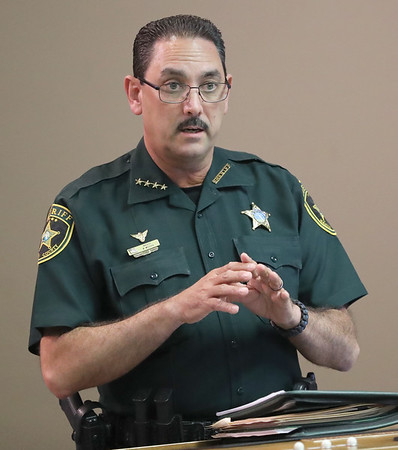
Marion County Sheriff Billy Woods speaks during a County Commission workshop in Ocala on March 21, 2022. [Bruce Ackerman/Ocala Gazette file photo]
Marion County Sheriff Billy Woods has cut his request for more patrol deputies by more than half in response to budget concerns raised by Marion County Board of County Commissioners during the 2025-26 budget talks held on July 23.
While pressing the need for the agency to have more deputies, Woods noted the agency’s patrol side is now at full staff, thanks to an unlikely source: “Chopper Cops.” The popular television show follows the agency’s Air One aviation unit as it assists ground deputies in responding to calls within the 1,600 square miles the MCSO patrols.
“I’m full,” he said. “Every position on patrol side is full right now. I don’t have a vacancy. About 225 applicants are on hold right now. When I took office, we barely had 10.”
“The value of the benefit, there’s no monetary value on what the show does for us. It highlights the work in which the men and women do every single day, and it gets me the positions filled like it should,” he explained.
During the budget workshop, Woods cut his request for patrol deputies from 28 to 12. The sheriff’s department proposed budget for 2025-26 year was $218,913,093, rising 17% over last year.
This reduction in patrol deputies comes on the heels of a staffing study the MCSO conducted in May that indicated they were short on the number of patrol deputies needed to meet nationally recognized staffing benchmarks for coverage and response.
The $75,000 staffing study by Miller Justice Consulting, indicated that currently there are 215 deputies assigned to calls for service at MCSO, but the consultants indicated the department needed 323, a shortfall of 108 deputies.
Documents provided to the “Gazette” in May in response to a public records request showed MCSO had 690 sworn personnel and 430 unsworn personnel for a total of 1,120 employees.
Sworn officers can arrest, whereas unsworn employees of MCSO cannot.
The sheriff also reported progress at the county jail, which has historically struggled with staffing shortages.
“The jail is at a position now that it’s just right between 20 and 30 vacancies. That’s a good revolving door for them, but I also have two recruit classes coming up for the jail. Those positions will be filled,” Woods said.
Woods also added six new support staff positions, which included: one dispatcher, one intervention specialist (CIS team), one IT employee, one human resources employee, one radio employee and one fleet employee, a mechanic.
Woods said that his budget allowed for a 4% increase in pay for department personnel.
Woods anticipates providing increased traffic support
Woods also wants to add 10 community service specialists (CSS) to help with traffic calls. Although the Florida Highway Patrol handles traffic accidents in unincorporated Marion County, Woods told the commissioners he saw the need for his department to play a greater role.
During the budget workshop, he explained that the county’s rapid population growth has led to more accidents and greater demands on law enforcement.
“I don’t need to beat that into the ground, because we know what our growth is,” he said. “If you look at that staffing study that I sent to each and every one of y’all… the experts made it abundantly clear that we sit 108 deputies short currently.”
“One of the biggest complaints, I’m pretty sure you get them, obviously, is traffic and the crashes,” he told commissioners. “One of the things this office has never done is work crashes, but we’re going to be heading in that direction because, truthfully, I’m tired of my citizens having to wait two to four hours for a [FHP] trooper to show up to work a wreck.”
Woods pointed out that deputies often must wait with citizens at accident scenes, sometimes for hours, because the FHP is stretched thin.
“Most of the time, probably about half of those crashes, the deputies are having to sit there with the citizens, whether the vehicles be… not drivable, can’t be moved, or people just don’t want to be left alone with some total stranger,” he said.
The new community service specialists will help fill this gap. While they won’t have the full authority of sworn deputies, they will be able to respond to and manage many traffic accident scenes, freeing up deputies for other duties.
“Now they don’t get to do, obviously, everything that a sworn deputy does but that does allow them to work a lot of calls,” Woods explained.
The sheriff emphasized that the addition of CSS positions is both a cost-saving measure and a practical response to the county’s needs.
School resource officers budget dispute
The commission and Woods also discussed the cost-sharing arrangement for School Resource Officers (SROs) in local schools—a topic that has become increasingly contentious as budgets tighten.
Woods said private schools in the county are required by law to cover the entire cost of the officer assigned to their campus. “The private schools pay for the full package,” he said, noting that this includes salary and all associated expenses.
In contrast, the Marion County School District pays only about half the cost of each SRO, with the county commission subsidizing the remaining amount in the sheriff’s budget.
“What I currently charge them is half of what a deputy is,” Woods said, adding that this arrangement was designed to split the financial responsibility between the county and the school board.
Commissioners, however, voiced strong concerns about the fairness of this setup.
Commissioner Kathy Bryant pointed out that the school district now has access to multiple funding sources, including a one-and-a-half mill property tax, a half-penny sales tax, and impact fees.
“It almost feels like it’s a double dipping to the county commission, for the county commission to have to pay for those school resource officers,” Bryant said.
The school district, however, is restricted from using penny sales tax and impact fees as funding mechanisms for school resource officers, but no one from the school district was at the workshop to correct the record.
Bryant and other commissioners argued that if the county has to pay a portion of the SRO costs, commissioners should be involved in the contract negotiations with the school board.
“It’s a disservice to this board to ask us to pay for something that another entity should be paying for and we don’t even have any—we’re not even involved in the negotiations,” she said.
The sheriff acknowledged the complexity of the issue, noting that there is no consistent funding formula across the state and that negotiations must be handled carefully to avoid prompting the school district to create its own police department—a move he opposes.
As budget pressures mount, the commission signaled that the current arrangement may need to be revisited, with a greater push for the school district to shoulder more of the financial burden for keeping students safe.
As previously reported, MCSO negotiated a less-expensive contract for 2025-28 that would allow the agency to be the sole provider of SROs for all schools across the district, cutting out Ocala Police Department and Belleview Police Department.
Ocala Police Chief Michael Balken did not want to lose the contract, explaining that SRO officers in city schools provide valuable crime intelligence to the OPD.
Overall jump in public safety costs
Bryant noted the challenge of keeping up with rising expenses, not just for today, but for years to come.
“We’re not just talking about today’s costs, but legacy costs,” she said. “And quite frankly, I feel for commissions who are trying to figure all this stuff out in 15, 20 years, because … I don’t know how our communities are going to keep up with it.”
Commissioner Carl Zalak echoed these concerns, pointing out just how much of the county’s resources are devoted to public safety. “More than 50% of our budgets are all going to public safety,” he stated.
The commissioners also discussed the difficulty of balancing the need for public safety with the financial realities of the county’s other obligations.
“We all have budgets that we are working within,” Bryant said, referencing the strain that public safety costs place on the county’s ability to fund other services

Support community journalism
The first goal of the Ocala Gazette is to deliver trustworthy local journalism so corruption, misinformation and abuse are not hidden from the public or unchallenged.