
Ocala renews contract with Wear Gloves
The nonprofit provides jobs for local laborers to provide litter and stormwater cleaning services.
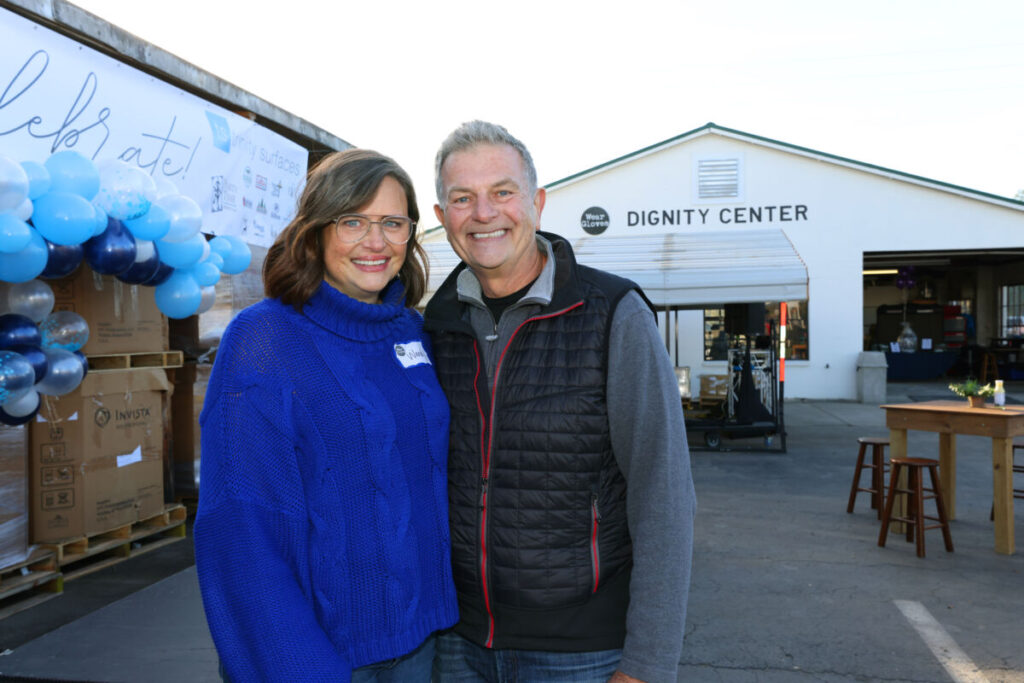
Wendy and Ken Kebrdle, the founders of the nonprofit Wear Gloves, Inc., are shown at their ministry center in downtown Ocala in 2023. [File photo by Bruce Ackerman/Ocala Gazette]
The Ocala City Council has approved a one-year $433,472 contract renewal with Wear Gloves, Inc., a nonprofit that provides jobs for local laborers in litter control and stormwater drain/inlet cleaning services.
The renewal extends services from Aug. 1, 2025, to July 31, 2026, with an option for an additional one-year renewal. The decision, praised by council members, reflects Wear Gloves’ strong performance since 2019.
According to Darren Park, Public Works director for the city of Ocala, Wear Gloves began litter control services in September 2019, replacing an inmate labor crew.
“Before we brought in Wear Gloves, we had an inmate labor crew and a day labor crew that did litter control,” Park said. “We replaced one of the inmate crews with Wear Gloves as a test run, and they did an exceptional job.”
The 2022 agreement, approved June 7, 2022, cost $174,460 annually for 305 weekly hours at $11 per hour. The first amendment (June 21, 2023) added 138 weekly hours of drain cleaning and raised the hourly rate to $16, increasing the cost to $368,754. The second amendment (Feb. 11, 2025) expanded litter control locations, raising the total contract sum to $960,587 over the initial three-year term (Aug. 1, 2022, to July 31, 2025).
The $433,472 renewal, approved via a procurement exception on Dec. 3, 2024, funds 521 weekly hours: 383 for litter control and 138 for drain cleaning.
“Wear Gloves right now, for litter, they’re doing 383 hours a week. And then for stormwater, they’re doing 138 hours a week,” Park explained. At $16 per hour, this equates to 27,092 annual hours, supporting approximately 13 full-time workers at a 40-hour workweek.
Mayor Ben Marciano sought clarity on growth potential at Tuesday’s city council meeting.
“What this contract does is allows us to add money to the contract cap as we find those opportunities, but we would have to bring it back to council for approval for the additional money,” Park said.
According to Park, services cover daily litter control in approximately two dozen parks and drain cleaning across Ocala’s stormwater system.
“There’s a schedule for the parks Monday through Friday. They do about close to two dozen a day,” Park said. Drain cleaning targets “hot spots” with heavy tree canopy, where debris like palm fronds causes flooding. “By keeping the drains cleaned, it helps the stormwater conveyance system,” Park noted. The city assigns Wear Gloves to specific grids, cycling through sections to cover the entire city.
Wear Gloves submits weekly labor hour reports, with the city conducting spot checks.
“Drain cleaning is pretty obvious. If the litter’s gone, they’ve done the work,” Park said.
According to Park, there are no mandated targets for debris removal.
“They do report the number of bags to us,” Park noted, though volumes vary weekly.
Drain cleaning reduces flooding risks, with success measured by fewer incidents in targeted areas. The 2023 amendment saved $114,994 annually by replacing Florida Department of Corrections contracts, a cost-efficiency retained in the renewal.
Council member Jim Hilty Sr. praised the visible impact.
“I’ve seen them in action, and they do a great job in trying to keep the parks clean. They’re very diligent. When they come in, they come in a van, they spread out, they know what they’re doing and clean everything up,” Hilty said.
In terms of safety and compliance, the contract mandates safety protocols, including yellow safety vests, a drug-free workplace, E-Verify usage and a 40-hour workweek limit. Drain cleaning workers hold Florida Department of Transportation Temporary Traffic Control Intermediate Certifications.
“We interface with their supervisor, and we follow up behind them and spot check,” Park said.
Wear Gloves meets insurance requirements ($1 million general liability since 2022), with no reported defaults or terminations.
The 2019 agreement required a performance evaluation by July 31, 2025. Park highlighted Wear Gloves’ “exceptional” service, noting their replacement of both inmate and day labor crews.
“It’s tough to find workers that are willing to do tasks that are pretty mundane. Finding people that take pride in what they do and do a good job is not an easy thing,” he said.
According to Park, Marion County’s litter problem persists.
“We have throughout Marion County a challenge with litter. People, for whatever reason, seem to think it’s OK. So, that’s always a challenge,” he said.
The renewal maintains robust service hours to address this, with no specific adjustments noted for challenges like workforce turnover.
Wear Gloves’ mission to employ underserved individuals aligns with significant community benefits, Park said.
“They try to provide meaningful employment to those that may struggle to find employment because they’ve got a background issue or some other challenge,” he said.
Marciano highlighted the demand.
“When I talked to the founders, Ken and (Kebrdle), they said that they actually have a waiting list of people wanting to do the jobs,” he said.
Marciano also emphasized the social impact.
“If it’s working out well, and we’re able to then provide jobs to get homeless off the streets, I think it’s a great opportunity,” he continued.
Park is optimistic about a second renewal after July 31, 2026.
“If they continue to do the same type of job, we would absolutely renew with them,” Park said.
The city is exploring additional tasks, as Park noted in response to Marciano’s question about growth.
“We started with litter control. We’ve expanded to storm water drain and inlet cleaning and we’ll continue to look for avenues of opportunity to expand and grow,” Park said.
“I’m a big fan of this. It’s just a great program,” Marciano said.
To learn more about Wear Gloves and its various programs, go to weargloves.org
surname?

Support community journalism
The first goal of the Ocala Gazette is to deliver trustworthy local journalism so corruption, misinformation and abuse are not hidden from the public or unchallenged.