
Ocala to target rising pedestrian, bicycle fatalities
New grant will fund high-visibility police operations along dangerous traffic corridors.
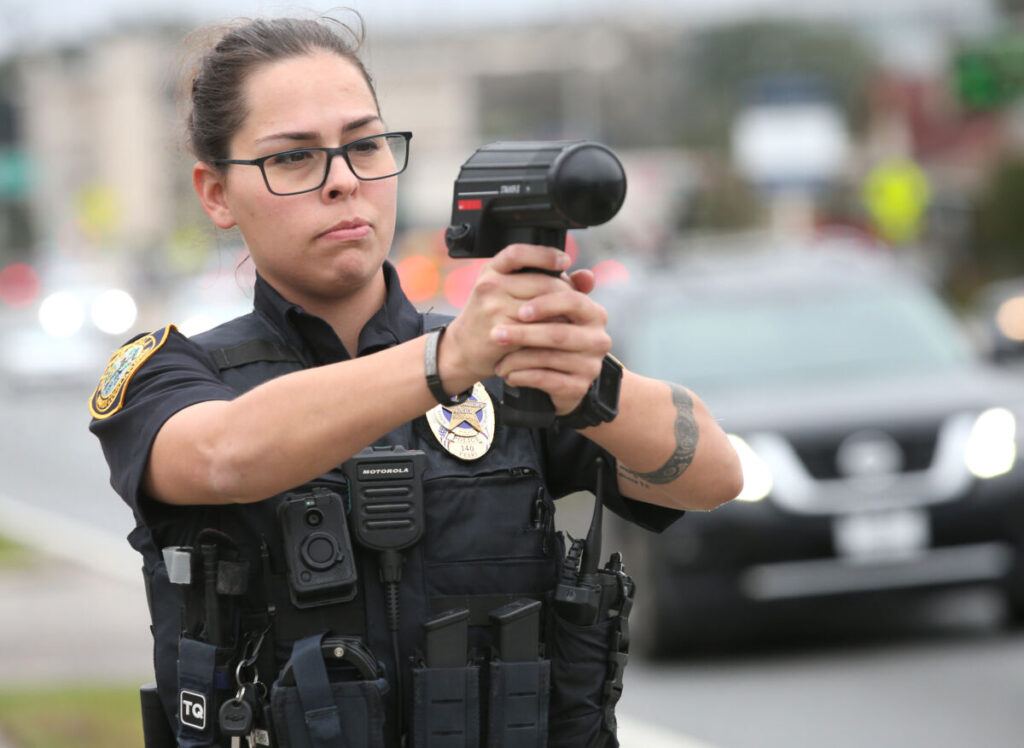
Officer Cheyenne Bower of the Ocala Police Department operates a handheld radar gun as she checks the speed of traffic on South Pine Avenue in Ocala on Dec. 20, 2021. [File photo by Bruce Ackerman/Ocala Gazette]
The city of Ocala is launching an education and enforcement initiative aimed at pumping the brakes on the rising number of pedestrian and traffic fatalities in Marion County.
Using a $47,099 grant from the University of North Florida’s Institute of Police Technology and Management, backed by the Florida Department of Transportation, the city will fund overtime for Ocala Police Department officers to conduct targeted educational and enforcement operations in high-risk areas through May 8, 2026.
The grant, accepted by the City Council on Aug. 5, will fund the city’s response to traffic fatality data from the “Pedestrian and Bicycle High Visibility Enforcement and Support Grant” document that shows in 2023, Florida recorded 3,375 traffic deaths, with 791 pedestrians (over 23%) and 234 bicyclists (more than 6%) among the fatalities, driven by factors like speeding, impaired driving and distractions.
Marion County accounted for approximately 2.65% of Florida’s pedestrian deaths in 2024 (21 out of 791 statewide), despite having only 1.9% of the state’s population, according to the Florida Highway Patrol and U.S. Census data.
The FHP Crash Dashboard at flhsmv.gov reflects that by late July 2025, the county recorded 11 pedestrian and 40 total traffic fatalities, many along major corridors like U.S. Highway 441.
For this enforcement campaign, the state selected specific locations in Ocala that have been identified as high-risk for pedestrian and bicycle crashes based on the previous year’s crash data, said OPD Public Information Officer Jeff Walczak.
The high-risk locations include U.S. 441 (S Pine Avenue) from SW Fort King Street to State Road 40; SW 17th Street to SW 23rd Place; SW 13th Street to SW Eight Street; State Road 200 (SW College Road) from SW 38th Court to SW 48th Avenue; Interstate 75 to SW 27th Avenue; U.S. Highway 27 (Blitchton Road) from NW 35th Avenue to NW 24th Avenue; and SR 40 (Silver Springs Boulevard) from SW 21st Avenue to SW 19th Avenue; and NW First Avenue to NE First Avenue.
Walczak said the program will emphasize enforcement, education and visibility.
“The operation enhances safety by enforcing rules through citations, providing educational materials and information about right-of-way rules, and promoting safe driving practices via social media and public messaging,” he explained.
Officers must complete a mandatory four-hour in-person training on state laws governing pedestrians, bicyclists, crosswalks, sidewalks and bike lanes, followed by an annual two-hour refresher.
Reimbursements are limited to eight overtime hours per officer daily, with caps on personnel per site based on corridor size. All activities will comply with state and federal regulations including sovereign immunity provisions. The initiative includes distributing educational materials and bicycle lights to improve nighttime visibility, alongside at least two media engagements to raise public awareness.
“Traffic safety requires drivers, bicyclists and pedestrians to remain cautious and responsible—so be patient, stay alert and always be aware of your surroundings,” Walczak said.
OPD encourages community involvement to help reverse the county’s troubling fatality trends. Residents can expect increased police presence at these key locations, designed to educate all road users.
For more details, contact IPTM or the Ocala Police Department at (352) 369-7000.

Support community journalism
The first goal of the Ocala Gazette is to deliver trustworthy local journalism so corruption, misinformation and abuse are not hidden from the public or unchallenged.