
MCPS renews contract for law enforcement in schools
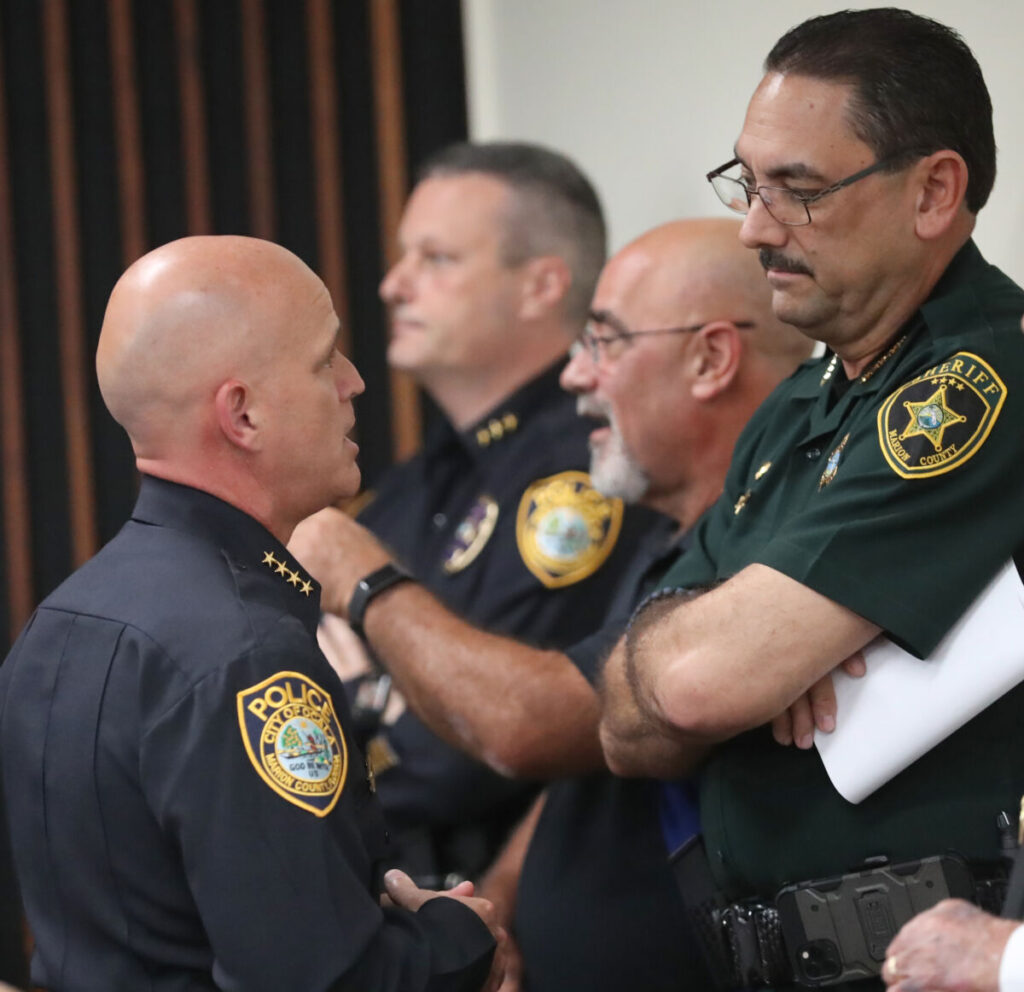
File photo: Ocala Police Chief Mike Balken, left, talks with Marion County Sheriff Billy Woods, right, before the start of the Ocala City Council meeting at Ocala City Hall in Ocala, Fla. on Tuesday, July 6, 2021. Shane Alexander, the former Ocala Fire Chief, was fired from his position last week by Ocala City Manager Sandra Wilson. The Ocala City Council voted not to remove Wilson from her position as City Manager for firing Alexander during the meeting. [Bruce Ackerman/Ocala Gazette] 2021.
The Marion County School Board agreed to an initial $16.3 million contract on March 13 with three local law enforcement agencies to provide School Resource Officers, rather than allowing the Marion County Sheriff’s Office to take over for all school safety.
The renewed SRO contract will be enacted through 2028 to continue provisions from MCSO, the Ocala Police Department and the Belleview Police Department to safeguard Marion County Public Schools.
At the March 13 work session, Safe Schools Coordinator Dennis McFatten said the current three-year SROs contract that began in 2022 ends on June 30, 2025, and the school board needed to renew or modify who would provide the officers going forward.
Under the Marjory Stoneman Douglas Act, passed in 2018 by former Gov. Rick Scott, a law enforcement officer must be present at every school in the district during regular operating hours.
As the existing contract is soon coming to an end, MCSO negotiated a less expensive contract for 2025-28 that would allow MCSO to be the sole provider of SROs for all schools across the district.
Currently, McFatten said MCSO supplied 40 SROs and one roamer, OPD supplied 21 SROs and BPD supplied one SRO across school campuses for the 2024-25 school year.
The total cost for these 63 officers was $4.9 million, with each SRO averaging $78 thousand in annual salaries. McFatten shared a cost comparison chart with the board, explaining three possible scenarios for them to select from for a 2025-28 contract.
With Scenario 1, all three agencies would continue providing SROs for the county with an increased number of officers and increased total cost. Under Scenario 2, MCSO would be the sole provider for all officers at a lower cost. Scenario 3 was not considered by the board.
Marion County Sheriff Billy Woods and OPD Chief Mike Balken shared their opinions at the work session on the best way to proceed with the SRO contract.
“In any dynamics, regardless of what it may be, the perfect scenario is one entity that oversees something, not multiple,” Woods said.
He said scenario 2 would be the best-case scenario, but assured the public that Balken and the current law enforcement officers prioritize student safety first, so the three entities would put aside any disconnect and work together.
In 2022, the school board rejected a proposal from MCSO to take over the district’s Department of Safe Schools, opting instead to keep McFatten in charge of safety standards in coordination with law enforcement agencies.
Balken said, although he agrees with almost all of Woods’ comments, he said, “I am going to stand here today and tell you that I absolutely do believe that all of our city’s schools should be staffed only by city cops.”
Balken said Ocala officers are in the schools building positive relationships with the students daily through mentorship and crime prevention strategies.
“I believe what’s best for Ocala is to have an SRO that has a truly vested interest, in not only what occurs on school grounds during school hours, but what also occurs in the surrounding neighborhoods,” Balken said. “I believe they should have a vested interest in not just the kid but the family and the neighborhood nearby.”
He said OPD does a good job of ensuring the school and community’s safety.
In the cost comparison chart for 2025-26, Scenario 1 has a total cost of $5.3 million for 65 SROs, including 41 MCSO officers and one roamer, 22 OPD SROs and one BPD SRO. The total will increase to $5.4 million for 2026-27 and have a small increase again for 2027-28.
One SRO provided by the MCSO is $75 thousand and one SRO provided by OPD is over $95 thousand, posing a $20 thousand difference and a higher total price with Scenario 1 than Scenario 2, which does not include OPD officers.
School Board Member Sarah James said she “struggles” with the higher cost of OPD officers compared to MCSO officer costs and believes the city should be paying what the county is paying.
“Unfortunately for Chief Balken, he is not in charge of his money,” James said. “He doesn’t have the discretion to decide, like the sheriff does, how much he’s going to charge us; and so, I do not agree that there should be such a varying cost between the two agencies, and I believe whole heartedly that safety in our schools is a community responsibility not a school responsibility.”
Scenario 2 costs $4.9 million for 66 SROs, which are all provided by the MCSO. Scenario 2 supplies one more additional officer than Scenario 1, and Scenario 1 will have a higher cost for the following two years up to 2028 because OPD officers are included and have higher wages.
“While I am all about controlling costs, I am not willing to do that on the backs of our children or our school employees,” School Board Member Nancy Thrower said. “I want the people with the training and the law enforcement, ideally that are closest to each specific community school to be the ones embedded there.”
School Board Member Allison Campbell said she was comfortable with Scenario 1 as well. “Rather than the money changing, if it’s not broke don’t fix it,” Campbell said.
Vice-Chair Eric Cummings also backed Scenario 1 and agreed with Campbell that if the system works, keep it working. He acknowledged the price difference, but said the city has a different dynamic with retirement and benefits, affording little leeway.
When Chair Lori Conrad called for consensus, four board members were confident in renewing the SRO contract and using the first scenario’s strategy, while James said she would support the board’s decision, she wants to start this conversation months before consensus for future contracts.
The 2025-28 renewed contract will be approximately $16.3 million to afford all three agencies’ officers.
“I’m a proponent of safety no matter what the cost is because you can’t put a value on a life,” Cummings said.

Support community journalism
The first goal of the Ocala Gazette is to deliver trustworthy local journalism so corruption, misinformation and abuse are not hidden from the public or unchallenged.