
Revisiting kratom in Ocala
City Council discusses synthetic drugs; mayor urges building awareness of risks.
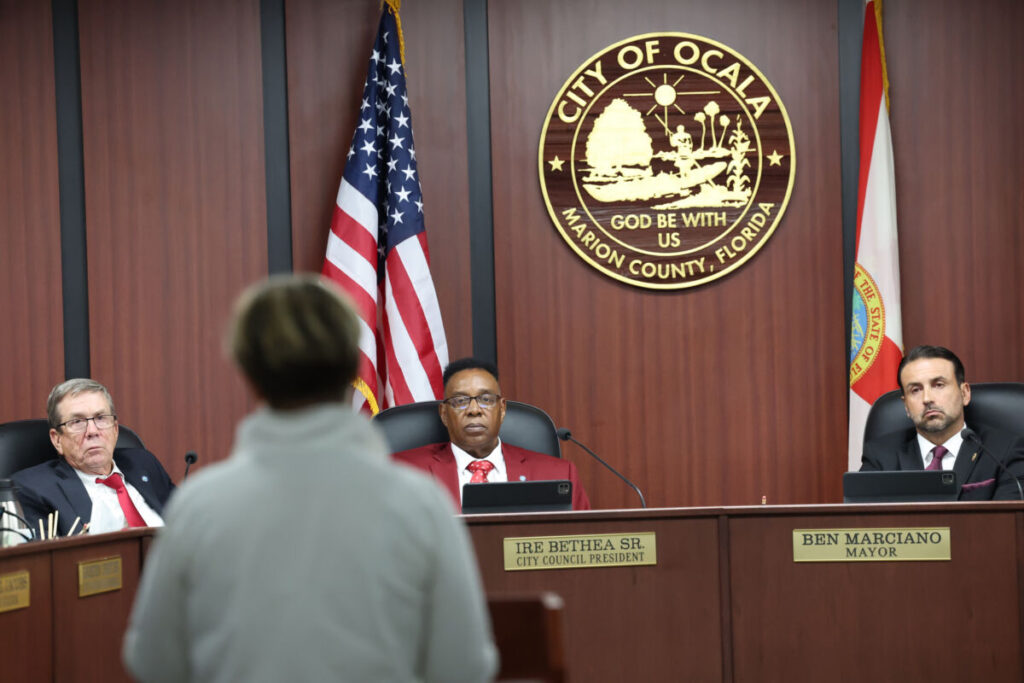
Ocala City Council members Jay Musleh and Ire Bethea Sr., and Ocala Mayor Ben Marciano, left to right, listen as people speak in opposition to a proposed ban on kratom during a council meeting at City Hall on Dec. 2, 2025. The council took no official action at that meeting or during one on April 21, 2026. [Bruce Ackerman/Ocala Gazette file photo]
Ocala City Council member Barry Mansfield brought a constituent’s personal pain to the attention of his fellow board members during their April 21 meeting.
“I usually don’t get these calls, but I got a call from a concerned mom whose son was at the hospital overdosing on kratom. She was concerned she wouldn’t know what to do,” he said.
“I called the (police) chief. He was nice enough to get involved a little bit,” Mansfield explained, but then pivoted to ask the board to revisit the issue of kratom use in the community. “We talked about it months ago but maybe we should revisit it because now, you know, it was just sort of a wake-up call for me.
“It’s like, I don’t deal with this, but a mom’s calling me asking for help from the city council to cancel this stuff because her son was overdosing on it,” Mansfield said. “So, it was heart-wrenching for me, having two boys of my own.”
The leaves of kratom, a tropical tree native to Southeast Asia, contain compounds that can produce stimulant effects at low doses and opioid-like sedation at higher doses. While state law provides some regulation on the sale of kratom, the substance can be purchased locally at some gas stations, smoke shops and health boutiques.
The availability and use of kratom have been hot topics for the council. Ocala Mayor Ben Marciano in December 2025 urged the board to ban the sale of kratom within city limits, citing health and addition risks.
Marciano last week referenced those previous discussions.
“We were talking about this months ago and the media was picking it up,” he said, but nothing was decided on the council level.
The council took no official action on the topic during the April 21 meeting.
Marciano said that since December, local school principals and parents have thanked him for helping them understand the concerns of the substance.
“A lot of them had no idea what it is. I think a lot of it right now needs to be an awareness campaign. And that’s one thing that I want to do over the next couple of months, talk about these synthetic drugs, build awareness around it. I think it needs to happen from a state level to get some teeth into it. I know that we wrote, I think, a letter in support of any kind of bill that might restrict it, because I did speak to a city that did develop an ordinance against it, and they were having a really hard time enforcing it,” he said.
“But I think the more that we can build awareness around it and just educate people, because again, the kids think it’s next to the candy. They think it’s something, ‘Oh, I can grab’ and now they’re hooked on something, and it does take them down a pretty bad path,” Marciano said.
Council member Ire Bethea recommended a local resource that might help the woman who reached out to Mansfield and others like her.
“I know that the Marion County Children’s Alliance has a lot of data regarding kratom,” he said. “That’s a source that we could possibly utilize to get more information if we need to in the immediate term.”
According to Hilary Jackson, director of prevention for the Marion County Children’s Alliance, there is limited local-level data specific to kratom use among youth in Marion County.
“Most available data on youth substance use (such as school-based surveys and statewide reporting systems) does not currently isolate kratom as a tracked substance, which makes it difficult to quantify use or trends locally,” Jackson said.
“Based on our ongoing work with youth, parents, schools and community partners, we do not currently have evidence to suggest widespread use of kratom among youth in Marion County. However, the lack of specific data does not necessarily indicate absence of use,” she continued.
“From a prevention standpoint, kratom remains a concern due to its accessibility, lack of regulation and documented health risks, particularly as it is often marketed or perceived as a ‘natural’ product. These factors can contribute to misunderstanding about its safety,” Jackson stated.
Jackson emphasized that their approach focuses on proactive education.
“We work with parents, educators, community leaders and law enforcement to increase awareness and reduce risk. This includes providing factual information about emerging substances so communities are better equipped to respond early,” she said.
Council member Kristen Dreyer pointed to Ocala Fire Rescue’s overdose response team.
“If we get those calls immediately, you can call them and they’ll go right away,” she said.
Marciano said he remains opposed to the use of kratom, which he detailed to the “Gazette” in December in this article: ocalagazette.com/kratom-conundrum/
“My view on kratom has not changed since the last time it was a hot topic. I’ve received emails and calls from citizens giving me stories about how friends or loved ones have been addicted to this. I would support any state legislation or federal legislation to ban kratom, and I’ll continue to be a voice against it. Also, I plan to do an awareness campaign about the harmful effects of kratom and other synthetic drugs,” he said.
Jackson provided a kratom fact sheet to the “Gazette” that lists the following policy recommendations/considerations:
- Ban kratom and kratom-based products. List mitragynine and 7-hydroxymitragynine as controlled substances in FS 893.03 Schedule 1. Establish legislation to regulate preparation, distribution and sale of kratom-based products that contain the alkaloids mitragynine and/or 7-hydroxymitragynine.
- Require a permit from the Department of Agriculture; establish a standard serving size and limit of total mitragynine in each package; establish warning labels; prohibit products that are attractive to children; prohibit flavors and marketing of kratom to minors; prohibit health claims not verified by science/research; establish corrective actions/penalties for actors/agencies that would violate such legislation.
- Require an annual review of deaths associated with kratom in the Florida Department of Law Enforcement Florida Medical Examiners Drugs in Deceased Persons report as well as kratom exposures reported by Florida Poison Control Centers and allow localities to ban kratom sales.

Support community journalism
The first goal of the Ocala Gazette is to deliver trustworthy local journalism so corruption, misinformation and abuse are not hidden from the public or unchallenged.