
Kratom conundrum
The Ocala City Council will review options on local sales after mayor raises concerns.
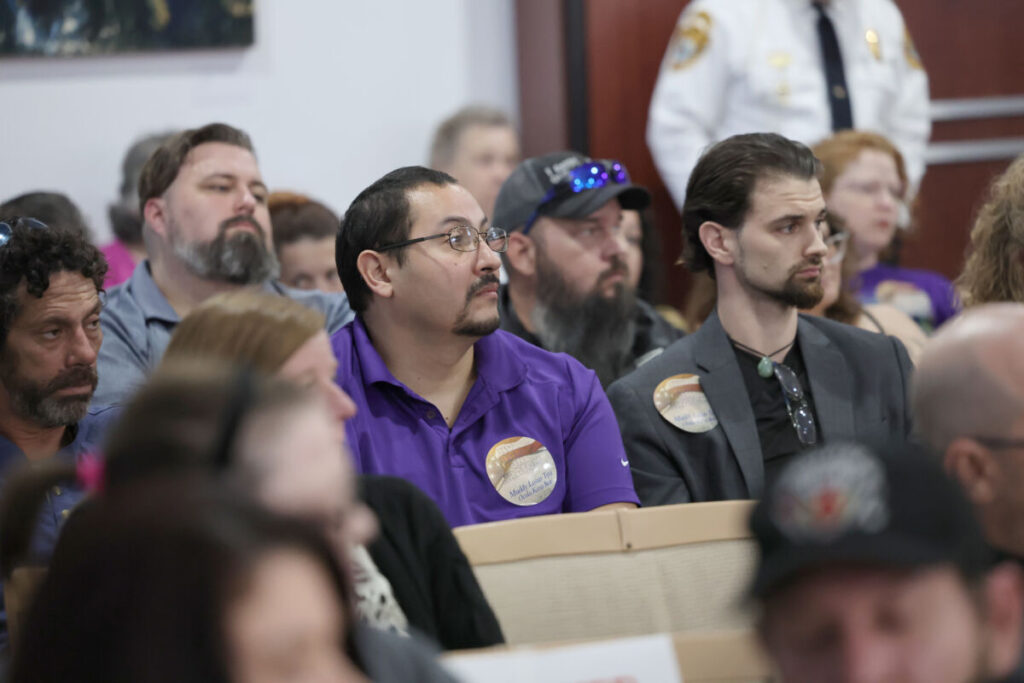
Numerous people representing Muddy Lotus Tea Kava Bar gather in opposition to a proposed ban on kratom during the Ocala City Council meeting at Ocala City Hall in Ocala, Fla. on Tuesday, Dec. 2, 2025. [Bruce Ackerman/Ocala Gazette] 2025.
Ben Marciano is not shy about sharing with people his battles with addiction and how he turned his life around and set out on a path that has led him to become the mayor of Ocala. When he recently spoke about his journey with a group of middle school students, he said he was stunned by the interactions he had with some of them after his talk.
“There was a significant number, it actually shocked me how many kids came up to me and said that they were either struggling with mental health or substance abuse, and kratom was mentioned, and it really bothered me,” Marciano said.
Kratom is a tropical tree native to Southeast Asia. Its leaves contain compounds that can produce stimulant effects at low doses and opioid-like sedation at higher doses. While state law provides some regulation on the sale of kratom, the substance can be purchased locally at some gas stations and smoke shops as well as certain health boutiques.
This easy access has led Marciano to call for a ban of the sale of kratom within the city limits. During the Nov. 18 Ocala City Council meeting, he mentioned that local gas stations are selling kratom without proper regulation, citing it as an “introductory drug” for getting kids into more serious drug use.
“There’s been legislation on making kratom illegal, and I don’t know if there’s a timeline on that,” Mariciano said. “So, what can we do as a city to address that?”
Ocala City Manager Pete Lee said he did not know if the city can regulate kratom if it is not regulated by the state.
“I know there were some proposals last session, and I know that there will be again,” Lee said. “I’ll find out what the status is.”
Some Florida cities and counties have instituted total bans: Sarasota (2019), St. Johns County (2021) and Winter Park (2024).
Florida’s 2023 Kratom Consumer Protection Act sets the minimum purchase age at 21, requires third-party lab testing, bans certain high-risk synthetic alkaloids and explicitly preserves the right of local governments to enact stricter regulations, including complete retail bans.
The owner of Muddy Lotus Tea Kava Bar, a local business that sells kratom-based products, posted an open letter to Marciano on Facebook criticizing what she believes to be the mayor’s “scientific inaccuracies” on kratom and lamenting his office’s refusal to engage in dialogue.
The letter questioned why kratom faces scrutiny when alcohol does not and reaffirms the bar’s commitment to protecting minors through strict age checks and incident-free operations.
“Florida already regulates kratom at 21 and up, and the governor has put clear safety measures in place,” said Kibbie Fulton, owner of Muddy Lotus Tea Kava Bar. “My concern is not about local rules. My concern is that the mayor used children as a narrative when state law already protects minors.
“What I would have liked to hear is the mayor asking the city manager to look into the real problems hurting Ocala: illegal drugs, overdoses and the fact that Marion County has one of the highest overdose rates in Florida. We also have an overflowing homeless population with serious mental health needs. Those issues deserve attention far more than a legally regulated plant,” Fulton said.
Marciano said his comments were not an attack on Muddy Lotus as a business.
“Early on, they had heard that I was against kratom,” Marciano said. “I made some comments and they mentioned, ‘We only do kratom in certain teas,’ And I said, ‘My only problem would be your kratom if you’re doing other stuff that isn’t as addictive and causing harm.’ I’m not trying to destroy their business, but if their business model is to sell kratom to people, then yes, I would not be in favor of that. That would be something that I’m adamantly against.”
According to the FDA, many people use kratom to manage a range of conditions, including chronic pain, cough, diarrhea, anxiety, depression, opioid addiction and symptoms of opioid withdrawal.
The FDA, however, has not approved kratom or its primary alkaloids for any medical use and lists risks including liver toxicity, seizures and substance-use disorder. Until its scientists complete a full evaluation of kratom and its compounds, the agency cautions the public against using kratom as a medical treatment.
Marciano noted that kratom may work for some people, “But when it’s taking out such a large number of people that are trying to get sober, or people that are getting hooked on this stuff, or our kids, if it’s affecting them negatively, then we need to look at it.”
Marciano shared an example of a friend who he said fell back into active addiction due to his use of kratom.
“About three months ago, I got a call from a buddy who had pretty long-term sobriety. He doesn’t live in our community, but he drove by, I don’t know if it was a gas station or whatever, that sold kratom, and it was a tea form, and it said something like, ‘relieves anxiety.’ So, not thinking that there would be any issue with it, he took it, and long story short, he called me after about two weeks of being on it, and he was like, ‘Man, I’m back in active addiction. I don’t know how to stop,’ and I encouraged him, I said, ‘Get back into meetings. You know, if you have to detox, do whatever you have to do,’” Marciano said.
Voices from the community
Ocala City Council members took up the kratom issue again at their Dec. 2 meeting and heard from residents in support of its use. Brigette Smith, a registered nurse in Ocala, stepped to the microphone to share her position on kratom as a user of it in the form of tea.
“Many of you know me, but you don’t know what I’ve been through for 20 years,” Smith said.
“I have been on opioids. I have a plate in my neck, I have failed back surgery, I have knee implants, but you still see me go, go, go, go, go, right? So, I wanted to come off opioids and my nose would start dripping, immediate withdrawal. My eyes would water, I would start yawning. And I found kratom because it helped me with withdrawal symptoms. And that’s how I got off opioids. I still take it today, and I have it in tea. People here know I was a Starbucks addict, but I was trying to find some other place for my iced tea and I get my iced tea at Muddy Lotus now,” Smith said.
Other residents who credit Muddy Lotus and its kratom tea with turning their lives around also spoke at the council meeting.
Christy House stepped forward with an emotional plea. “I’m here as a resident, a performer, a mother and most importantly today, someone who owes a great deal of her recovery and her community to a place called Muddy Lotus Tea,” she said.
“In 2012 I suffered a traumatic brain injury and underwent a craniotomy. I moved here in 2015 with a brain that didn’t always fire in the right order and a body that hurt constantly. I had relapsed after just short of 11 years of sobriety and was trying desperately to climb my way back out,” House said.
She described wandering into Muddy Lotus looking for a safe, alcohol-free space while her child was at rehearsal.
“I had no idea what kratom or kava were. All I knew was the lights were soft, the people were kind and nobody expected anything from me except to breathe,” House continued. “I tried my first glass of tea and something began to change. For the first time in years, I started sleeping through the night. I didn’t wake up in pain. My brain felt a little less scrambled. Sleeping pills hadn’t done that. Painkillers, for sure, hadn’t done that, but this did, safely, legally and responsibly.”
House now hosts a weekly spoken-word open mic at the lounge and says the community itself is as vital as the tea.
“Today, I’m back on stage, back on horseback, back to being a functional adult human that my family actually recognizes,” she told the council members.
“Muddy Lotus gave me a safe place to land. This business reduces harm. It reduces isolation. It reduces the number of people turning to alcohol for the wrong reasons. If this city wants fewer people drinking to excess, fewer people using dangerous substances, fewer people isolated and struggling, then Muddy Lotus Tea is part of the solution, not part of the problem,” House said.
Marciano told the “Gazette” he listened to the kratom supporters but “yesterday’s meeting did not change my view on pursuing a local kratom ban.”
Regarding what comes next for a potential ban on kratom, Marciano stated that, “The ball is in my court on what direction we will go.”
“It really needs to be at the state level. I think for us, as an immediate thing, we are going to support any legislation about banning it. I will come back with some ideas in a couple weeks,” Marciano said.
For some users, kratom exacts a grim toll
Two local addiction-treatment professionals with a combined 30 years of experience shared their observations on kratom.
Davieoyn Hopson, a licensed clinical social worker and certified addictions professional at SMA Healthcare and Open Arms Village, said that a few years ago, kratom was not on drug test panels. Now, it is.
“Kratom is definitely a drug,” he said. “It’s very unregulated. I’ve had a lot of clients who relapsed while in residential care using kratom, and you know, it was bad. They would tell me ‘Oh, my God, it’s unbelievable.’ It’s a drug, and it’s prone to abuse and it’s very addictive.”
A “Tampa Bay Times” 2023 analysis of Florida medical-examiner records from 2013–2022 found 579 overdose deaths in which kratom was detected; 46 involved kratom alone.
“It wasn’t up until recently, maybe six years ago, that we were able to get kratom on the 12-panel drug test,” Hopson said. “When a client goes to probation, or if they’re in residential treatment and they do their drug tests, kratom is on the list, and if you test positive for kratom, you can be discharged, violated and sent back to prison.”
Hopson described the kratom withdrawal symptoms he has witnessed as being similar to heroin.
“The detox is horrible,” he said. “Nothing positive I’ve seen comes out of it. We’ve seen clients sell their shoes, sell shirts, sweatsuits and gift cards. And it comes out that, they’ll say, ‘You know what, I’ve been using kratom, and I’m struggling, and I can’t get off of this stuff.’ They end up absconding, just leaving the program because of the withdrawals. They’ll just say, ‘Mr. Davieoyn, I can’t take it. This is way too much for me,’” Hopson continued.
Hopson sharply rejected comparisons often made by kratom advocates that it is no different from caffeine.
“You know, I just don’t see anybody drinking too much coffee and committing crimes,” he said, adding, “Coffee is not on that drug test.”
Hopson emphasized that his concerns are limited to the substance-abuse and mental-health population he treats daily, acknowledging that his experience may not reflect every user.
“I have no experience with somebody who takes it responsibly and uses it as it’s supposed to be prescribed and the benefits it may have for whatever. I can’t speak from that. I’m just speaking from somebody who’s been working in this field with mental health and substance-abuse individuals, and then they venture out into using kratom, and it’s been a very, very sad thing to watch, because they lose everything,” he said.
For people who purchase kratom teas at kava bars as what they say is a “safer” alternative to alcohol, Hopson remained cautious.
“I’m not here to close anybody’s coffee shop down. I’m just speaking from a substance-abuse population and my experience with individuals who’ve lost everything, went back to prison, violated their probation, sold everything that they had, and the cause or some symptom, I guess would be kratom,” he said.
He added that he has never personally witnessed a positive long-term outcome involving kratom with the clients he serves.
“I’ve never seen anything good come from kratom use in a residential-treatment or substance-abuse setting,” Hopson said. “It might have started out that way. They get that euphoria, but then it’s, ‘Oh, I tested positive on a 12-panel drug test. Now what?’ There’s nothing they can give you for kratom detox unless it be Suboxone or something just like in the opioid family.”
Michael Lloyd, a certified intervention professional and director of Sober Escorts who lives in Ocala and conducts interventions nationwide, including locally, has concerns with kratom.
“We’re seeing kids fail out of school that are just whacked out 24 hours a day,” Lloyd said.
He pointed to vape shops and smoke shops as the primary access points for youth.
“The problem that you have with kratom specifically is it can mimic multiple kinds of drugs. So, if you take a low amount of kratom, it can mimic a stimulant response. Whether people like to do uppers or downers, kratom can kind of feed the need for anybody, and it’s very easy to get. You don’t even have to look for drug dealers anymore. You can just go straight to a vape shop and get any kind of effect you want,” Lloyd said.
Lloyd said he first noticed kratom’s impact locally seven or eight years ago while sponsoring people in Alcoholics Anonymous.
“I had a lot of guys I was sponsoring that were just using kratom and just relapsing on kratom, and they had to go back to treatment because they couldn’t get off it,” he said.
“It starts as innocent as, ‘Oh, well, the vape shops sell it. It’s OK,’” he said.
Like Hopson, Lloyd rejected the comparison to caffeine.
“People don’t get impaired driving with too much coffee,” he said.
Lloyd acknowledged that some adults may be able to use kratom responsibly but stressed the scale of abuse he sees.
“I think there are adults that maybe need it and use it properly. I think that’s a possibility. But I would say that there’s more people that abuse it than use it safely, for sure,” Lloyd said.
Lloyd supports the idea of a city-wide ban of kratom.
“As someone who has skin in the game, I would feel great about it, mainly because it would be one less product that the people, even people in halfway houses here in Ocala, who are supposed to be trying to get sober, can get. They’re going and getting kratom. It’s keeping them from actually getting better,” he said.
Not all kratom sellers are the same
While Marciano’s comment targeted kratom being sold in gas stations, he clarified that he is opposed to its sale anywhere within the city.
“I really just don’t want kratom in our community at all because of what it’s doing,” he said.
Fulton, however, said this stance ignores the potential benefits of kratom.
“The people who come to us are not looking for a way into something harmful. They are looking for a healthier way out. Many choose us instead of alcohol or instead of substances they are trying to move away from,” she said.
Fulton said what makes the products she serves different from what is sold at smoke shops and gas stations that she orders directly from “trusted” overseas suppliers, not from warehouses that sell vape shop or gas station inventory.
“The quality of our products is extremely important to us,” Fulton said. “People can take their drink to go just like they would from any coffee shop, but we do not sell the unregulated products found in smoke shops or gas stations.
“We are not here to convince anyone to approve or accept something they do not want. Some people prefer orange juice, some prefer coffee. But our drinks are not the only thing that matter. Our space is the vibe, the comfort, the sense of belonging. The ambience speaks community. The governor has already regulated kratom in our state. Targeting a small business that pays taxes, supports families and provides a safe space so a mayor can appear protective is not the answer, especially when he uses children as the narrative. There are real issues that deserve attention. We are not one of them,” Fulton said.
“A gateway drug pushes someone toward danger. What we offer helps people step away from it,” she continued. “The tea we serve is natural kratom leaf, not extracts or 7OH.”
7-OH refers to 7-hydroxymitragynine, a powerful opioid-like compound in the kratom plant. Although it occurs naturally in very small amounts, some products extract and concentrate it, creating forms of kratom that are far stronger and riskier than the plant in its natural state. As of Aug. 13, Florida passed an emergency rule classifying isolated or concentrated 7-OH as a Schedule I controlled substance. That means any form of 7-OH above the permitted threshold is illegal to possess, sell or distribute.
“Our guests are not coming in to get high. They come to relax, socialize and stay away from alcohol or harder drugs. Used responsibly in the way we prepare it, I do not see it as comparable to the dangerous substances causing overdoses and serious drug problems in our city. Those issues deserve the mayor’s focus,” Fulton said.
According to Fulton, families often come into Muddy Lotus together after work.
“Parents get tea and their children get cacao, a real (chocolate) drink with no artificial ingredients. As long as a minor is accompanied by their parent or guardian, they are welcome in the space until 9 p.m. After 9 p.m. we are 18 and up,” Fulton said.
Kratom is not specifically advertised on Muddy Lotus Tea’s website or social media. Fulton says she does not need to advertise it.
“A kava bar by definition carries botanical teas, and kratom is only one of the many teas we serve. We keep our marketing general and focus on our alcohol-free space and community atmosphere,” Fulton said.
Fulton said she tried to schedule a meeting with Marciano through his secretary in May 2024 to discuss the issue of kratom sales but nothing came of it.
“I wanted him to see our space and understand the community we serve. A few hours later, (the mayor’s secretary) called back to cancel and said he would not be coming because he did not support our establishment. I followed with emails asking to build an alliance so we could help the community together. It takes a tribe. I never received a reply,” Fulton said.
Marciano said he does not think there will be any good outcome if he were to have a conversation with Fulton because he will not change his mind about kratom.
“I just think it’s pointless,” he said. “In brief email interactions, they were trying to justify kratom and there’s just not going to be any justification for me. I’m pretty adamant about it honestly, and it bothers me because, again, trying to sell a substance that I’m adamantly against. I see what it’s doing to people personally. I’m talking to kids that are using it, and I honestly don’t see any reason for it. You’re not going to convince me that kratom is safe to be used in our community and it’s not affecting people negatively.”
Fulton said, as a business owner, she does not feel supported by Marciano.
“Someone who ran on a platform of helping people struggling with addiction should acknowledge that even if we are not his cup of tea, we are someone else’s and our work deserves respect. Our community supports us. Our mayor does not,” she said.
Fulton warned that a local ban would have severe economic consequences.
“A ban would be devastating. I have staff who have been with me for years, with families and children who rely on their jobs. If a legal plant is banned because of misinformation, it would force us to reevaluate if we could remain in Ocala,” she said.
Marciano said his stance against kratom aligns with his general vision as mayor, which is to help people.
“I became the mayor because I want to change people’s lives and help them in a meaningful way, so they have a true foundation to be successful in life, that they’re not having to pop a pill or take something to mask whatever is truly going on,” he said. “When I see something that is hurting our community, I’m going to stand up and fight for it and do what’s right.”



Support community journalism
The first goal of the Ocala Gazette is to deliver trustworthy local journalism so corruption, misinformation and abuse are not hidden from the public or unchallenged.