
One week later: A tangle of agencies, cleanup efforts, and unanswered questions in Dunnellon
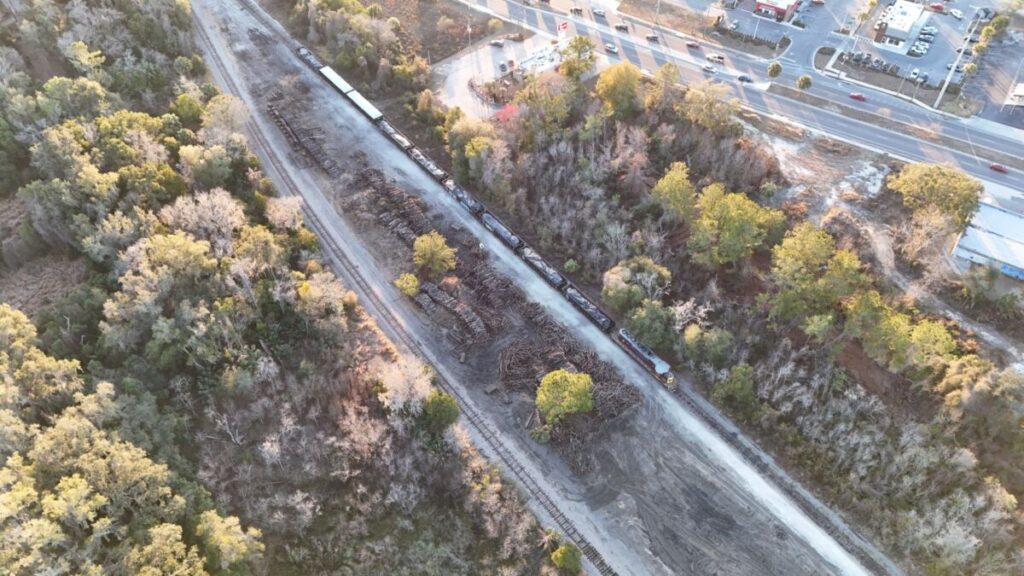
First set of rail cars appear following Feb. 1 fire to continue moving an estimated 60,000 creosote treated rail ties that remain on Feb. 6 in Dunnellon, Florida. [Photo courtesy of Bryce Hale]
By Jennifer Hunt Murty
One week after a massive Feb. 1 fire consumed an estimated 30,000-plus creosote-treated railroad ties in Dunnellon, the smoke has cleared, but a haze of jurisdictional complexity remains.
As of Friday, the first set of rail cars arrived at the site to begin loading an estimated 60,000 railroad ties that remained after the fire.
As the response transitions from emergency containment to recovery and investigation, a distinct cast of private companies and government agencies has emerged.
This is what we know, and what questions remain.
A snapshot of Dunnellon and the fire site
According to the U.S. Census Bureau, the city of Dunnellon spans just 6.3 square miles and is home to approximately 2,000 residents. The city is best known for its location near the Rainbow River, which contains a first-magnitude spring and is home to Rainbow Springs State Park.
Dunnellon’s locally elected governing body consists of Mayor Walter Green; Vice Mayor and Council Member Tim Inskeep; and Council members Reese Taschenberger, Valerie Hanchar and Rex Lehmann. The officials serve on a volunteer basis and receive a $150 monthly stipend.
The city employs approximately 23 staff members.
The investigation: Concerns over evidence
While Marion County Fire Rescue (MCFR) and the Dunnellon Police Department were the initial responders, the investigation into the cause of the blaze has been transferred to the state.
On Feb. 4, James Lucas, MCFR public safety information manager, notified the “Gazette” that “The state Office of Agriculture and Law Enforcement (OALE) will be the lead investigative agency.”
With heavy machinery actively clearing debris from the site immediately after the fire was contained, the “Gazette” asked OALE whether cleanup activities conducted by CSX contractors could have affected evidence relevant to the investigation. As of publication, OALE had not responded.
The corporate players
Determining responsibility for the site requires untangling a web of ownership, leasing and operational roles:
CSX Transportation: Owns the parcel of land where the fire occurred. CSX has stated it does not own the railroad ties or operate the rail line. The company entered into a verbal agreement with Dunnellon and Marion County to remove the ties and, after the fire, deployed contractors GHD and Arcadis to conduct environmental monitoring and cleanup.
GHD and Arcadis: Contractors hired by CSX to conduct real-time environmental monitoring and remediation activities.
Florida Northern Railroad: Leases and operates the rail line located on CSX property.
Track Line Rail: Owns the railroad ties involved in the fire and is responsible for handling and relocating the material.
In a letter to Green a few days after the fire, CSX Regional Vice President Craig Camuso wrote: “For questions regarding claims or property damage, residents should contact Track Line Rail at 312-848-1812.”
Local government actions
The city of Dunnellon initiated code enforcement actions against the corporate entities in November 2025 and filed formal opposition to Track Line’s application to grind or chip railroad ties on site.
Because some of the stockpiled railroad ties extended into unincorporated Marion County, the Marion County commissioners also initiated code enforcement actions in November and submitted formal opposition to Track Line’s air-permit application to the Florida Department of Environmental Protection.
In early December, the city and county entered into a verbal agreement with CSX to remove the railroad ties. That agreement was followed by the DEP’s approval of Track Line’s air permit to grind the ties on site on Jan. 9.
MCFR, which provides fire services to the area, led the response to the Feb. 1 fire and successfully contained the blaze. Nearly a month before the fire, MCFR Chief James Banta had penned a letter on Dec. 4 expressing concern over the stockpiled creosote rail ties.
During the fire, Dunnellon declared a state of emergency, triggering emergency response protocols under the Marion County Comprehensive Emergency Management Plan. Under the plan, the county is responsible for emergency management functions within its jurisdiction, with oversight delegated to the Marion County Sheriff’s Office.
The county commissioners declared a local state of emergency related to the fire on Feb. 3.
Public information and emergency communication
One component of the county’s emergency plan for significant incidents is the activation of a Citizens Information Line, which the plan states “will be activated during major and catastrophic disaster events” to provide official information and manage misinformation.
The hotline was not activated during this incident. Instead, some residents near the site were sent a text through the Alert Marion system with the CSX toxicology hotline.
When asked about the decision, MCSO spokesman Lt. Paul Bloom said the department did not believe the volume of calls warranted activation of the hotline, a departure from protocols typically used during major events such as hurricanes.
Air testing and environmental monitoring
As of Feb. 4, Marion County Emergency Management had received only the first day of air-quality monitoring conducted by CSX’s contractor during the fire.
Bloom wrote that Emergency Management was not involved in the monitoring itself, stating, “We are not part of the mitigation. Emergency Management’s role is to connect all the involved parties (CSX, Dunnellon, etc.).”
CSX has since provided a summary of contractor GDH’s real-time air-monitoring results covering Feb. 1 through Feb. 4 to Dunnellon and to the “Gazette.”
Marion County has indicated it intends to pursue litigation alongside Dunnellon, including injunctive relief, to compel removal of the remaining railroad ties from the site.
As of Sunday, no such lawsuit has been filed, according to the Marion County Clerk of Court.
Environmental oversight
Florida Department of Environmental Protection (FDEP): Oversees cleanup activities. Soil sampling and remediation plans are prepared by CSX contractors and submitted to FDEP for review and approval.
Florida Department of Health (FDOH): Serves as the point of contact for private well water testing.
Florida Governmental Utility Authority (FGUA): Responsible for monitoring public water supply wells.
Neither Marion County, FDEP or FDOH have released information detailing what environmental monitoring they have conducted or received related to air, soil or water quality at the site.
However, FGUA issued a media update on Feb. 6 stating it had collected samples from four public wells within a one-mile radius of the fire site — two within Dunnellon city limits and two in Rio Vista. The agency said the samples are being tested for “Creosote, Arsenic, VOC (Volatile Organic Compounds (VOCs) are synthetic chemicals that can contaminate water supplies, posing significant health risks and environmental concerns).”
FGUA expects results by Feb. 11 and stated they will be posted to its website. “Customers who experience water quality concerns or have other questions regarding their regular service may contact FGUA Customer Service by phone at (877) 657-8889, or submit an email form online at www.fgua.com/support-center/contact-us/.”
In an email dated Feb. 5, a spokesperson for FDOH would not answer “Gazette” questions or requests for records, only saying the agency was “currently working with local agencies to identify potential private drinking water wells for testing.”
The “Gazette” has also requested all environmental data received by FDEP as part of its oversight of CSX’s contractors. Those records and testing criteria had not been provided as of publication.
Upcoming meetings
Residents seeking more information or wishing to observe enforcement proceedings have two opportunities this week:
Special City Council Meeting:
Today at 5 p.m.
Dunnellon City Hall, 20750 River Drive
Agenda includes discussion of the “Railroad Ties Fire Incident.” Public comment will be permitted.
Special Magistrate Hearing:
Tuesday at 9:30 a.m.
Dunnellon City Hall, 20750 River Drive
Code enforcement hearing regarding Case No. CE2025-089 against CSX Transportation, citing alleged violations related to public nuisance and safety.
Green said he has requested that state officials and corporate representatives attend the hearings to answer questions from Dunnellon residents.

Support community journalism
The first goal of the Ocala Gazette is to deliver trustworthy local journalism so corruption, misinformation and abuse are not hidden from the public or unchallenged.