
Initial plan for clean-up of Dunnellon rail tie fire released
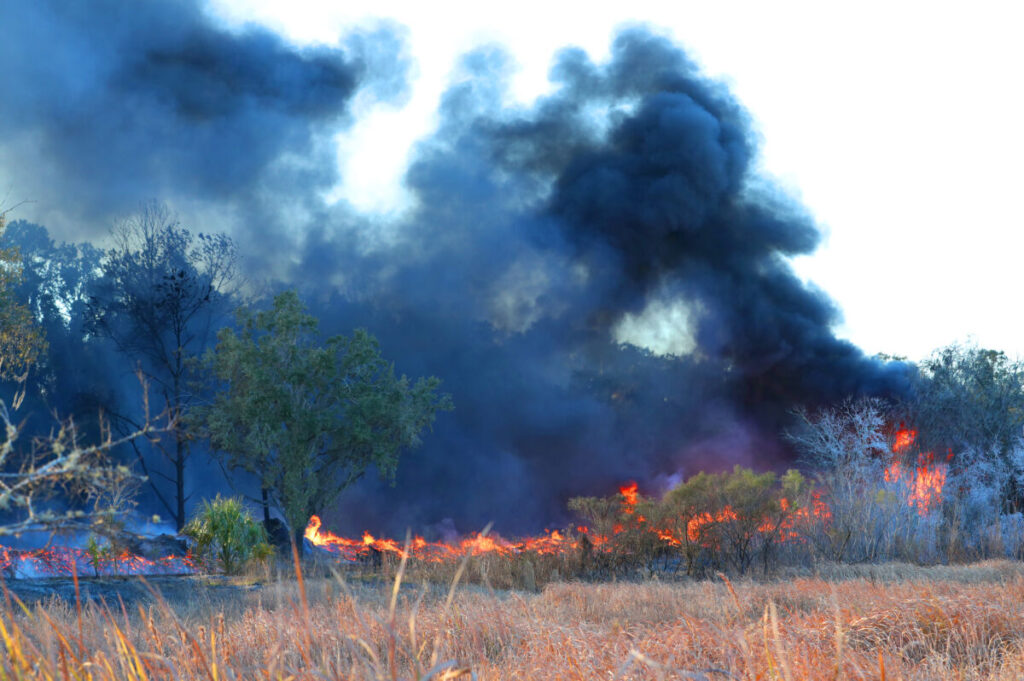
Thick, black smoke rises from a raging inferno as raliroad ties burn behind the Comfort Suites in Dunnellon, Fla. on Sunday, February 1, 2026. [Bruce Ackerman/Ocala Gazette] 2026.
By Jennifer Hunt Murty
During a charged special Dunnellon City Council meeting on Monday, city officials and residents voiced frustration over the management of last week’s creosote fire aftermath, leading to the appointment of Vice Mayor Tim Inskeep as the city’s official liaison to oversee the cleanup. The meeting occurred just hours after the Florida Department of Environmental Protection (FDEP) approved a new cleanup plan that addresses critical gaps in air monitoring.
“We’re here to get this fixed,” Craig Camuso, FDEP’s regional vice president for government relations, told the council and residents. Reacting to the frustration of the residents, he noted that he lives near a CSX line and would “feel the exact same way” if his community were impacted.
“Screams lack of urgency”
Inskeep provided a stark assessment of the current site operations at the start the meeting. He described an incident from Monday morning where crews appeared to be “trying to get ahead of themselves” by moving ash piles without proper protocols.
“They’re out there loading up a semi-truck… stirring up dust,” Inskeep said. He expressed concern that equipment might be “running through the contaminated area, spreading the contamination going to make the original contaminated footprint even larger.”
Inskeep stated that these actions indicated “there’s no on-site controls… no on-site oversight that understands what they can and can’t do.” Regarding delays in soil sampling, he noted that radiation and hazardous waste “doesn’t take the weekend off,” adding that the delays “screams lack of urgency.”
The council unanimously voted to appoint Inskeep, who brings a 40-year background in the nuclear industry and project management to the task, as the liaison to coordinate with agencies and report back to the public, utilizing his technical experience to “guide the traffic” of the remediation.
The new cleanup plan
At 3 p.m. Monday, shortly before the meeting, the FDEP approved the “Source Removal and Surface Water Sampling Work Plan” submitted by CSX contractor Arcadis.
The plan outlines the excavation of the “burn area,” a zone approximately “1,150 feet long, up to 95 feet wide, and up 2 feet deep.” The excavated material will be “live loaded into dump trucks and transported to a State of Florida licensed landfill.”
Crucially, the plan introduces specific air monitoring that was absent during the fire. The plan requires “Four (4) fixed-point particulate matter monitors” and daily sampling for “polycyclic aromatic hydrocarbons (PAH’s)” and “creosols.”
Why the new monitoring is Vital
The inclusion of particulate matter and PAH monitoring represents a shift from the initial response. Earlier reports from CSX’s contractor, GHD, monitored primarily for volatile organic compounds (VOCs) and gases but did not track particulates.
According to the Agency for Toxic Substances and Disease Registry (ATSDR), this distinction is vital for public safety. While lighter chemicals evaporate, “higher molecular weight PAHs will likely be present predominantly in the particulate phase.”
The ATSDR warns that creosote-treated wood “should not be incinerated” in uncontrolled settings because burning releases “particulate matter” and “various chemicals” including carcinogenic PAHs. Substances in the particulate phase “have longer atmospheric half-lives” and can be deposited into the lungs or onto soil. By failing to measure particulates during the fire, previous monitoring may have missed the heavier, more persistent toxins. The new plan’s focus on particulates during excavation aims to prevent further spread of these dust-bound chemicals.
Public outcry: “Fox watching the hen house”
Residents expressed deep distrust of the process and the initial lack of communication, and criticized CSX for taking the lead cleaning up a mess most felt they created.
Numerous members of the public accused CSX of taking advantage of “small towns that have property values below the national value, so that they can get off as cheaply as possible.”
Jim Peterson, a resident of Blue Cove who also owns a business, River Wheel Marine, at “ground zero” for the fire, stated, “Myself and my family have been devastated… It’s all in my lungs.” He criticized the lack of safety gear on site, noting, “Nobody’s wearing proper PPE”.
Jan Cubbage, a retired science teacher, urged the council to focus on “containment” of the toxins before they migrate further. “There’s no containment out there of these toxins,” she said, suggesting the immediate use of berms and absorbent mats to stop runoff from recent rains.
Scott Matthew, another resident, criticized the notification system. “The only reason I learned about this was from Facebook… there was no city or county… message letting me know my community was on fire,” he said.
Another speaker summarized the community’s sentiment regarding CSX’s self-monitoring: “We have the fox watching the hen house.”
Next steps
Excavation and confirmation soil sampling were scheduled to begin this week. Groundwater monitoring wells will be installed only if soil samples indicate that leachability levels exceed state standards. The FDEP, which has provided sporadic appearances to the site over the past week, sent an email Monday stating that someone from the department will remain on-site to “provide direct oversight” of the excavation.
The council voted to have legal counsel coordinate with Marion County to prepare a lawsuit for an injunction as a strategic safeguard to ensure the complete remediation of the fire site.
City Attorney Andrew J. Hand explained that this legal action would be filed under Chapter 60 for “nuisance abatement,” designed to “compel behavior”—specifically the cleanup of hazardous materials—rather than to stop an action. The council’s strategy is to have the complaint drafted and “held in abeyance,” meaning it will not be served upon CSX or Track Line Rail immediately, but will instead function as a “pressure tool” or, as described by Inskeep, a “bullet sitting in the chamber” that can be deployed instantly if the companies’ cooperation falters or if cleanup efforts become unsatisfactory.
Inskeep explained the difficulty providing a clear deadline for when CSX should be expected to remove the remaining 60,000 creosote rail ties on the site, saying that setting a precise timetable was difficult because the city lacked a necessary “second data point” required to calculate the removal rate.
He noted that while approximately 17,000 ties had been removed via over 40 rail cars prior the fire, and the city had been waiting for those specific cars to unload and return to determine the turnaround time and calculate a reasonable time frame for the rest. He stated that the fire occurred Feb. 1, just days before the empty cars were scheduled to return (between Monday and Wednesday), preventing officials from doing “the calculation to see exactly how long it was going to take at that pace to remove all of the [ties].”
Camuso said during the council meeting that the safety of citizens is the company’s top priority and directed residents with specific health or property concerns to call a dedicated toxicology hotline (1-888-479-6583) so the company could maintain a record of the impacts.
City council members asked if they, too, could receive the data from those calls so they could monitor complaints. Camuso agreed and said some of the information could be shared but indicated care would have to be used in sharing sensitive health data of callers.
See initial air testing results and clean up plan using this link: https://www.dropbox.com/scl/fo/vfjjfze1g0zqxwjnoax4f/AKAIIqc5TzBPR4IIFuKwTFE?rlkey=hxbnd3tsiuej6kpi2inq3kqmp&st=ujqsp05i&dl=0

Support community journalism
The first goal of the Ocala Gazette is to deliver trustworthy local journalism so corruption, misinformation and abuse are not hidden from the public or unchallenged.