
CSX releases same-day air monitoring results of consultant, GHD, after Dunnellon rail-tie fire
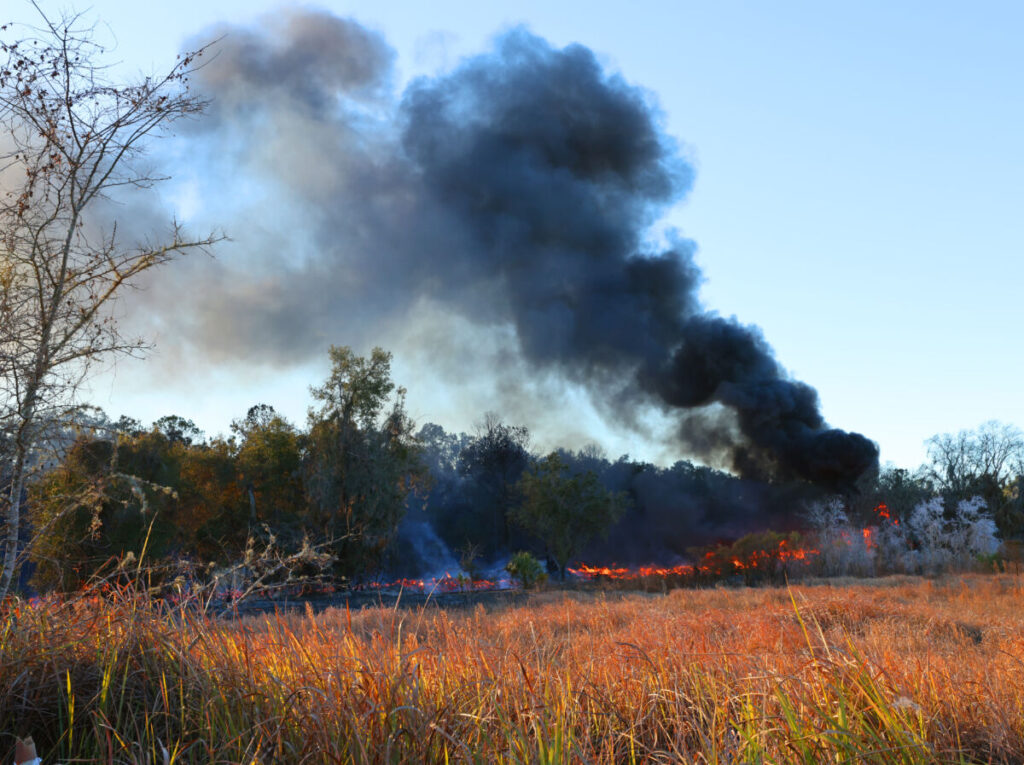
Thick, black smoke rises from a raging inferno as raliroad ties burn behind the Comfort Suites in Dunnellon, Fla. on Sunday, February 1, 2026. [Bruce Ackerman/Ocala Gazette] 2026.
By Jennifer Hunt Murty
Public records regarding the recent rail tie fire in Dunnellon reveal that while air monitoring was conducted, the testing methodology employed by CSX contractors excluded measurements for particulate matter—the very mechanism by which some of the most dangerous chemicals in creosote travel through the air.
The reports: Who, when and what was tested
Following the outbreak of the fire involving approximately 100,000 creosote-treated crossties, air monitoring was initiated by contractors working on behalf of CSX. The Florida Department of Environmental Protection and local officials have relied on this contractor’s readings since the incident.
The reports cover the critical early days of the incident directly from CSX for the date the fire started, Sunday, Feb. 1 through Feb 4.
According to the reports, the monitoring recorded real-time air monitoring data using hand-held instruments near the site perimeter and within the surrounding community of Blue Cove, the residential neighborhood hit hardest by the black plume during the fire.
According to the “Technical Memorandum” submitted to CSX by the contractor, the testing focused on a specific list of gases. The contractors used “Honeywell MultiRAE instruments equipped with a photoionization detector… for total VOCs” and “colorimetric detection tubes” for other gases.
The specific “constituents of interest (COI)” measured included:
- “O-Cresol and m-Cresol as total volatile organic compounds (VOCs)”
- “Nitrogen dioxide (NO2)”
- “Sulfur dioxide (SO2)”
- “Carbon monoxide (CO)”
- “Hydrogen sulfide”
The reports concluded that for these specific gases, “No readings… were documented above the action level” during the monitoring periods.
What was not tested: Particulate matter, and this is why it matters
Despite the heavy smoke generated by the fire, the data tables in the GHD technical memorandums confirm that Particulate Matter (PM)—microscopic solid or liquid droplets suspended in the air—was not listed as a “Constituent of Interest” and was not measured.
The contractor’s own “Creosote Treated Rail Ties Fact Sheet” acknowledges that, “A fire involving rail ties has the potential to generate noxious odors, particulate matter, and various chemicals.”
According to federal toxicological profiles, testing for vapors (VOCs) alone is insufficient for creosote fires because the heaviest and most dangerous chemical components do not float as gas; they bind to smoke particles.
The Agency for Toxic Substances and Disease Registry (ATSDR), a federal public health agency, states in its toxicological profile for creosote: “In general, phenolic compounds, low molecular weight PAHs, and some heterocycles tend to exist predominantly in the gaseous phase; however, the higher molecular weight PAHs will likely be present predominantly in the particulate phase.”
The agency further warns that these particle-bound chemicals behave differently in the environment: “Substances in the particulate phase generally have longer atmospheric half-lives than vapor-phase substances and are removed from the atmosphere by wet and dry deposition.”
By failing to measure the particulate phase, the air monitoring may have missed a significant portion of the toxic release. The ATSDR notes that proper monitoring requires capturing both phases to avoid inaccurate safety assessments.
“Current air sampling methods for semi-volatile substances employ two-stage sampling media, which includes a filter to collect particles and a sorbent material to collect vapors,” the agency states. “Data collected historically using only a filter or a sorbent material most likely underestimated actual atmospheric levels and subsequent inhalation exposures.”
This distinction is critical because, as the ATSDR notes, “The Environmental Protection Agency (EPA) has determined that coal tar creosote is a probable human carcinogen.” Without particulate data, the community is left with an incomplete picture of their exposure to the “higher molecular weight PAHs” that may have been carried into their neighborhoods on the smoke.
In a Feb. 4 letter, Terrell K. Arline, an attorney for Sierra Club-Florida Chapter, the Rainbow River Conservation, Inc., and the Concerned Citizens for Chatmire, Inc. asked the Florida DEP to test for fine particulate matter (PM2.5) and creosote-related PAHs in addition to the volatile organic compounds (VOCs), referenced in the current air testing results from CSX’s contractor.
“This monitoring is essential to protect nearby residents, workers, and vulnerable populations,” Arline wrote.
Inquiry by the “Gazette” to CSX regarding this testing omission was made by email, and this article will be updated with their response.
Air quality reporting obtained by the Gazette can be downloaded using this link: https://www.dropbox.com/scl/fo/vfjjfze1g0zqxwjnoax4f/AKAIIqc5TzBPR4IIFuKwTFE?rlkey=hxbnd3tsiuej6kpi2inq3kqmp&st=ey4m3nia&dl=0

Support community journalism
The first goal of the Ocala Gazette is to deliver trustworthy local journalism so corruption, misinformation and abuse are not hidden from the public or unchallenged.