
Water woes
731,000-gallon leak leaves a $2,200 bill and a plea for help.
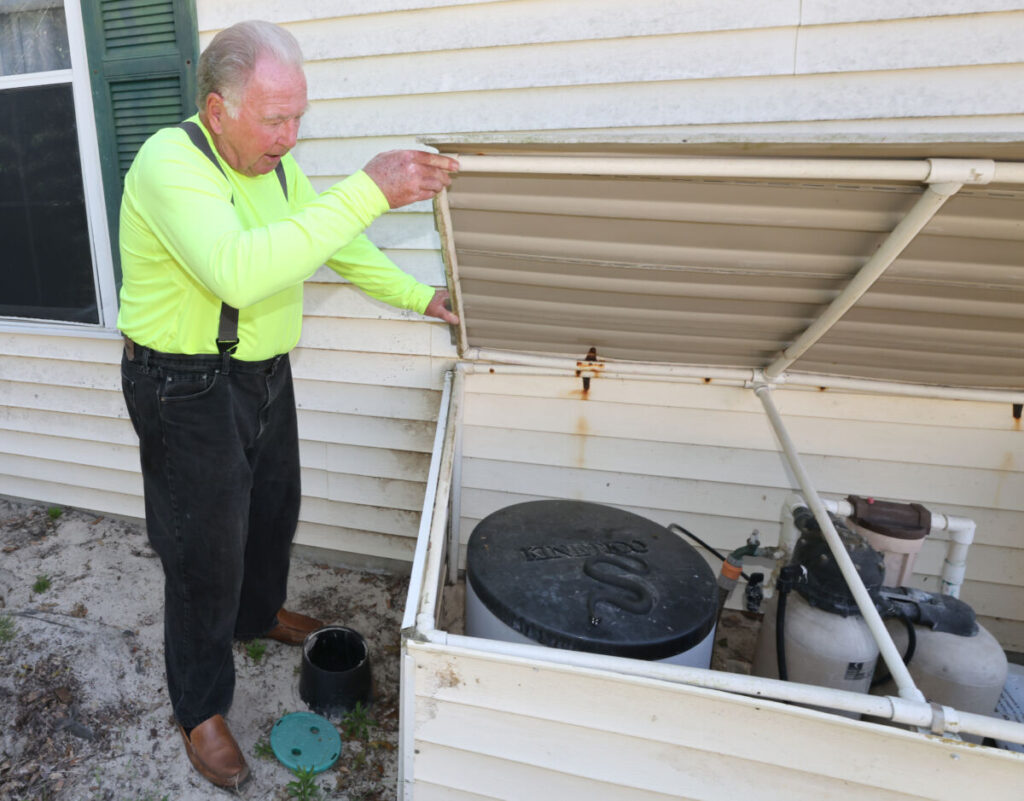
Ray Gangluff talks on Tuesday, April 21, 2026, about how a pipe connected to his water softener burst last year at his home in Ocala’s Oak Run Community when he was out of town for six weeks and 731,000 gallons of water leaked out. [Bruce Ackerman/Ocala Gazette]
A U.S. Navy veteran who describes himself as a “snowbird” is being billed $2,200 by Marion County Utilities for 731,000 gallons of water lost to a broken pipe at his Oak Run Community home while he was away for six weeks. Ray Gangluff detailed the incident in a letter to the editor of the “Gazette,” dated April 12, 2026.
Rather than just run Gangluff’s letter on its own, the “Gazette” team decided to ask questions of the utility in order to learn more and let readers know how to possibly avoid winding up in this situation with either MCU, which provides public water and wastewater services to more than 45,000+ customers in Marion County, or perhaps another local utility provider.
Here is Gangluff’s letter:
“I am a 79-year-old retired Navy veteran and a six-year Oak Run Community resident. While I was away from home for six weeks, a large water pipe feeding the water softener on the left side of my home came apart. The water flowed above ground into the woods behind my home. It discharged approximately 23,580 gallons of water each day. About six days after the leak began, my water meter was read and showed very excessive water usage. Four days later, Marion County Utilities responded with an automated telephone water leak message they sent to a local 352 area code telephone number. That number is owned by a person with private well water and has no connection to me. My only phone number for at least the past 10 years begins with area code 609. Two days later, a work order was issued, sending a Marion County Utilities worker to my home. Finding no one at home, the worker allegedly hung a message on the outside handle of my unlocked front porch screen door concerning the water leak. The message has never been seen by any neighbors or by me. He obviously did not look around my yard where the flowing water above ground was extensive and visible,” Gangluff wrote.
“My 609 cell phone number and the telephone numbers of three of my neighbors are clearly posted on my front door, which is just eight feet inside the unlocked porch screen door. The water leak was allowed to continue for 28 more days after his visit. At the next water meter reading, the meter reader entered my still unlocked front porch, called my posted cell phone and finally shut my water off. A grand total of 731,000 gallons of water had been lost. I am unfairly being required to pay in excess of $2,200 for the total water loss even after all possible discounts were taken. I don’t feel I am responsible for the last 28 days of the leak. I have submitted written email appeals to management and to one of our county supervisors with no success to date. Florida Consumer Affairs has refused to investigate because the county government is involved,” he continued.
Gangluff ended his letter with a call for help.
“Please share this information with other Oak Run residents,” he wrote.
The “Gazette” reached out to Marion County Utilities (MCU) for guidance on preventive measures that other Oak Run residents in particular — as well any local resident and even snowbirds (part-time residents) — could take to avoid similar water-leak disasters while they are away for weeks or months.
Marion County Public Relations Specialist Roger Waddell said the county’s policy in such cases, as when a customer is out of town and a pipe breaks, is governed by Ordinance No. 09-05, Section 19-179(G).
“The customers’ pipes, apparatus and equipment shall be selected, installed, used and maintained in accordance with standard practice and shall conform with the rules and regulations of the county. The county shall not be responsible for the maintenance and operation of the customers’ pipes and facilities,” Waddell stated.
Waddell continued by citing the county’s Deposit Receipt and Service Agreement.
“It is further understood and agreed that the sale of water to the customer occurs at the meter, and the utility has no responsibility relative to service or supplying water after said water passes through the meter. The customer is advised not to tamper with the meter, including turning the water service on or off, which is prohibited. Tampering with county property carries a $250 fee. The utility’s responsibility relative to gravity sewer service ceases at the customer’s property line,” Waddell said,
Waddell also referenced the county’s policy on adjusting bills under Ordinance No. 09-05, Section 19-179(T).
“If a customer incurs an abnormally excessive charge for usage due to a leak, the county may review and adjust a customer’s bill on an individual basis to the third tier of the water rate structure and adjust wastewater to the customer’s average use in accordance with the policies of the county,” he stated.
Waddell added that for any water usage over 20,000 gallons, the county adjusts from $5.61 a thousand gallons to $2.80 per thousand gallons.
Waddell explained how Gangluff’s bill was adjusted.
“Accordingly, MCU adjusted his bills: 12/22/25 we adjusted -$2,125.20; 01/02/26 adjusted -$103.32; 01/14/26 adjusted -$191.24. The adjustments include three months of sewer due to the customer not being home,” Waddell said.
Waddell clarified the protocol for when a worker is dispatched to read the meter and cannot get hold of the resident.
“MCU’s process begins when abnormal high use is detected in exception reports for monthly meter reads. Those reports are reviewed, and then automated calls are made for customers to contact the office. More recently, we have added text and email to that notification attempt. If the use is more than 20,000 gallons above normal, we also issue a work order to have a technician visit the home, reread the meter to see if the high use is continuing, or reflects a leak. If the high use is continuous, the technician will attempt to contact the customer at the residence and if no one is home, they will leave a door hanger message for the customer to contact the office. Many customers will react and fix the problem on their own, and we may not hear back from them. Others may not contact us until they get the higher bill and then we work with them to adjust the bill amount according to the county ordinance and/or make a payment plan to spread the cost over time,” Waddell said.
“At the end of the day, it is the customer’s responsibility to manage plumbing and equipment on their side of the meter, since the utility’s infrastructure ends at the meter,” he continued.
Waddell’s advice to homeowners while they are out of town is to ensure they can be reached.
“Make sure MCU has good contact information for you. Get electronic billing so you can see your bill and water use ASAP. Have a friend check on your home while you are away and/or shut off your water at the house valve until you return. Perform good maintenance and always keep an eye out for damaged irrigation, toilets running, or other leaks that can happen inside or outside your home. Additionally, MCU offers a seasonal meter turn-off option for a $25 fee,” he said.
Under county policy, the utility’s responsibility ends at the meter, so any leak on the homeowner’s side is the customer’s responsibility to detect and repair. The county does not shut off water automatically for absent customers; it relies on monthly meter reads, exception reports, automated calls, texts, emails and door hangers when high usage is flagged. Bill adjustments for leaks are available on a case-by-case basis, but the county maintains the homeowner must manage plumbing after the meter.

Support community journalism
The first goal of the Ocala Gazette is to deliver trustworthy local journalism so corruption, misinformation and abuse are not hidden from the public or unchallenged.