
Horse Fever gallops on
On the anniversary of the beloved public art project, its first artist created a special Tribute 25 statue to be raffled off by the Marion Cultural Alliance.
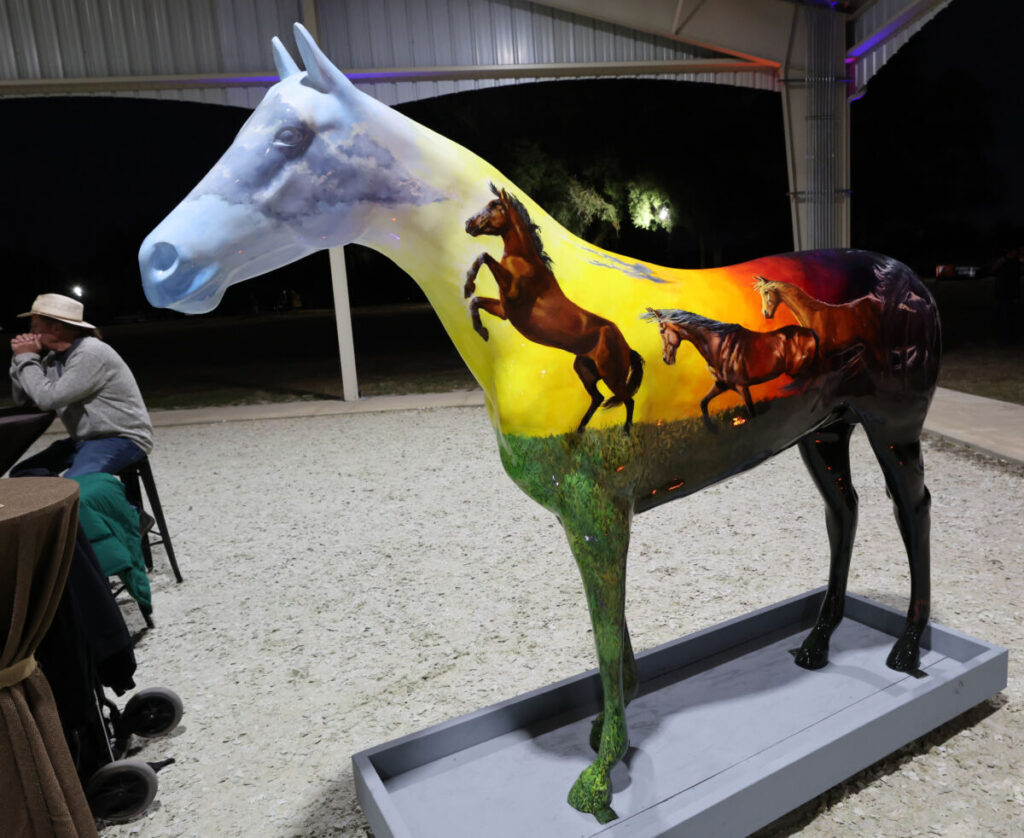
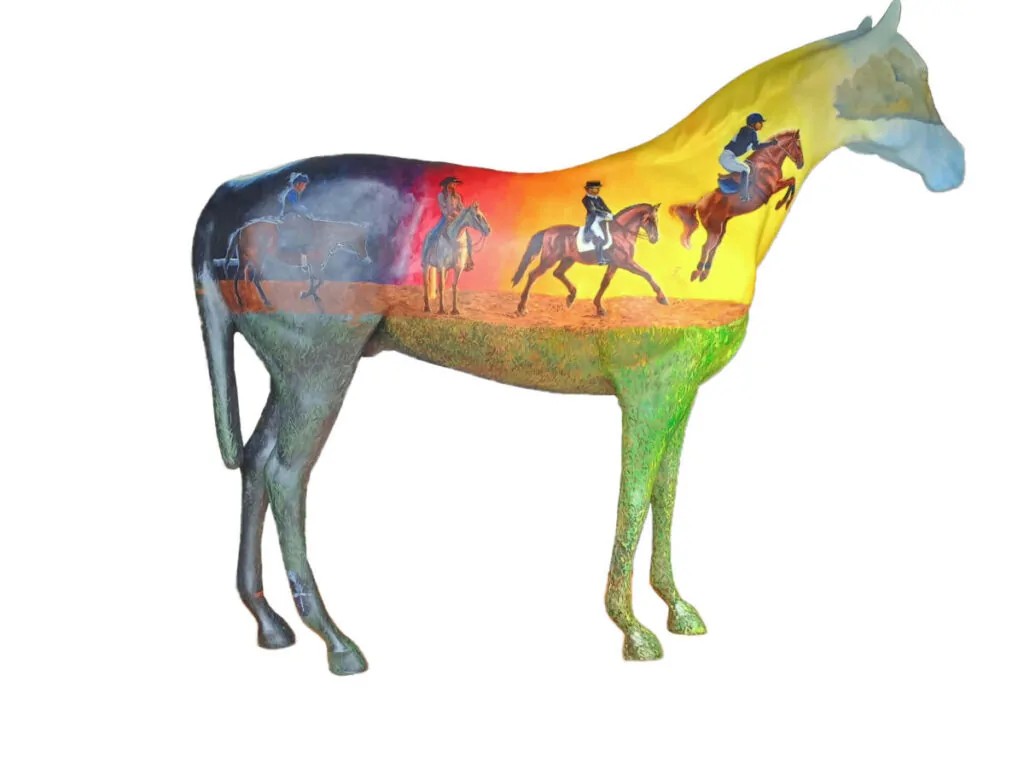
Horse Fever horse Tribute 25, by artist Sharon Crute, with the left side portraying four riderless horses, was on display at the Divertimentos & Dressage Ocala at GoldMark Farm on Jan. 29, 2026. [Bruce Ackerman/Ocala Gazette file photo]
You can see them “galloping,” “noshing” or just “posing” peacefully all around Marion County. They are the Horse Fever equine statues that have been creatively born from talented area artists.
The Horse Fever public art project has not only captured the hearts of people for a quarter of a century, it also launched the formation of the Marion Cultural Alliance (MCA), which over its 25 years has awarded hundreds of thousands of dollars in grants to local artists and organizations.
Horse Fever, with co-chairs Laurie Zink and Paula King behind the project, launched in 2000, followed by Horse Fever “herds” in Motion in 2005, Horse Fever II in 2010 and Horse Fever 2020.
For the last time, members of the public have a chance to become an “owner” of a Horse Fever special edition equine statue named Tribute 25, created by internationally known equine artist Sharon Crute.
“As we celebrate 25 years of the Marion Cultural Alliance, we’re inviting the community to be part of a legacy that began with Horse Fever and continues to shape our community today. The Tribute 25 Raffle is more than a chance to win — it’s a chance to invest in the future of the arts in Ocala/Marion County,” MCA officials noted, adding that one charity will be selected to receive 12% of the proceeds.
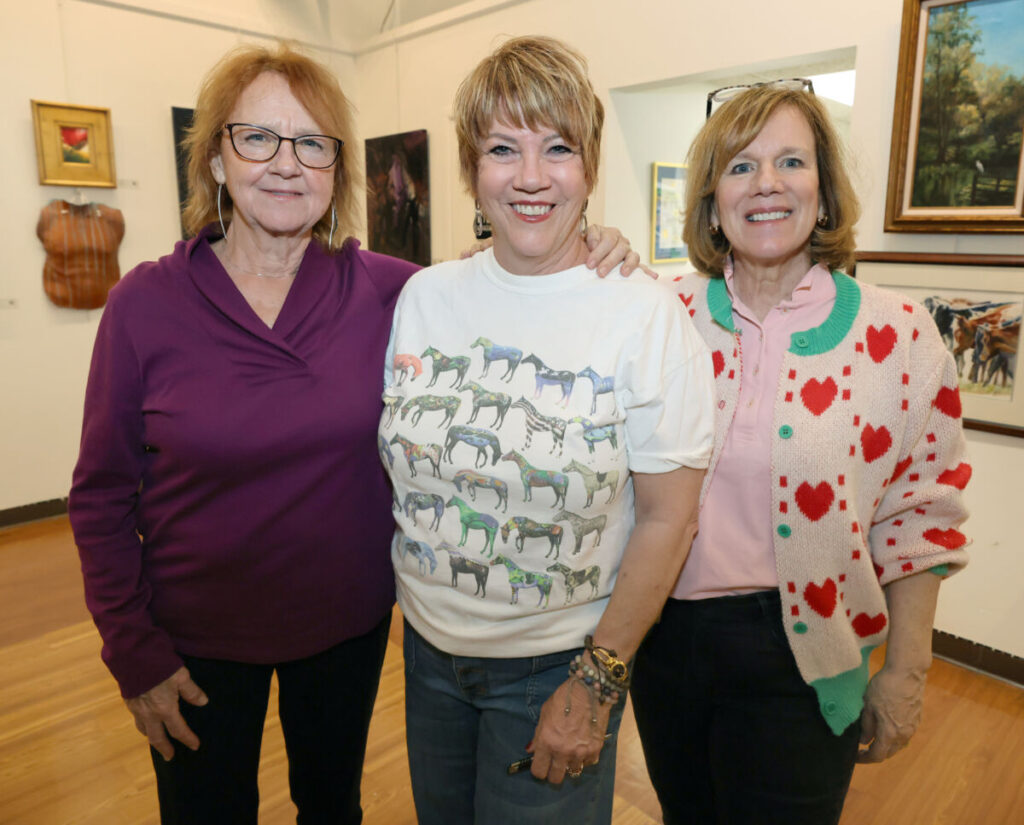
and Paula King, attended the 25 Years of Creativity: Horse Fever Artists
Now reception at the Brick City Center for the Arts in Ocala on
Jan. 9, 2026. [Bruce Ackerman/Ocala Gazette file photo]
“To me, Tribute 25 is a gift to the community,” Zink said in a phone conversation on April 22. “He could have gone to auction and done well in terms of the amount of the sale, but we wanted to give the community a chance to be involved. Doing the raffle was important to me in two aspects — getting the community reinvolved and giving back to charity, which is in homage to the very beginning.”
ALL ABOUT THE ARTIST
A feature article about Crute, written by JoAnn Guidry, appeared in the February 2023 issue of the “Gazette’s” former sister publication, “Ocala Style.” These two excerpts reveal some of the reasons Crute has attained such a stellar reputation for painting equines. (Read the entire article at ocalastyle.com/capturing-the-thoroughbred-spirit/)
Art and racehorses
While she doesn’t remember a time she wasn’t drawing and painting, Crute does recall with clarity her early introductions to thoroughbred racing.
“I grew up in rural Rhode Island, where the biggest thing to happen every year was the state fair. And there would be horse races there in a more casual setting than a racetrack,” she shared. “I was 4 years old when my father put me up on his shoulders so I could see the races. That was the first time I saw horses racing.”
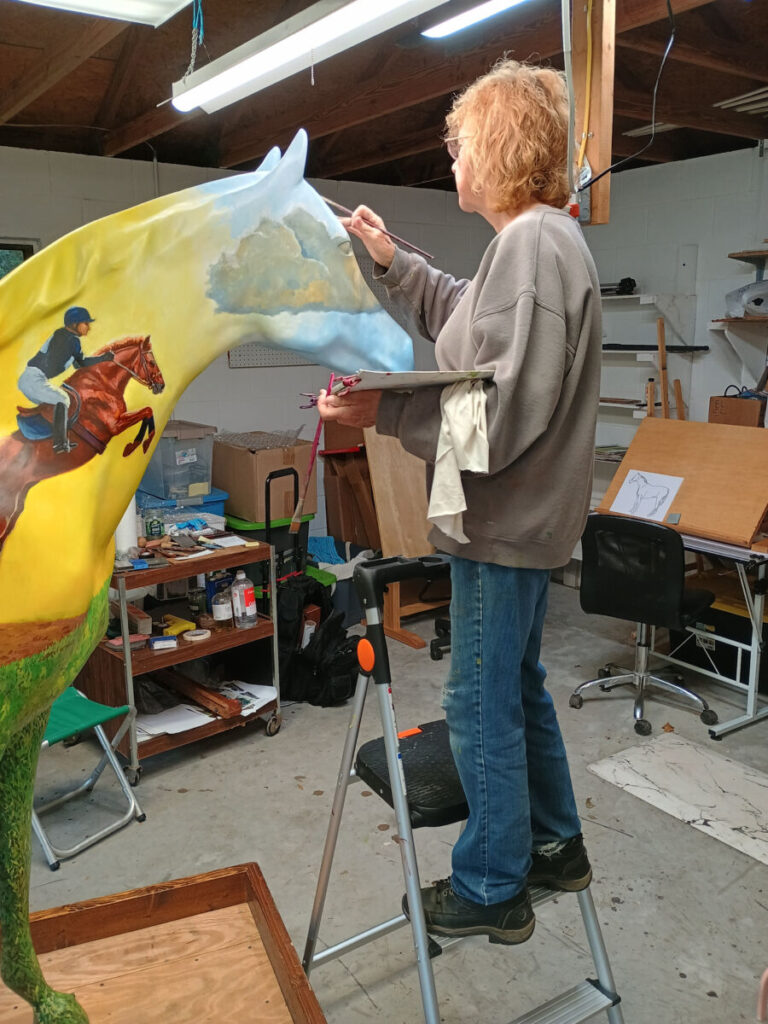
Crute’s father and older brother were avid horse racing fans, going to races in Rhode Island almost every Saturday during the meet.
“I’d always plead with my father to take me to the races and one Saturday he actually said yes,” Crute recalled. “But the problem was that I was only 12 and you had to be 16 to get into the grandstand. My father told me to just tell the guy at the admission booth that I was 16. Don’t think that man believed me, but he let me in and that was all that mattered to me.”
In a life-changing moment that day, Crute’s father later took her down from the grandstand to stand close to the starting gates for a race.
“It was so exciting to see those racehorses so close. And when the gates opened, I was overwhelmed by the sounds and flashing colors as the horses raced past us,” she recounted. “It was in that moment that I became hooked on racehorses. And not long after that, I started painting them.”
Intent on being a racehorse trainer, Crute once again lied about her age and at 15 got a summer job at the racetrack.
“My first job was as a hot walker,” she said. “On the racetrack, hot walkers walk horses after their morning gallops or races around the barn shed-row to cool them down. I thought it was the best job in the world.”
After graduating high school, Crute attended the Swain School of Design in New Bedford, Massachusetts. She graduated in 1978 with a Bachelor of Fine Arts degree, majoring in painting.
“In the summers, I would still work on the racetrack backside and had moved up to becoming a groom,” she noted. “Once I graduated, I continued to work on the racetrack while also pursuing my art career.”
And, as fate would have it, a racetrack connection led Crute to her future husband, Michael Bray, who was the son of a perennial leading trainer on the Northeast racing circuit.
“A longtime friend of mine had previously worked for Michael’s father. I was visiting her in Miramar, Florida, at the same time Michael and his parents owned a house in nearby Lakeland,” she shared. “My friend invited me along to visit them and Michael was there. We hit it off immediately.”
Fittingly enough, the two were married by a racetrack chaplain in his office between races at Miramar-based Calder Racecourse in 1980.
On the move
The couple moved to California in the mid-1980s, being active on both the Northern and Southern racing circuits of that state. When not on the backside, Crute continued with her artwork and had other jobs.
“While we were in California, I was a contract mural artist for SeaWorld,” she said. “I had a stint as a racing official and was in charge of program production for the California Authority of Racing Fairs.”
In 1989, the couple relocated to Ocala, Michael’s hometown.
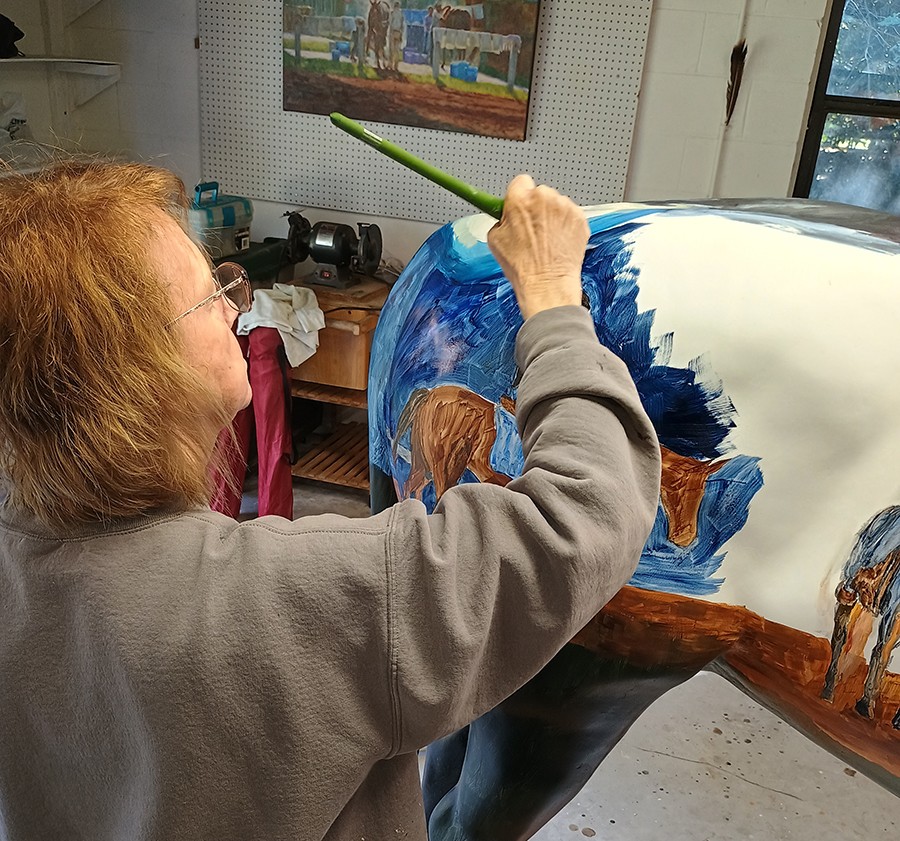
“I loved Ocala right away. If you’re a horse person, how can you not love Ocala?” Crute noted. “My first job in Ocala was part-time in production with ‘The Florida Horse’ magazine. Of course, I continued with my artwork.”
Crute began to make a name for herself with her signature large, 48-inch by 60-inch, racing-scenes paintings. She was then selected to design the prototype life-size fiberglass horse for the initial Horse Fever Community Art Project in 2001. Crute also designed and painted Cultural Champ, a foal-sized fiberglass horse, which was the project’s ambassador to spread awareness and support. She painted Champ, which is adorned with the brightly painted silks of Ocala’s prominent thoroughbred breeders and owners. Champ still stands today at the front of the Florida Thoroughbred Breeders’ and Owners’ Association headquarters in Ocala. Crute’s World Champ, part of the 10th anniversary Horse Fever project, stands in Ocala’s downtown square.
“It was truly an honor for me to be involved with the Horse Fever projects,” she said. “It’s nice to see the horses still all around Ocala.”
TRIBUTE 25— ‘TRANSITION’
In her artist’s statement on the MCA website, Crute explained her thought process in creating the two-sided design for Tribute 25.
“With the theme of ‘transition,’ I wanted to represent the Horse Fever artwork literally by portraying the equine subject as the design. Depictions of narrative and symbols illustrate the creation of the Marion Cultural Alliance and the first ‘fever’ project of 25 years ago as a bold idea. Their ensuing efforts would strengthen the presence of various artistic genres, creating new ones and transitioning into the thriving art community Ocala is today,” she wrote.
“My artwork begins with a nightscape: a full moon on top of the horse’s rump. The left side portrays four riderless horses. The horse below the moon hesitates in the dark, unsure of making an initial move and looking back over its shoulder for reassurance. The second horse stands alert, curiously attentive but cautious. The third horse bravely steps out and is inspired to follow the fourth horse as that horse rears up in joy and fearlessness. The light progresses throughout the horses from darkness into a sunrise of brilliant light,” Crute noted.
“The right side of the horse pictures a selection of four genres of horsemanship in Marion County. A thoroughbred walks to the track in the dark, representing speed and survival. The Western horse is a partnership in a working relationship. The dressage horse is about refinement and discipline transitioning into beauty and the fourth, a jumper, is fearlessness and successful,” she noted.
“Nestled in the dark hind legs are four nocturnal critters indigenous to Marion County — a raccoon, a skunk, an armadillo and a rat snake — who represents the transition from the year of the snake to the year of the horse,” Crute wrote.
“As an equine artist living in horse country, it felt only natural to draw my inspiration from the horse. In Tribute 25, I wanted to explore the idea of transition — the quiet, powerful shifts from uncertainty to confidence that both horses and people experience,” Crute shared via an email message on April 21.
MAKING HIS ROUNDS
While Tribute 25 can often be seen at the alliance’s headquarters, the Brick City Center for the Arts at 23 SW Broadway St., in downtown Ocala, the artwork also “travels” around the area to appear at various events, such as Divertimentos & Dressage Ocala at GoldMark Farm, Live Oak International and the recent Florida Thoroughbred Breeders’ and Owners Association banquet. He will be at the Community Foundation for Ocala/Marion County’s Inspire Gala on May 1 at the Circle Square Cultural Center and then at the Brick for most of May.
“As Tribute 25 travels throughout the county, he continues to delight audiences — many calling him a fitting tribute to the legacy of Horse Fever. Ticket buyers are already imagining him in their yard — or even donating him to a park or school if they win. It only takes one ticket, and the excitement is real,” said MCA Executive Director Jaye Baillie in an email message on April 21.
On Wednesday, Zink added that “it’s fun going and having him at events. People have a good time talking about putting him by their pool, or front yard or donating him. They are just super excited.”
JOIN THE FUN
The suggested Tribute 25 raffle ticket donation is $75 each or you can secure five and get an additional one free. Each ticket purchase will receive a complimentary six-month subscription to the “Ocala Gazette,” valued at $72, for new subscribers only.
“Each ticket also gives you the opportunity to nominate your favorite arts, cultural, heritage, history, science or equine nonprofit. The organization with the most nominations will receive 12% of the proceeds, extending the impact of this project and honoring Horse Fever’s legacy of charitable giving through public art,” Baillie added.
Tickets may be obtained at the Brick City Center for the Arts during regular gallery hours, which are 10 a.m.-4 p.m. Tuesday-Friday and 11 a.m.- 4 p.m. Saturday.
The live raffle drawing for Tribute 25 will take place at 6 p.m. on Dec. 4, at the Brick.
To learn more and get raffle tickets, go to mcaocala.org/horse-fever-raffle

Support community journalism
The first goal of the Ocala Gazette is to deliver trustworthy local journalism so corruption, misinformation and abuse are not hidden from the public or unchallenged.