
‘Out of control’ growth
Marion County sheriff warns officials that his agency is struggling to keep pace with rising demands for service.
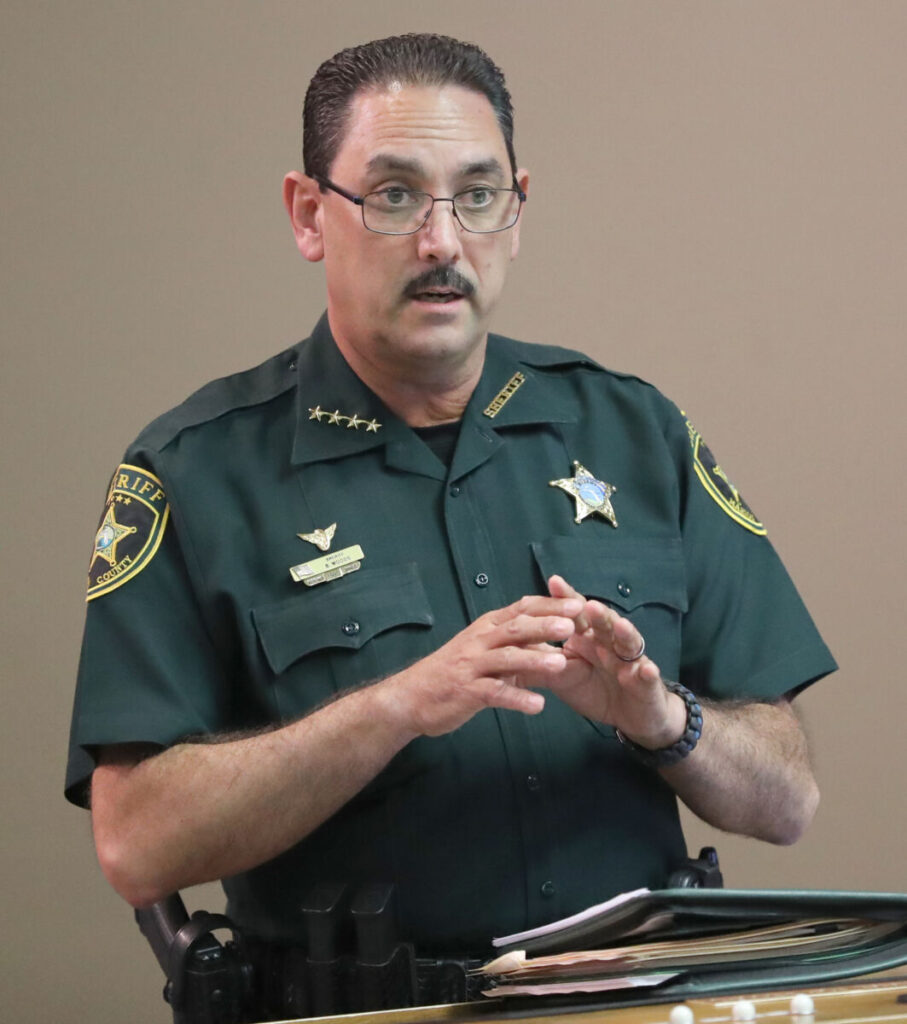
Marion County Sheriff Billy Woods [Bruce Ackerman/Ocala Gazette file photo]
Pointing to a massive influx of calls for service and escalating jail medical expenses, Marion County Sheriff Billy Woods used the April 7 county budget workshop to sound the alarm on how local population growth is impacting his agency.
Addressing the Board of County Commissioners, Woods explained that his office responded to 264,000 calls last year, a massive jump from 225,000 in 2016. Noting that the county’s population now sits around 450,000, Woods requested help tracking the true burden on local infrastructure.
“The demand on my office is just it’s out of control with this growth, frankly,” he told the commission. “Is there a way that we can put people in a think tank to figure out how many… individuals we got coming into this county that are actually not residents?”
Woods expressed concern over upcoming road closures, like the impending closure of the 66th Street bridge over Interstate 75, which will force deputies to navigate heavily congested corridors like State Road 484 to traverse the county.
To address the strain, Woods referenced a staffing study conducted last year, reminding commissioners of the stark deficit in personnel.
“You’ve seen the study in which I gave you, they did a prediction in there,” he said. “The road (deputies) currently, we sit 120 short, and it predicted needed something over 300… because of this population group.” To slowly bridge that gap, Woods plans to request 30 to 35 new road deputies each year over the next four years, along with five to 10 new detention deputies to manage the jail.
The jail, however, presents the sheriff’s largest financial unknown, heavily driven by inmate medical care. Out of a $24 million jail operating budget, just under $15 million (62%) is consumed by medical expenses.
Woods revealed that his office is sending out requests for bids because the agency’s contract with the Heart of Florida Health Center (the current medical provider for inmates) is expiring in September. He warned the board to prepare for a steep price hike.
“We are at the point of the contract for Heart of Florida is up, and we are…looking for other vendors,” he said. “These other vendors are going to be more, considerably more. And we’re not talking like $100,000 or $200,000 we’re talking probably $2 million to $4 million, which is unknown for me right now.”
As previously reported by the “Gazette,” the Heart of Florida contract includes all medical care for inmates, including emergency room visits. Due to the high number of deaths at the jail, some of which have been attributed by the state’s disability watchdog, Disability Rights Florida, and a jail nurse whistleblower to poor medical care at the jail, concerns have been raised that lax medical care could be tied to an effort by the provider to cut costs.
One notable example cited is the number of inmates being taken to local hospital emergency rooms for care having been cut nearly in half from what it has historically been.
Woods was quick to clarify that he was not disparaging Heart of Florida.
“Does that give a suggestion that Heart of Florida is done or is doing anything wrong?” he said. “There are always areas in which we can improve, but Heart of Florida has always done their best.”
Instead, Woods highlighted the challenges of providing health care in a detention setting. In just one month, inmates required nearly 1,200 prescriptions, 71 physician visits and 1,500 nursing visits, he said.
A one-month flat rate billing of Heart of Florida inmate care costs on average $1.2 million, with no specific medical bill coding tied to each per inmate.
Woods detailed how some inmates actively subvert their medical care by “mouthing” medication — hiding pills in their cheeks to spit out later and sell within the jail to get high.
“I give you a picture, because people don’t truly understand what goes on in a jail,” he said, emphasizing why the high cost of rigorous medical staffing and oversight is unavoidable.
The sheriff described the staffing situation at the jail as a “revolving door,” noting that at the end of February, his office had 12 vacancies for detention deputies and seven for detention assistants. In that same month, nine employees left, seven of whom were detention deputies or assistants working in the jail.
Regarding costs and compensation, Woods confirmed that the starting wage for a detention deputy is $62,400. To combat the high turnover rate, he stated that he is planning for 3% salary increases to keep pace with the market and keep their “heads above water.”
He warned the commission that dropping below a 3% increase would actively create more vacancies by driving employees to leave for higher-paying jobs.
To manage the heavy workload — which includes an average of 1,000 individuals coming into the jail each month and detention deputies performing 14,000 cell shakedowns in February alone — Woods indicated he will be requesting five to 10 new detention deputy positions in the upcoming budget to keep up with the county’s growth.
According to the clerk’s office, the constitution officer’s initial proposed budgets are due June 1.

Support community journalism
The first goal of the Ocala Gazette is to deliver trustworthy local journalism so corruption, misinformation and abuse are not hidden from the public or unchallenged.