
Ocala City Council rejects air curtain incinerators
Recycling company proposed burning yard trimmings, brush, tree debris, grass clippings, pruned shrubs, Christmas trees, nursery/greenhouse residuals and landscaping/land-clearing waste.
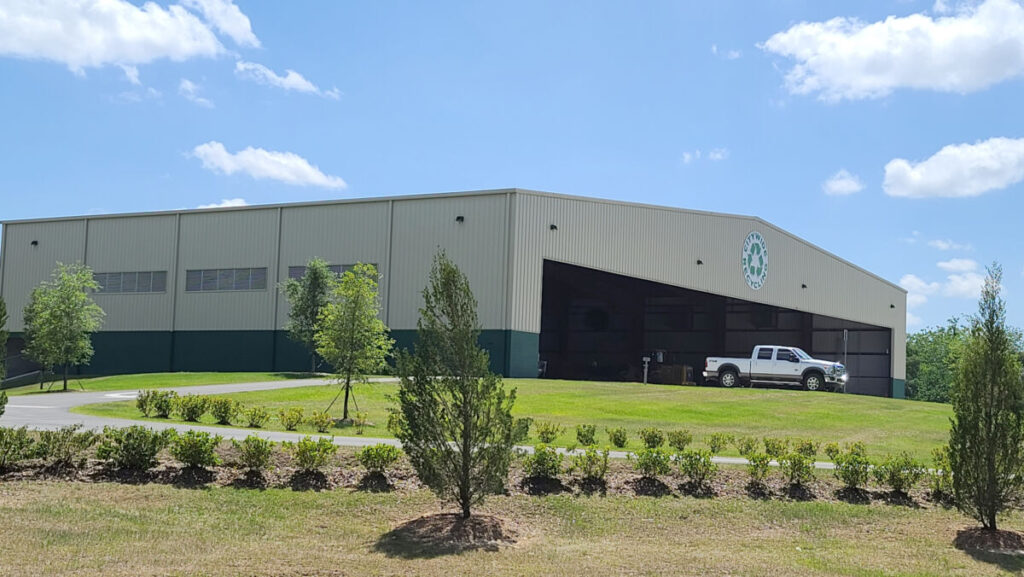
Friends Recycling is shown on Northwest 27th Avenue in Ocala on May 5, 2021. [Bruce Ackerman/Ocala Gazette file photo]
Citing environmental and moral concerns, the Ocala City Council last week rejected a proposal that would have allowed a local recycling company to burn yard waste and other materials in special incinerators that critics say would have pumped pollutants into the air near residential areas.
The proposed zoning amendment ordinance pushed by Friends Recycling would have allowed the company to add air curtain incinerators at its site at 2350 NW 27th Ave. The incinerators would burn yard trimmings, brush, tree debris, grass clippings, pruned shrubs, discarded Christmas trees, nursery/greenhouse residuals and landscaping/land-clearing waste.
Council members on Feb. 3 unanimously rejected the proposed ordinance, which would have permitted permanent above-ground air-curtain incinerators as an ancillary use at materials recovery facilities on parcels of 10 acres or more.
Members of the public and council members expressed strong opposition, centering on fire risks near a construction and debris (C&D) landfill, health impacts pollutants and concerns about placement of the facility in historically Black neighborhoods.
An environmental consultant said the amount of pollutants the facility would release into the atmosphere was “equivalent to 3,300 large diesel trucks idling at the recycling facility.”
Council member Kristen Dreyer framed her opposition as a moral concern.
“This is a quality-of-life issue, OK?” she said. “People live there. When it’s mentioned that this is an industrial area, that’s because none of us wanted this in our neighborhood. So, it was put in the Black neighborhood. They didn’t want this. You wouldn’t want this. I wouldn’t want this either.
“Morally, I just can’t say yes,” she continued. “I went to Mary Sue Rich’s funeral a month ago. I can’t even imagine what she would say to this, but morally, I just can’t say yes. But I would say that if you are a yes, I would make changes to this.”
Dreyer noted, “We have the option to vote no. We have the option to vote yes as written, or we have the option to change what we have before us. I am a no.”
After debate, the council voted 5-0 to deny the proposed ordinance.
The vote comes less than a week after a massive fire in Dunnellon burned an estimated 30,000 to 40,000 creosote-treated railroad ties, blanketing nearby neighborhoods in thick, black smoke and forcing a state of emergency amid growing concerns for health and environmental damage.
Proponents’ argument: Cleaner, proven alternative
Friends Recycling representatives showed a video demonstrating how the air-curtain incinerator uses a high-velocity air stream to trap and reburn smoke particles, producing mostly heat waves once the unit reaches operating temperature. They argued that the technology is far cleaner than open burning or landfilling vegetative debris.
Austin Daly, an attorney with Klein & Klein LLC, explained the emissions performance.
“As we recirculate this, it burns off the majority of (emissions), leaving CO2, water vapor and PM2.5… usually at around 10% opacity, which is pretty tough to detect to the human eye,” Daly said.
According to the U.S. Environmental Protection Agency, PM2.5 are tiny air pollution particles that are 2.5 micrometers or smaller in size, so small they can be breathed deep into the lungs and even enter the bloodstream. They come from sources such as vehicle exhaust, factory smoke and burning wood or trash.
Daly cited USDA Forest Service, Oregon Department of Environmental Quality (DEQ) and Arizona DEQ studies showing 80–90%+ reductions in PM2.5 and carbon monoxide compared to pile or broadcast burning. The applicant also argued that landfilling vegetative material produces methane, which he said the EPA states has 28 times the warming impact of CO2, making controlled burning a preferable alternative.
Fire Marshal Clayton Anderson of Ocala Fire Rescue confirmed that safety and setback concerns had been addressed, with daily burn approvals tied to real-time weather and dispersion conditions.
The proposed ordinance would have prohibited burning biological waste, hazardous waste, asbestos, mercury devices, pharmaceuticals, tires, rubber, used/residual oil, asphalt, roofing, tar, treated wood, plastics, garbage, trash or any material banned under the Florida Administrative Code.
The final draft of the ordinance included the following safeguards:
- Minimum 200-foot setback from any residential zoning district, dwelling, church, daycare, school, hospital or public park; 100-foot setback from other property lines
- Operation restricted to Monday–Friday, 8 a.m. to one hour before sunset
- Mandatory site plan and detailed operations plan (covering fire prevention/suppression, emissions control, odor and dust mitigation), subject to annual city administrative review
- Daily burn authorization from the City Fire Marshal (following Florida Forest Service dispersion/weather guidance)
- 14-day limit on unprocessed debris storage; maximum 25-foot pile height
- Ash retained only in the burn chamber (no ground stockpiles)
- Immediate revocation authority if approved plans were violated
Opposition focus: Quality of life, health risks and environmental justice
Opponents focused on potential health and environmental concerns.
David Tillman, CEO of Tillman Engineering, warned of landfill fire hazards.
“We’re going to put a burn box, a fire source, on top of or adjacent to a C&D landfill… how long will a dump site typically burn once it catches on fire? We’re talking decades sometimes. This is a nightmare that I think we’re introducing,” he said.
Tillman commented on his personal stake and fear for the community.
“I own 16 acres directly across the street from the site, and I’ve made that investment even after they came and asked for the expansion. This is something that I fear. I greatly fear this for all the people that live in that area. I feel a fear for my own investment,” he continued.
Environmental consultant David Latham quantified potential emissions.
“This equates to about 37,000 pounds [of PM2.5] per year… equivalent to 3,300 large diesel trucks idling at the recycling facility,” he said.
“This incinerator equipment is designed to limit visible emissions. You’ve heard quite a bit now about the 2.5 microns. And yes, indeed, that is smaller than what’s emitted from an open burn pit. However, both the Florida DEP and the EPA regard this particle as a potentially dangerous entity to be breathed in by the general public. This means equipment that causes emissions of this particle size are still regulated by the DEP at most solid waste operations,” he added.
Latham also addressed ash generation and risks.
“The incinerator will also very quickly generate large volumes of ash. I think that was discussed earlier as well. When this is improperly managed, it can represent a fire hazard as well as a breathing hazard,” he said.
“And one other important point I wanted to make is that Geosyntec contacted the Florida Department of Environmental Protection to solicit FDEP’s opinion on these types of incinerators, posing the question as a generic topic, not referencing this specific issue. But FDEP responded that the majority of these incinerator-type permits that they deal with are typically related to storm-related vegetative waste, as I’ve already elaborated. And the locations of these facilities, these are typically in remote areas. I’d advise against locating them in an urban or suburban residential setting,” Latham said.
According to geosyntec.com, Geosyntec is widely recognized in the environmental consulting industry for its technical depth in waste, air and groundwater issues, and it frequently appears in regulatory filings, permitting processes and litigation support related to solid waste and emissions.
“As noted earlier, the goal of these incinerators is to reduce emissions to a particle size of 2 microns or less. However, these are still significant health risks associated with breathing particulate matter of this size,” Latham noted. “There’s obviously some serious health concerns here that we’re worried about.”

Support community journalism
The first goal of the Ocala Gazette is to deliver trustworthy local journalism so corruption, misinformation and abuse are not hidden from the public or unchallenged.