
Managing growth
Marion County leaders consider refining interlocal agreement.
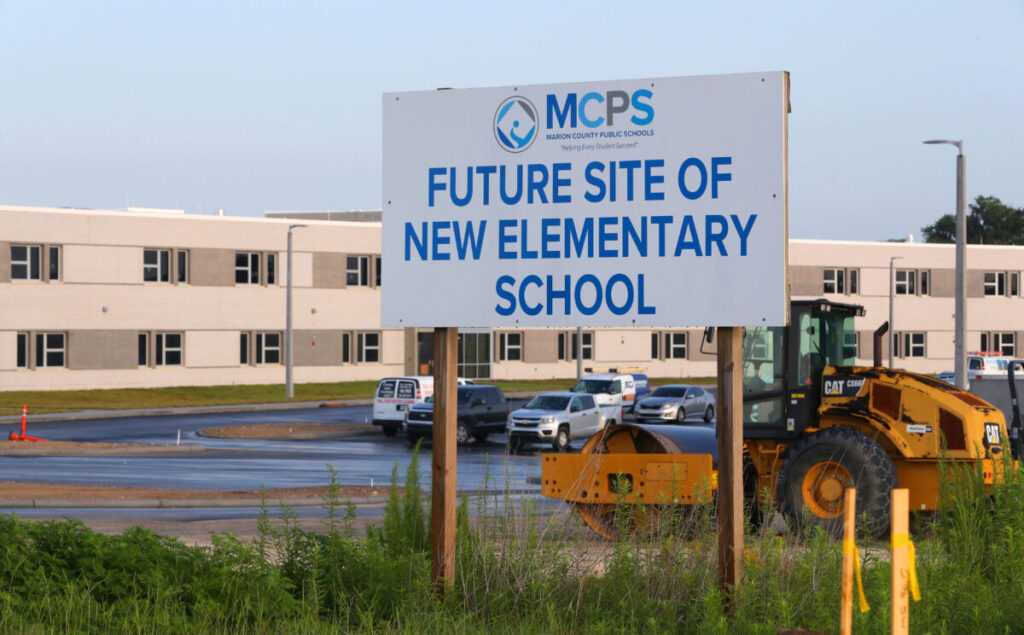
A sign is shown at the entrance to Winding Oaks Elementary School, which was still under construction on Southwest 49th Avenue Road in Ocala on May 30, 2025. The school opened on Aug. 11 that year. [Bruce Ackerman/Ocala Gazette file photo]
The Marion County Board of County Commissioners, members of the Marion County School Board and representatives from Ocala, Belleview, Dunnellon, Reddick and McIntosh convened for their annual joint planning workshop at the Southeastern Livestock Pavilion on April 1. The primary focus of the session was a comprehensive update to the Interlocal Agreement (ILA) for Public School Facility Planning, aimed at modernizing how local governments and the school district share data to manage the county’s rapid residential expansion.
The agreement outlines a methodology for the school district to obtain and plan around county and city development decisions so it can have enough schools to meet the needs of a rising population. This information sharing is crucial because the city of Ocala and the Marion County Board of Commissioners have elected not to implement school concurrency standards in their individual development decisions.
Massive development pipeline identified
The meeting highlighted staggering statistics regarding the county’s potential for future growth. According to data provided by the Technical Working Group (TWG) and consultants JBPro, Marion County currently has a maximum build-out potential of 144,000 additional residential units on existing vacant land designated for residential use. This potential expansion sits atop a current base of approximately 190,000 existing residential units.
More immediate growth is already in the pipeline. Officials noted that 66,000 residential units are currently in the “development approval” stage, representing projects that could move to construction in the near future. Active construction is also high; current records show 8,838 active residential building permits across the county, with the vast majority — approximately 7,300 — located in unincorporated Marion County and another 1,500 in the city of Ocala. Planners emphasized that this growth remains heavily concentrated in the southwest quadrant of the county.
“Ultimately, the reaction to development is this whole district’s obligation to respond to and we are prepared to continue to have really tough conversations about merging schools and bringing sites together and building new ones and communities to address this,” said school district chair Sarah James.
James expressed gratitude for the voter approved half-cent sales tax as well as the recent implementation of impact fees, which are collected when new homes are permitted and which the school district can use to meet these needs.
Realigning data for accurate planning
A significant portion of the meeting was dedicated to how the bodies have improved their data-sharing methodology. Historically, development data and school enrollment figures were collected at different times of the year, leading to a lack of alignment that hindered accurate forecasting.
To resolve this, the proposed Fourth Amended and Restated ILA introduces several key improvements:
- Synchronized Timelines: Development data will now be collected through September 30 each year to align perfectly with the School District’s October 40-day FTE (Full-Time Equivalent) student count.
- Quarterly Updates: Moving away from a static annual report, jurisdictions will now start sharing permitting and “vacant land” data quarterly to ensure planners can react to trends in real-time.
- Standardized Metrics: The TWG Subcommittee has worked to ensure “apples to apples” data consistency across all jurisdictions, tracking specific details such as the number of bedrooms in new developments to better apply Student Generation Rates.
School board member Allison Campbell shared that while the school district has moved to forecasting using standardized metrics per residential dwelling instead of entirely on birthrates, the nationwide trend of declining birth rates is being factored into decisions about what to do in the north end of the county where little growth is currently planned.
Meeting the capacity challenge
With the school district currently at 93% total capacity, these data improvements are critical for upcoming projects. Superintendent Danielle Brewer provided updates on immediate relief efforts, most notably the opening of South Marion High School in August 2026. The facility, the first new high school in Marion County in 26 years, will have an opening capacity of 2,011 students and is designed to relieve overcrowding at West Port, Belleview and Dunnellon high schools.
Stephen Ayres, Director of Student Assigment and Records for Marion County Public Schools, told the assembly, “The state wants us to maintain a minimum of 80% capacity in our schools. They don’t want us building empty schools.”
He further explained that the state discourages spending money on facilities that will sit unused in anticipation of future growth, stating, “The state does not want us spending money to build empty schools and have empty school programs.”
Consequently, the district begins investigating the causes — such as population shifts or school choice — whenever a school’s utilization “falls below 80%,” such as the case in a few schools primarily located in the less densely populated north end of the county.
School officials noted that while traditional brick-and-mortar enrollment has seen some declines due to the expansion of school choice and scholarships, the overall influx of residents moving into the county requires aggressive long-range planning. By refining the data-sharing process, leaders stated they can now “tell a story” with the data, allowing them to proactively identify where to buy land for schools 20 years before the first student walks through the doors.
The Board of County Commissioners is expected to formally ratify the new Fourth Amended ILA in the coming months, following legal reviews by the participating municipalities.

Support community journalism
The first goal of the Ocala Gazette is to deliver trustworthy local journalism so corruption, misinformation and abuse are not hidden from the public or unchallenged.