
IHMC evening lecture series resumes
Research scientist Zachary Graham will lead off the series on Sept. 12 with a discussion about the health of the muscle and nervous system.
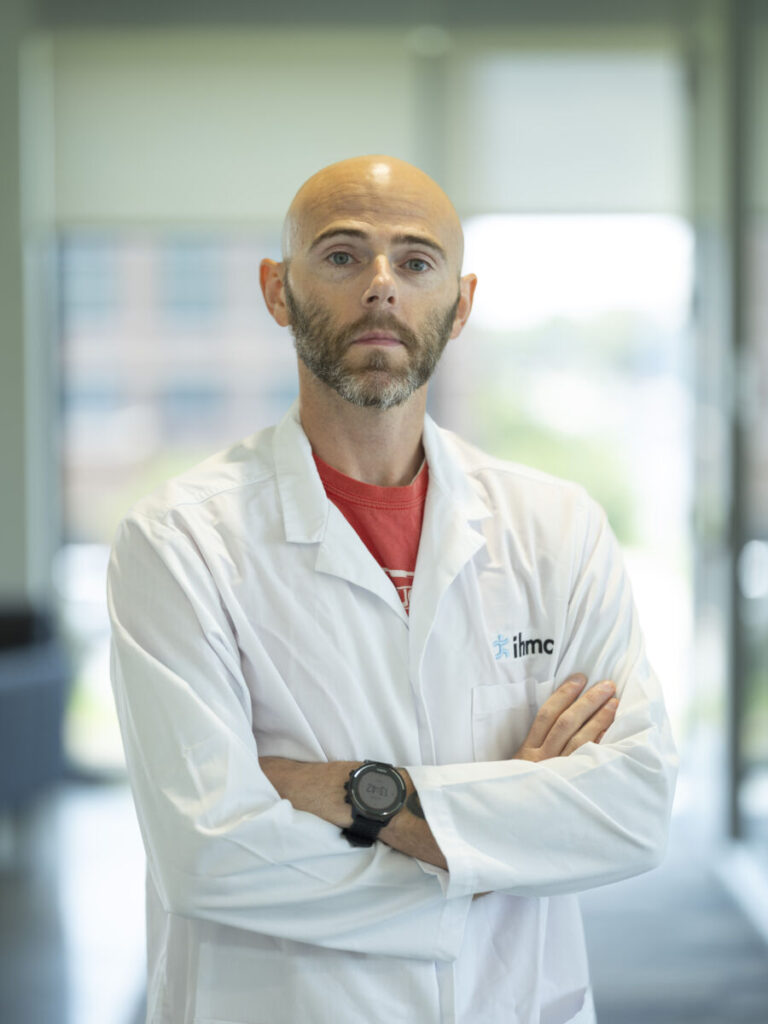
Zachary Graham [Photo courtesy IHMC]
The Institute for Human and Machine Cognition in Ocala is kicking off its newest round of evening lectures on Sept. 12 with a discussion by research scientist Dr. Zachary Graham about the health of the muscle and nervous system. Additional lectures are slated for Oct. 10, Nov. 6 and Dec. 10.
Graham received his Bachelor of Arts degree in Spanish from Ohio State University in 2007 and his master’s degree and Ph.D. from the University of Kansas in 2010 and 2014, respectively. He completed his postdoctoral training in muscle physiology from 2014-2018 at the National Center for the Medical Consequences of Spinal Cord Injury at the James J. Peters VA Medical Center in the Bronx, New York, after which he joined the Birmingham VA Health Care System. He joined IHMC, which is headquartered in Pensacola, in 2021.
Graham was born in Delaware, Ohio, a college town about 30 minutes north of Columbus.
“I grew up mostly in the rural farmlands outside of Delaware. My primary interests were playing and watching sports. For watching, it was mostly Ohio State football but I was also a big fan of the Cincinnati Reds/Bengals. I played baseball and wrestled. As I got into high school, music became more interesting once I discovered Jimmy Page. Then I got into the major British hard rock bands of the time like Led Zeppelin and Black Sabbath,” Graham shared.
As a young sports and exercise enthusiast, he said that during his undergraduate work he had planned to become a high school physical education teacher but then life took a turn.
“I was double majoring in Spanish as well, but I was really starting to get into art and modernism, primarily literature. During my fourth year at Ohio State, I studied abroad in Granada, Spain. Modernism and Granada strongly revolve around Federico Garcia Lorca and, when returning from Spain, I had a major interest in doing graduate work focusing on the literature leading up to the Spanish Civil War, largely influenced by Garcia Lorca’s drama and theatre works,” he shared.
“But as all things go, my phys ed program required a class that was only offered when I was abroad, which meant I was delayed 1.5 years for graduation. So, I graduated with only my Spanish degree and waited to see if I was accepted into Ohio State’s master’s program. My time in phys ed exposed me to a kinesiology class that heavily focused on exercise physiology and that class was one of the most interesting I took in college,” he explained.
He said that while he was abroad, he made a friend who worked in the building that housed the exercise physiology program at the University of Kansas.
“At the time, KU allowed you to get your teaching credentials while getting your master’s degree so I thought this would be a good way to accelerate getting my phys ed degree. I applied to the program and, to this day, I’m not quite sure why Phil Gallagher, who ultimately became my master’s and Ph.D. advisor, accepted me. His lab was my first exposure to research, and exercise and muscle physiology at the molecular level. So, I would say my time in Phil’s lab was what embarked me on my current path. But this path was greatly reinforced by my postdoctoral mentor, Chris Cardozo. The path has led from human-based research to solely animal-based research and now I’m at the place I want to be … trying to build a program where I can do both,” Graham elaborated.
In addition to his work as a research scientist at IHMC, Graham also is a health science research specialist at the Birmingham VA Health Care System.
“I am very interested in how exercise can be implemented to improve the health and quality of life of individuals across disease states and the lifespan. Our group uses multiomic profiling to find novel molecular mechanisms and phenotypes that help guide individualized exercise prescriptions or more precise rehabilitation strategies. Spinal cord injury, Parkinson’s disease and aging are a few of my main research interests,” he notes in his bio on the IHMC website. “I also maintain an active pre-clinical line of research focused on muscle biology following spinal cord injury, predominantly focused on the role of connexin hemichannels in accelerating muscle dysfunction. Our collaborative team of talented interdisciplinary scientists is spread across many labs throughout the country, and we are always looking to extend collaborations.”
Graham said he was recruited to IHMC by Marcas Bamman, the current Healthspan, Resilience and Performance Director.
“I did all my work in his lab. When he left UAB to come lead this program at IHMC, I stayed in Birmingham but was interested in what IHMC was developing. When I was first offered the opportunity to come down, I originally turned it down to stay in Birmingham. But then I continued to see how it was growing and what it was turning into, I made sure not to turn it down a second time,” Graham shared.
Graham offered this synopsis of his upcoming lecture in Ocala: “The health of your muscle and nervous system is obviously a major factor in how well you can function during the normal day. When something happens that disrupts this relationship, such as trauma to the spinal cord or a degenerative condition like Parkinson’s disease, it causes major impact of health and quality of life. My talk will discuss some of the difficulties of treating these types of severe and chronic neural injuries and disorders.”
The lecture will take place at the IHMC campus at 15 SE Osceola Ave. and the evening will begin with a reception at 5:30 p.m.
To learn more and RSVP, go to ihmc.us/life/evening_lectures/ocala-lecture-series

Support community journalism
The first goal of the Ocala Gazette is to deliver trustworthy local journalism so corruption, misinformation and abuse are not hidden from the public or unchallenged.