
Fifth graders inspire hope for greater civic engagement
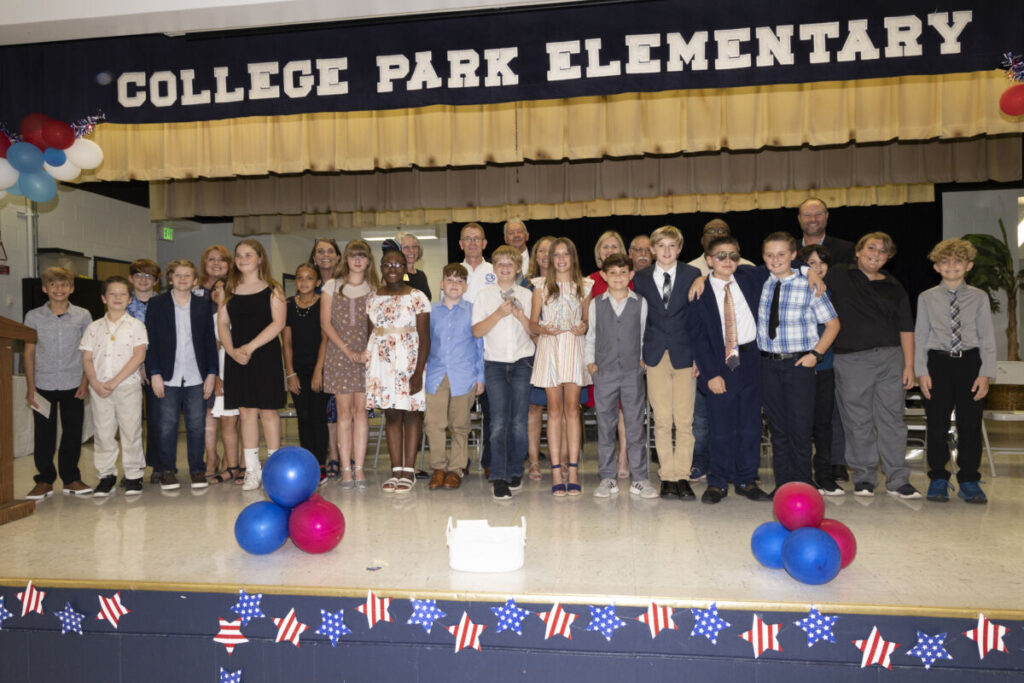
Students from South Ocala, which won the overall “District Leaders for Understanding American Values” award. This award was for the class that had the highest total score on the presentations. Included are: Jake Appleman, Brielle Baily, Robert Blackmer III, Kenneth Cerrato, Bryant Clark Jr, Jayce Collins, Colden Deiter, Ryker Dick, Robert Digaetano II, Jayden Ellis, Christopher Hallinan, Eva Kakande, Nicholas Kalafor, Kyleigh Keck, Melody Martinez, Cynia Miller, Bryson Murray, Lincoln Newby, Adam Rountree Jr, Emily Schmeltz.
In this politically polarized time in our nation’s history, it is easy to become frustrated when some people make arguments that demonstrate either an incomplete or utter lack of knowledge about the basics of American government. The frustration only grows deeper when many of these same people then refuse to engage in government either by voting or attending meetings to have their voices heard.
This lack of civic knowledge and engagement is not just a local concern; it’s a nationwide problem that crosses every political party line and demographic.
In 2021, when Gov. Ron DeSantis signed legislation intended to “collectively strengthen civics instruction and civics literacy education in Florida’s kindergarten through postsecondary public schools,” he issued a statement that acknowledged the information gap.
“The sad reality is that only two in five Americans can correctly name the three branches of government, and more than a third of Americans cannot name any of the rights guaranteed by the First Amendment,” he said. “It is abundantly clear that we need to do a much better job of educating our students in civics to prepare them for the rest of their lives.”
In Marion County, a unique program called “We the People: The Citizen and the Constitution” has been developed to help fifth graders gain a stronger foundation in the basics of our government. With the school year wrapping up, elementary school students around the county last week got to show off their knowledge before panels of judges who hold key positions around Marion County.
When I was asked to be one of the judges, I jumped at the chance to hear from this next generation of citizens.
“The curriculum and hearing format were developed by the Center for Civic Education in 1987 to help celebrate the bicentennial of the Philadelphia Convention. Originally funded for three years, it proved so successful that it kept going,” explained Buddy Oswald, who practiced law before becoming an educator and an enthusiastic volunteer and mentor of the program for several years.
“There are now numerous independent studies that demonstrate (the program’s) effectiveness, not only in increasing student performance but increasing civic participation,” he added.
The culminating activity for this program is a simulated congressional hearing “students serve as experts on the Constitution and are required to demonstrate their knowledge by responding to questions from a panel of community leaders.”
Hundreds of parents showed up to watch the exercise at College Park Elementary on Thursday, May 16.
Also participating as judges were Jim Yancey, a former school principal; Marion County School Board Chair Nancy Thrower along with fellow board members Allison Campbell and Lori Conrad; Marion County Clerk of Court Greg Harrell; Marion County Supervisor of Elections Wesley Wilcox; and Bob Haight, executive director of the United Way of Marion County.
Some of the fifth graders participating were from College Park, Saddlewood and South Ocala elementary schools. Oswald credited Rebekah Winkler, assistant principal at College Park, and Rebecca Miller, assistant principal at South Ocala, with guiding the program through the challenges of the COVID-19 pandemic and turning it into the robust exercise it is now.
“Each school and teacher takes a different approach but generally, they start in the spring semester and take several months studying the entire text,’’ Oswald explained. “Then, after standardized testing has been completed, they spend several weeks preparing for the presentation.”
The elementary school teachers who oversaw this year’s mock congressional hearing were Anne Osborne, South Ocala; Maria Flaitz, College Park; Leah Pfriender, College Park; and Casey Miller of Saddlewood.
Judges were divided into three teams and listened to six panels of students working as teams to answer questions about the intent of the framers of constitution concerning the rights and responsibilities of citizens. These fifth graders not only gave impressive background information on the subject and their analysis but agreed to disagree as a group in certain areas to though-provoking questions like, “Which is more important, freedom of expression or our right to vote? Or “Is the executive branch too powerful today?”
When it came to conversations about exercising their “freedom of expression,” a few students referenced doing so through their choices in dress. One student, however, added that it gave them the right to protest their government. Another opined that voting was a form of freedom of expression.
Conrad asked the students if they felt public schools should be able to limit their use of TikTok and other social media platforms. Interestingly, the students consistently answered, “Yes, while we’re on school campus learning.”
When one group of fifth graders was asked how we could encourage more young people to participate in government, one answered that youth are more encouraged when those in government “set an example.” Other children suggested creating more fun activities for youth to encourage participation.
Asked how they see themselves “participating in government,” some students offered ideas for bringing their neighborhoods together to take care of the community and said people should strive to be a good human and neighbor.
According to Oswald, the successful program “is very inexpensive,” only requiring a set of textbooks. When I asked him how the public could contribute to the success of the program, he responded, “The greatest help the public can provide is to ask all of our educational leaders the same question my students used to ask me: Why aren’t all of the schools and students doing this?”
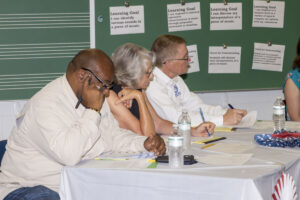
Wesley Wilcox, Nancy Thrower and Eric Cummings ponder follow up questions while listening to students.
Thrower said she is “thrilled” to have the curriculum in Marion County schools because they “foster strong interest in civic virtue and responsibility starting in elementary school.” Campell added that the program also enhances the children’s communication and critical thinking skills.
Wilcox said this was his third time judging the event, and he always comes away “extremely impressed” by not only the children’s knowledge but their presentation.
Wilcox’ office also does outreach in public schools to increase civic engagement. “We do a yearly voter registration event at each public high school. We present a trophy to the school that has the highest registration rate,” he said.
Founding father James Madison said, “Knowledge will forever govern ignorance; and a people who mean to be their own governors must arm themselves with the power which knowledge gives.”
I couldn’t help wondering whether some, if any, of the parents and adults in the room could match the level of knowledge these students demonstrated as they answered tough questions from the judges. Perhaps it’s true, the children will lead us.

Support community journalism
The first goal of the Ocala Gazette is to deliver trustworthy local journalism so corruption, misinformation and abuse are not hidden from the public or unchallenged.