
Bear hunt in Florida approved by FWC
Members of the public spoke for and against the proposal during a packed meeting in Ocala.
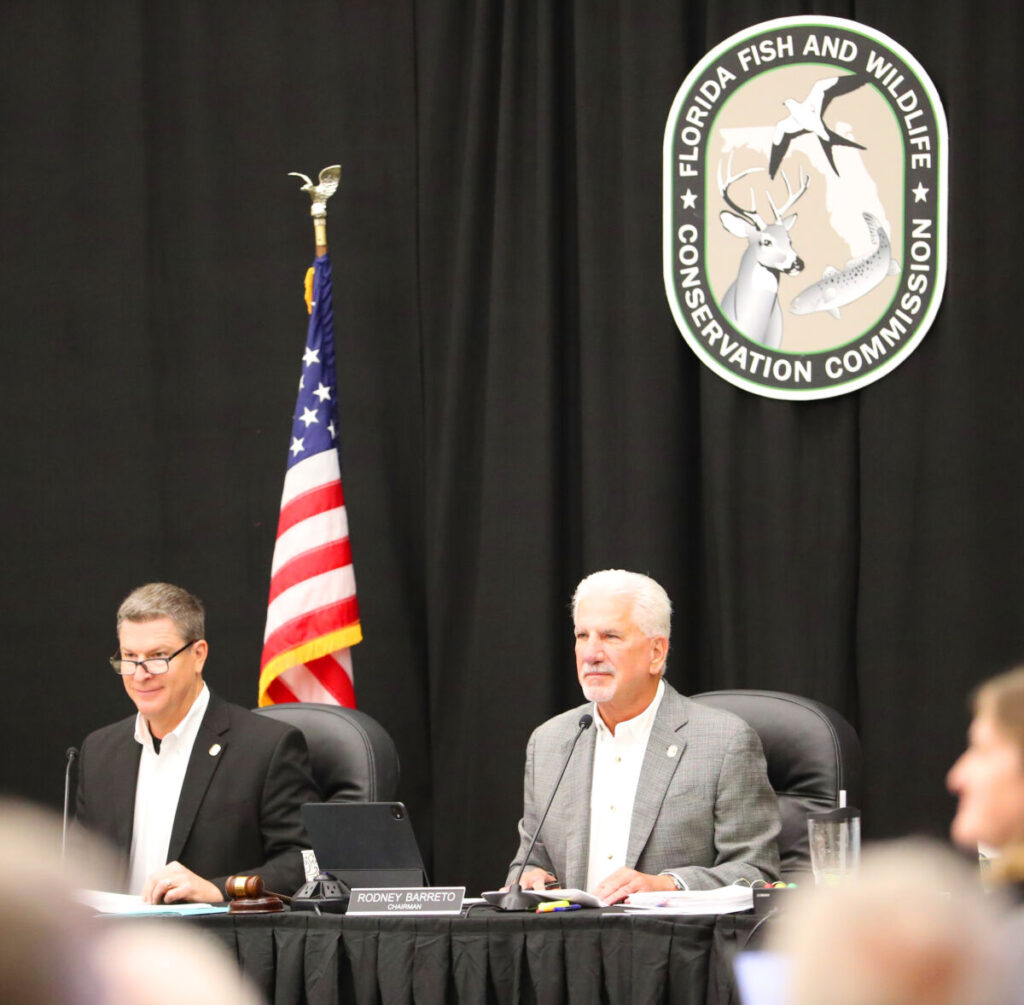
Roger Young, executive director of the Florida Fish and Wildlife Conservation Commission, left, and Rodney Barreto, chairman, listen during a May 21, 2025, meeting in Ocala on a proposed Florida black bear hunt, which was approved later in the year. [Bruce Ackerman/Ocala Gazette file photo]
The Florida Fish and Wildlife Conservation Commission voted 4-1 on May 21 to hold a Florida black bear hunt with methods including baited feeding stations, hunting on private lands, hunting with dogs and archery for kills. Vice-chair Steven Hudson voted no.
Present at the meeting were FWC commission Chairman Rodney Barreto, Hudson and members Albert Maury, Gary Lester and Sonya Rood.
The commission members faced a packed room of public commenters concerned about the proposed bear hunt during its meeting at the Klein Center at the College of Central Florida in Ocala. The number of speakers was unexpectedly high, and overflow rooms were used to accommodate the public. The commission had to reduce speaker time from two minutes to only one minute and cut off public speakers’ microphone time, often in mid-sentence.
The hunt would have stipulations for permits and quotas, specific geographic zones, a calendar season and reporting and tagging requirements.
Kelsie Bloode, the youngest speaker at age 9, opposed a bear hunt. She held up a photo of a black bear after climbing onto a chair in order to reach the microphone.
“If someone came into our neighborhood and said there was too many of us, we’d be scared too. Please protect bears,” she said.
Public opinion showed widely varying viewpoints as speakers from the Panhandle area, Tallahassee, Miami, southwest Florida, Orlando and the Ocala area commented for and against the proposed bear hunt.
Overview of hunt parameters
George Warthen, chief conservation officer of the FWC, opened the morning with a formal presentation to the commission, outlining the proposed bear hunt.
Florida is one of six states that does not currently allow bear hunting. Of those six states, Florida has the highest estimated population of about 4,000 black bears.
The commission proposed to issue hunt permits through a random draw system and the hunt dates would be revised yearly. For 2025, the proposed dates are Dec. 6-28. The commission staff suggested 187 permits be issued; the population estimate they used is 3,798 bears in the state based on a 2014 study.
The Central bear hunting zone that covers Marion County is bounded by State Road 16 to the north; east to Interstate 95; south to the St. John’s Rivers and Interstate 4; and west at the Florida Turnpike, Interstate 75 and US Highway 301. The area covers the majority of Marion County, including the Ocala National Forest and parts of the Marjorie Harris Carr Cross Florida Greenway.
The FWC presentation stated the bear population in Florida is “stable and increasing” with 51% of the state having bears living in it, a range that has expanded since 1992.
The FWC held three virtual public meetings in April of this year, with 566 participants. About 4,000 emails were received on the topic. Additionally, stakeholder emails were sent, with 13,000 responses. The survey showed 13,098 respondents, with 75% opposing a hunt; 86% of respondents self-reported as Florida residents.
Speakers held opposing views
Marion County Sheriff Billy Woods spoke first at the meeting on Wednesday, using six minutes of speaker time. He stated that in the previous nine months his office had received 107 calls for service dealing with bears in Marion County.
“The zone of concern is west of I-75,” he said, mentioning Oak Run and On Top of the World as communities close to the Greenway, which runs through Marion County.
“The other thing I know about my citizens—I love ’em; they’re gun-toting individuals—they will protect themselves and they will protect their property. And they’ll have my support,” Woods said, after which applause broke out that was quickly tamped down by Barreto.
Overall, discussion was restrained and polite, with both sides of the argument showing as organized and focused, asking the commission to use science and data to make decisions, “not opinions.” Some hunters were dismissive of general public opinion, stating that only hunters should have a say on the issue.
Hunter Vincent Phelps said flatly, “If you don’t have a license, you don’t have a say.”
Hunter Adam Steele said, “Public opinion has no place in wildlife management.”
Many opposing speakers questioned current population data and the use of the FWC’s previous population study from 2014 and 2015. A new one is due this year and repeated speakers questioned the validity of population data from the FWC.
Speakers opposing the hunt used more barbed comments to describe the hunt, such as, “It’s “cruelty under the guise of conservation” and “these [human/bear] issues should be dealt with by education, not bullets.”
One speaker admonished the commission to “stop trying to defend the indefensible.” Another told them to “avoid the embarrassment of the 2015 hunt. We don’t have a bear problem, we have an overdevelopment problem.”
Some speakers were in favor of hunting in general but opposed the use of archery, feeding stations and dogs to hunt bears. Several cited the bad press relations from a 2015 hunt in which lactating females and cubs were killed.
The FWC stated that using feeding stations would allow hunters to clearly identify adult male bears more easily and avoid taking females and cubs in error. There would be no distance requirement.
One of the last speakers, Wesley Hucker, was vehemently opposed to the hunt. It’s just “people doing things they have the right to do,” likening it to slavery in the South that was once legal.
“It’s destructive, predatory behavior of grown men who go into the woods to desensitize kids” to cruelty and death,” Hucker said. “There’s no scientific justification for this hunt. There’s never been a reason (to kill black bears) as they’re no threat to humans.”
The FWC issues a press release following the meeting that stated, in part: “Hunting would allow the FWC to start managing population growth rates for the Bear Management Units, or BMUs, with the largest bear subpopulations. Balancing species population growth with suitable habitat helps to maintain a healthy population. Hunting is an important and effective tool for managing wildlife populations around the world, but it is important to acknowledge that managing bear populations does not manage human-bear conflicts. Conflict prevention and bear management practices will still need to continue regardless of whether commissioners approve final rules for reopening regulated bear hunting in the future.”
A final commission vote on the hunt will be taken in August.
For more information, go to myfwc.com



Support community journalism
The first goal of the Ocala Gazette is to deliver trustworthy local journalism so corruption, misinformation and abuse are not hidden from the public or unchallenged.