
Impact fees for road, fire and EMS on new construction are being debated this week
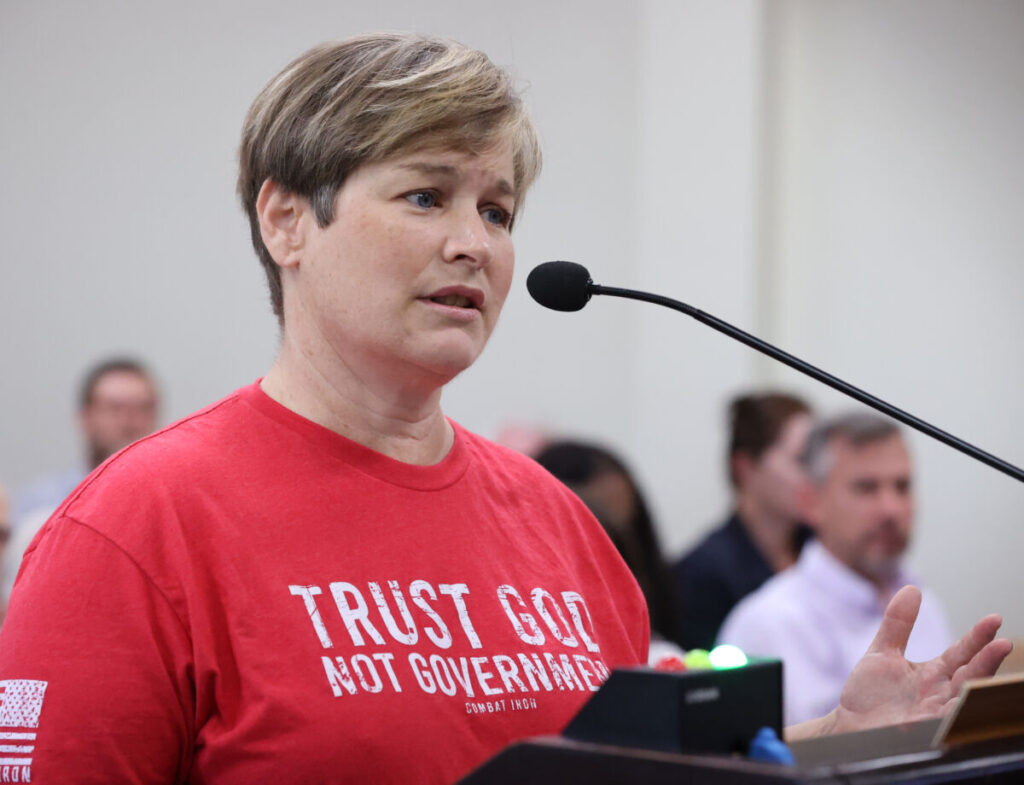
File photo: Brigitte Smith speaks during the Ocala City Council meeting at Ocala City Hall in Ocala, Fla. on Tuesday, May 3, 2022. [Bruce Ackerman/Ocala Gazette] 2022.
|
Getting your Trinity Audio player ready...
|
Editor’s Note: The original article erroneously reported there would be two public hearings on these impact fees- there is only one, on May 23.
A public hearing will be hosted by the Marion County Board of County Commissioners on May 23 to weigh in on whether the county should raise certain impact fees on developers and reinstate others to offset the rising costs of transportation improvements and fire services brought on by new residents and businesses.
The board on Feb. 18 considered whether to abide by legislative restrictions limiting the increase of impact fees to no more than 50% unless a supermajority of the board approved doing so and that the county demonstrated an urgent need by showing “extraordinary circumstances.”
Ultimately, the commission decided to claim “extraordinary circumstances” so they could use greater discretion over establishing how much in impact fees would be assessed without legislative restrictions.
The question remains whether they will adopt recommendations from a consultant and take steps to implement 100% of the recommended impact fees or set them at a reduced rate.
Information presented at prior workshops this year indicated that the majority of the MCBOCC felt they needed to restore the collection of impact rates to 2015 levels, after which they were reduced to support the building industry’s recovery, which is line with the funding recommendations from the consultants.
The debate between the citizenry and business community
In a May 15 letter from the Ocala Metro Chamber of Economic Partnership to the commission, the business organization expressed “strong concern” about the level of calculated transportation impact fees. The letter encouraged the commission to implement transportation impact fees at 50% of the calculated rate, increasing it annually by 12.5% until the needed rates are achieved.
In support of their argument, the organization said the proposed level would impact the “vibrancy of our local economy” by deterring new business, slowing commercial development, limiting job creation and stalling the expansion of our tax base.
The CEP argued that fully implementing the impact fees on residential would increase housing costs and further impact our “middle-income families, educators, healthcare workers and first responders.”
Diana Williams, chair of the Marion Democratic Executive Committee, wrote to the “Gazette” in response to that position: “Someone on a teacher’s salary cannot afford to buy a modest home built in the 1960’ that is in need of updates and renovations, let alone afford a new home—while we had NO/LOW impact fees. Where is the affordable housing now? That leads to a discussion of wages, inflation, and income disparity.”
Williams wrote that local democrats supported the MCBCC being proactive “finally” and that Marion County needed to “catch up” on infrastructure.
“They seem to be acknowledging their own complacency. Where was the appropriate input from staff, why didn’t they have this discussion years ago? We are one of the fastest growing cities in the country—because we have been less responsible to our residents to ensure cash flow to fix, improve and expand our infrastructure. Now we find out our expansive growth was at the cost of needed infrastructure that we simply ignored while the CEP and contractors were in their hay day, and county commissioners were heroes because of the low tax rate. And there’s no going back to recapture, new construction will pay the burden for this complacency,” Williams wrote.
Brigette Smith, chair for the Marion County Republican Executive Committee, offered the “Gazette” the letter that group wrote to the commissioners, which pointed to other counties that have been charging a lot more than Marion County and that the cost of living has increased since 2015 for everyone.
“We applaud the commissioners for correcting this overdue impact fee ’discount‘ as well as support free enterprise and fees set in a fair and equitable manner. We support the raising of impact fees well above 50% as needed to maintain the level of services that our residents deserve without shifting this economic liability onto county taxpayers,” the REC letter said.
MCBCC Chair, Kathy Bryant, wrote the CEP back asking them to share any data they had to back their assertions on May 21.
“Certainly, we all recognize that transportation improvements are integral to both economic success and quality of life. We welcome any data or insights you may have that support discounting the impact fees. If the CEP is aware of projections or economic indicators that suggest a different trajectory or need for our community’s growth, we would be grateful if you could share that information,” Bryant wrote.
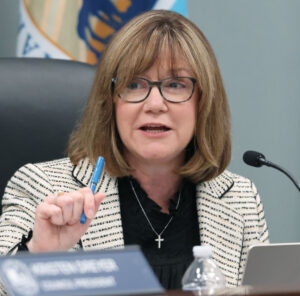
File photo: Marion County Commission Chair Kathy Bryant speaks during a joint workshop with the Marion County Commission and the Ocala City Council at the Marion County Commission auditorium in Ocala, Fla. on Thursday, March 13, 2025. [Bruce Ackerman/Ocala Gazette] 2025.
Impact fees are one-time assessments on new construction designed to offset the financial effects that new residential and commercial construction have on local infrastructure and public services.
Last November, Marion County voters agreed to renew the county’s 1-cent sales tax add-on for 20 years. The revenue generated from the tax served to reduce the impact fees now recommended because it factored in both community needs and other funding.
Impact fees are not collected until building permits are pulled, which means local governments are behind in receiving funds to meet the impacts of the new growth.
Impact fees can be used for capital improvements to meet the needs associated with new development; however, the money cannot be used for prior debt or projects unless “there is a nexus showing use for need due to new growth,” explained the county’s consultant during the Jan. 29 workshop.
Impact fee and sales tax revenue cannot be used for operations costs, which means that growing personnel costs to meet growth needs must be funded elsewhere.
Transportation Impact fees
The transportation impact fees were calculated on a consumption basis. The consultant recommended the following impact fees for transportation:
| Land Use | Unit | Current Impact Fee | Recommended Calculated Impact Fee |
| Residential single family | 2,000 sq ft | $1,397 | $5,318 |
| Light industrial | 1,000 sq ft | $428 | $2,145 |
| Office | 1,000 sq ft | $676 | $4,766 |
| Retail/Shopping Center | 1,000 sq ft | $676 | $4766 |
Fire/EMS
The impact fees proposed by the consultants were broken into Fire/EMS:
| Land Use | Unit | Current Impact Fees for Fire Rescue or EMS | Recommended calculated Fire Rescue impact fee (countywide except for Ocala) | Recommended calculated EMS impact fee
(countywide) |
| Residential single family 2,000 sq feet | Each dwelling unit | $0 | $744 | $238 |
| Light industrial | 1,000 sq ft | $0 | $190 | $56 |
| Office | 1,000 sq ft | $0 | $401 | $119 |
| Retail/Shopping Center | 1,000 sq ft | $0 | $1,156 | $343
|
Fire service impact fees would be assessed on all new construction outside the Ocala city limits. However, since Ocala relies on the county for ambulance services, those impact fees could be assessed countywide.

Support community journalism
The first goal of the Ocala Gazette is to deliver trustworthy local journalism so corruption, misinformation and abuse are not hidden from the public or unchallenged.