
School capacity and growth projections for Marion County Public Schools
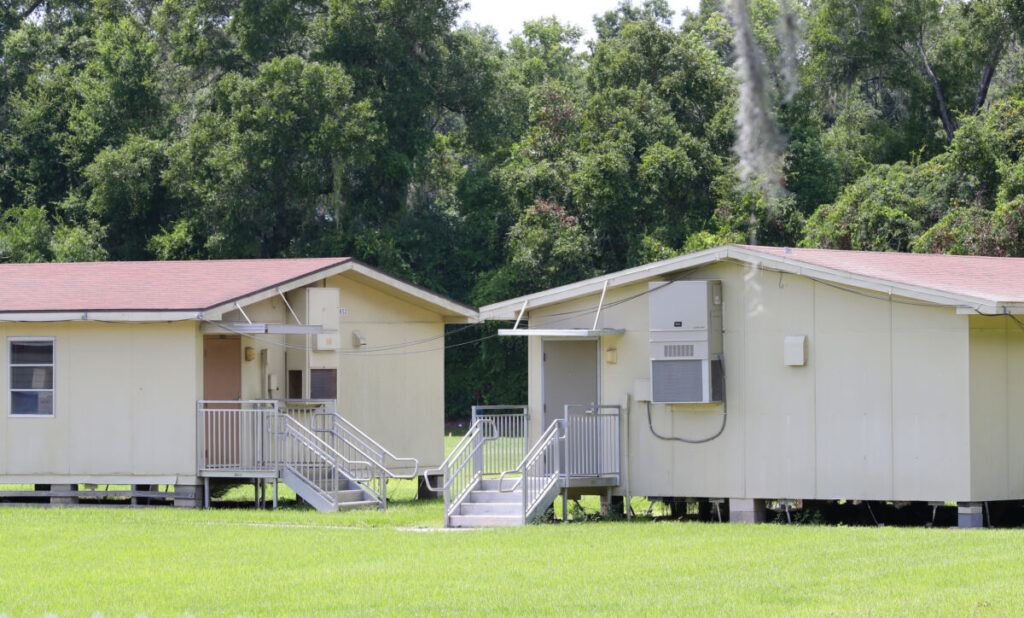
Portable classrooms are shown at College Park Elementary School in Ocala, Fla. on Tuesday, August 23, 2022. [Bruce Ackerman/Ocala Gazette] 2022.
This year’s data on school capacity, facilities and more has been certified by the Marion County School Board, giving a closer look into local impacts of population growth.
Florida Inventory of School Houses (FISH) data shows that Marion County’s current student capacity is 47,409, as of January 2025. If student enrollment remains on track with the district’s projections, the student population is expected to surpass capacity by 2028—not considering the three new schools under construction.
“This is the student capacity after the percentage deduction for school type is taken off per the State Requirements for Educational Facilities. For example, at the high school level the FISH is 95% of the student stations, at the middle school it is typically 90% of the student stations, and at elementary school they are both equal which is 100% of the student stations. This allows for some flexibility in use of space,” said Marion County Public Schools spokesperson Kevin Christian.
MCPS is combatting its lack of space by building new schools, adding wings to existing schools and planning more construction over the next decade.
In 2023, a long-range plan was conducted by Benesch, an independent consultant, to identify funding needs for capital projects. The study projected that MCPS’ student population in 2028 will hit 47,519, just above the current capacity of 47,409.
Marion’s number of total student stations is 51,694.
“This is the design capacity of the facility. Each room is evaluated based on square footage and use and a student stations capacity is determined. This is how many students can occupy that space based on design. The student stations number is higher than the capacity number,” Christian said.
The 2023-24 school year data showed that Marion County’s student enrollment had reached 45,651, as of December 2023.
The annual FISH report contains facility information reported by districts for all public schools, including data on overall school capacity, square footage, facility age and capital outlay for full-time equivalent students, according to the Florida Department of Education.
With localized overcrowding prevalent in the southwest area of Marion County, and an overall climbing number of students, the district is growing closer to its total capacity and number of seats for students each year.
Over the past 10 years, the district’s enrollment has grown by nearly 9%, according to MCPS.
The district is building two new elementary schools and one new high school. Recently named, Ross Prairie Elementary and Winding Oaks Elementary are both expected to open in August 2025. The new high school is expected to open in August 2027.
While opening new schools is expected to help, the issue remains of the many existing schools in Marion County that are aging, overcrowded, or both.
This year’s FISH data reports the average age of school facilities in Marion County is 39 years old, with 25% of all permanent buildings being over 50 years of age. The average age of Marion County’s portable classrooms is 50 years old—the oldest out of any district statewide, tied with Clay County Public Schools.
Based on square footage, 93.7% of Marion’s portable classrooms are 20 years old or older.
The Marion County School Board has pursued multiple funding avenues to offset the cost of new construction, and successfully reinstated impact fees and passed a half-cent increase to the sales tax.
The sales tax increase was approved by Marion County voters in the November 2024 general election and went into effect in January, while the collection of impact fees began in July 2024. Impact fees and the sales tax revenue can only be used for school district capital projects and infrastructure.

Support community journalism
The first goal of the Ocala Gazette is to deliver trustworthy local journalism so corruption, misinformation and abuse are not hidden from the public or unchallenged.