
IHMC speaker to discuss artificial intelligence
The evening lecture will take place May 15 at the campus in downtown Ocala.
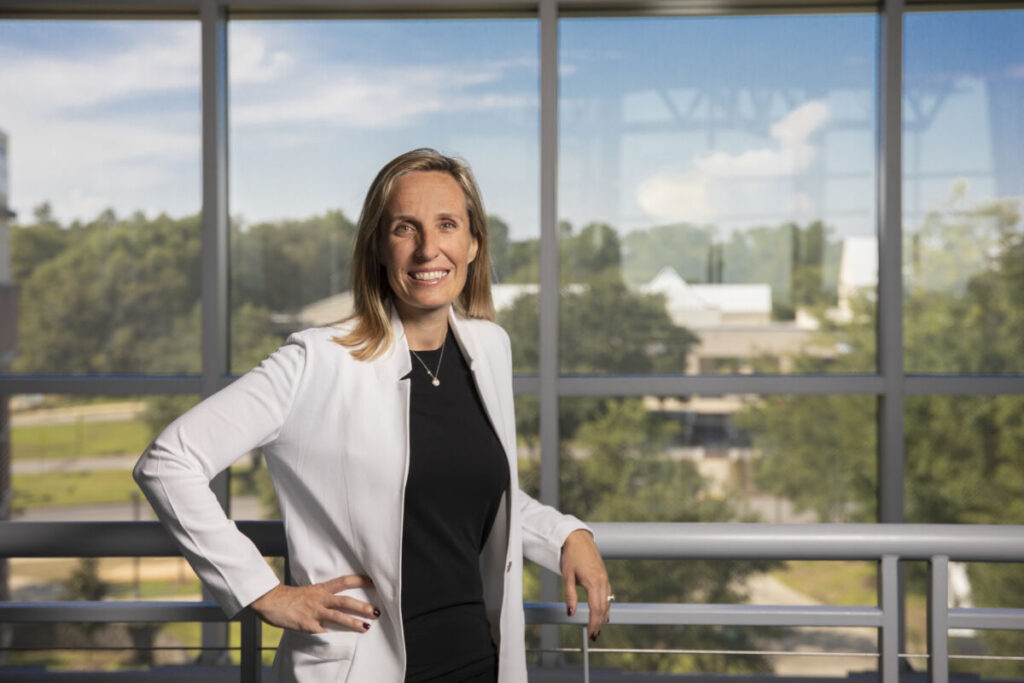
Kristen “Brent” Venable [Photo courtesy IHMC]
Kristen “Brent” Venable is the next speaker in the Florida Institute for Human and Machine Cognition (IHMC) evening lecture series in Ocala. Her topic on May 15 will be “Machines Thinking Fast and Flow How the Way We Think is Shaping Smarter AI.”
Venable graduated magna cum laude in pure mathematics from the University of Padova, Italy, and earned her Ph.D. in computer science and artificial intelligence with a dissertation on automatically learning preferences over schedules, developed at NASA Ames in support of the Mars Rovers Spirit and Opportunity.
Venable is a senior research scientist at IHMC and director of the IHMC–University of West Florida Ph.D. program in intelligent systems and robotics. She is a professor of computer science at the University of West Florida and previously was a professor at Tulane University and a tenured assistant professor of computer science at the University of Padova. She collaborates with premier research institutions, is the co-author of two books and has published more than 100 peer-reviewed articles in leading AI journals and conferences.
Her work focuses on developing automated models of preference to support decision-making in applications such as recommender systems, human-machine teaming and behavioral modeling. More recently, she has explored the ethical implications of AI technologies and their potential for advancing social good.
Venable was born in Dallas, Texas, but spent most of her childhood in Asolo, a small town in northern Italy.
“For much of my life, I’ve gone back and forth between Italy and Texas, and both places have shaped who I am. I’m fluent in Italian, though I still have a bit of an accent when I speak English—I like to say I speak “Texaliano,” she said.
Venable said she was “definitely a bookworm” as a youngster.
“I attended a classical high school with a strong humanities focus, where I studied five years of ancient Greek and Latin. Early on, I fell in love with mathematics, philosophy and abstract thinking. Outside of school, I enjoyed horseback riding and artistic swimming,” she shared.
In college, she chose to study pure mathematics, favoring it over philosophy “because I had already had my fill of history by then.”
“During my third year, I became increasingly fascinated by computer science. When Francesca Rossi, an expert in artificial intelligence, joined the faculty, I had the opportunity to work with her on my master’s thesis. After reading my first scientific paper in AI and completing a research project, I knew I wanted to dedicate my career to AI research. It became one of my core goals in life,” Venable explained.
“Rossi was a tremendous influence. She taught me how to approach research with rigor and creativity, and she served as an exceptional role model as a woman in science,” Venable noted.
“During my Ph.D., I interned at NASA Ames, where I worked under the guidance of Robert Morris. He inspired me with his passion for applied science and his holistic view of what it means to be a well-rounded human being. When I decided to return to the U.S. to continue my research career, he introduced me to Ken Ford and the team at IHMC. Ken has been a remarkable mentor—combining scientific excellence, entrepreneurship and a free spirit. I’m deeply grateful for his support during some of my most pivotal career decisions,” she added.
Venable, in turn, has mentored “several brilliant Ph.D. students.”
“Those who have already graduated—Jaelle Scheuermann, Taher Rahgooy and Andrea Martin—have gone on to exciting careers at META, Loyola University and the Naval Research Laboratory. I’m incredibly proud of them, not only because they are brilliant researchers, but also because they are wonderful human beings. They’ve brought fresh ideas, energy and joy into my work, and our collaborative journeys have been truly fulfilling,” she said.
Venable and her husband Jeffery have two children, ages 15 and 10.
“I love to travel with them, especially to beach destinations. One of my favorite hobbies is scuba diving. We also share our home with two beloved dogs—Nishy, a Yorkie mix we adopted from a shelter in Italy, and Ziggy, a 2-year-old cocker spaniel. We’re a family of animal lovers and we’re all vegan,” she said.
Of her talk in Ocala, Venable said, “My talk explores how models of human thinking—developed in psychology and cognitive science—can inspire advances in AI. One example is the dual-system theory of thinking fast and slow. Understanding how humans reason and make decisions can help us design smarter, more adaptable AI systems. At the same time, AI can help scientists test and refine theories about the human mind. It’s a powerful two-way exchange that’s reshaping both fields.”
This is the last lecture for the IHMC Ocala spring season. The fall lecture series will begin Sept. 9. To learn more, go to ihmc.us
IHMC is located at 15 SE Osceola Ave., Ocala. The May 15 lecture, which will begin at 5:30 p.m. with a reception, is free to attend but seating is limited. RSVP to ihmc-20250515.eventbrite.com or call (352) 387-3050.

Support community journalism
The first goal of the Ocala Gazette is to deliver trustworthy local journalism so corruption, misinformation and abuse are not hidden from the public or unchallenged.