
MCSO officers demoted over handling of domestic call
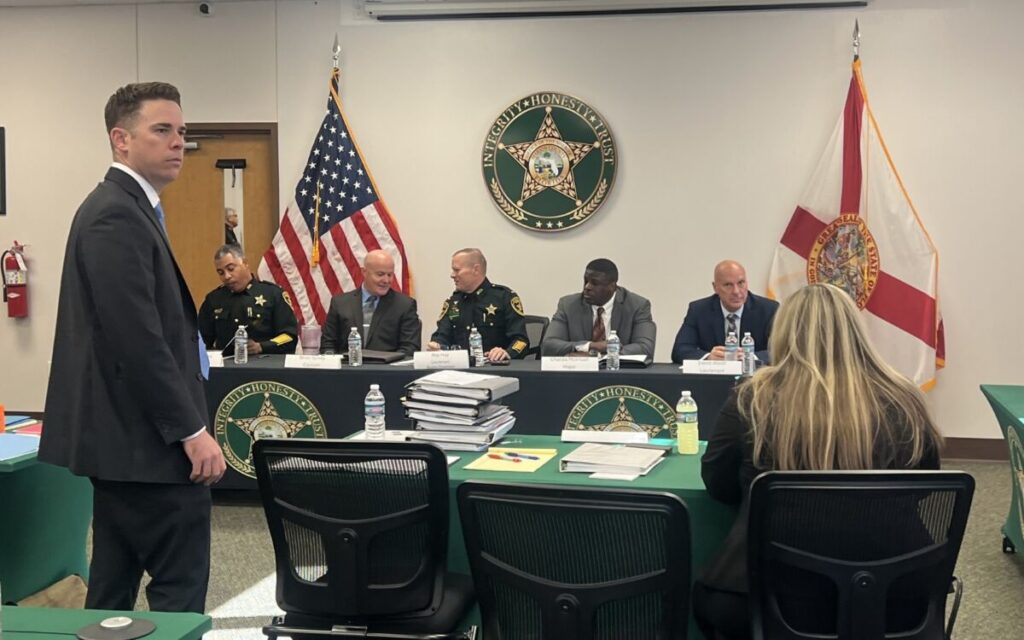
Appeal panel at the start of Sgt. Boyles public hearing on Feb. 24, 2026. [Jennifer Hunt Murty, Ocala Gazette]
By Jennifer Hunt Murty
Recent disciplinary proceedings involving two Marion County Sheriff’s Office supervisors, described by Sheriff Billy Woods as “outstanding human beings” with otherwise exemplary records, illustrate the complications law enforcement faces when navigating highly volatile officer-involved domestic violence cases.
The disciplinary proceedings stem from a December incident involving Lt. Ben Adams and Sgt. Jeff Boyles, tasked with retrieving agency property from a home in Lake County shared by two married MCSO deputies who were engaged in a volatile domestic situation. Domestic violence calls are among the leading causes of law enforcement deaths in the line of duty, according to a 2024 report with data compiled by the National Law Enforcement Officers Memorial Fund (NLEOMF).
Recognizing the seriousness of such calls, the MCSO has two policies guiding deputies on how to respond to domestic violence calls, one for the public and the other for deputies.
The general policy for the standard response to domestic violence calls involving members of the public emphasizes victim safety, building strong cases, and a pro-arrest policy for the primary aggressor.
The policy for when sworn officers are suspected of being the perpetrator or a victim of domestic violence, however, establishes protocols for early intervention, investigating allegations, providing safety to the victim, and relieving the accused officer of agency-issued firearms.
Boyles was demoted from Sergeant to Corporal, and Adams from Lieutenant to a Sergeant. Additionally, Boyles received a 160-hour suspension and Adams a 240-hour suspension- both faced removal from the SWAT team.
Both officers appealed the agency’s disciplinary action, entitling them to public hearings at which a panel reviews the evidence. A panel made up of MCSO staff was convened on Feb. 24 under the Career Service Act to consider the appeal of Boyles. The panel’s purview was to either sustain or unsustain the discipline rendered by the agency.
The incident
The incident began on the morning of Dec. 3, 2025, when Deputy Jeremiah Ricketts’ wife, also a deputy, was reportedly planning to leave him due to ongoing domestic issues. Fearing a dangerous domestic dispute if she returned to their shared Lake County residence to gather her equipment, she arranged for the MCSO to assist her by picking up her marked patrol vehicle, guns, and gear.
Adams testified at Boyle’s disciplinary hearing that he was told by command staff that Ricketts was “unhinged, off the rail, raging and tearing shit up” and was acting “off his rocker.”
Recognizing the heightened “level of risk” involved, Capt. Dennis Joiner testified similarly and explained why he chose Adams, a 20-year veteran who supervised Ricketts, to handle the assignment. Adams tagged Boyles, a 19-year veteran, to assist.
Joiner stated under oath at a subsequent disciplinary hearing that he chose them because he had “all the confidence in the world that they had enough knowledge to make the correct decisions in this matter.” He further emphasized that both men were “tactically sound SWAT members” and noted he had never seen either deputy let someone get under their skin.
Joiner acknowledged under oath that he knew it was a potentially dangerous domestic situation that required experienced supervisors who could make correct decisions.
When Adams and Boyles arrived at the Lake County home, they used a spare key to take the patrol vehicle down the road and discovered that the firearms and equipment were missing from it. They concluded the items were likely removed by Ricketts, who was on suspension during an MCSO internal investigation and therefore prohibited from accessing the agency’s property.
This development complicated the mission, which had started with the goal of retrieving MCSO property in Lake County, outside their jurisdiction, but was now factoring in a possible theft of agency property.
Adams contacted Joiner for guidance, and Joiner later testified that his instructions were to “call Jeremiah (Ricketts), ask him if he has the guns, and if not, call the county sheriff” (referring to the Lake County Sheriff’s Office).
When Adams returned to the residence to confront Ricketts about the missing gear, Ricketts began engaging in evasive behavior outside the front of the home that Adams later described as “playing games.”
Body cam footage reflected that when Adams asked about the weapons, Ricketts initially said the items were in “her” house. Confused, Adams verified that Ricketts did indeed live there and had the authority to go inside. Once his residency was confirmed, Ricketts immediately shifted his language and attitude, telling the deputies, “You can get it, but I don’t want you inside my house.”
Given Ricketts’ reported instability and the knowledge that he was armed, Adams placed Ricketts in handcuffs and removed Ricketts’ personal handgun from his waistband.
Body camera footage of the interaction did not show Adams or Boyles using force against Ricketts. Ricketts complied with Adam’s request to place him in restraints.
Adams later explained his concerns about letting what he considered to be an irrational, “unhinged” man back into the house alone. He stated he “wasn’t going to instruct him to go and get, by himself and be in possession of what I already think he has stolen.”
He adamantly refused to allow Ricketts to “go inside and touch the guns or get the equipment that he had just taken out of the car” without supervision.
Adams explained he tried to reassure Rickets during the interaction, while maintaining safety. The body cam footage reflects Adams told him, “You are not going in there and grabbing those guns. I want you to look at me, you know I speak the truth, I’m not going to allow that to happen. So, you can escort us in there, stay right by our side, so you know we are not searching anything, so you know we’re getting what we came to do.”
Hoping to resolve the volatile domestic property dispute quietly and avoid dragging a fellow deputy into a criminal case, Adams said he told Ricketts, “I can take those cuffs off of you, we can walk inside to gather that gear, we will take that gear, and when we leave, everything is done. That is what we are going to do. If you don’t want to do that, then I’ll sit you in the backseat of that patrol car … We’ll get Lake County (deputies) out here, and we’ll follow it that way. Sound good? So, which one do you want to do? There are no variations to the scenarios I just gave you.”
Ricketts agreed to the first option, and the deputies removed his handcuffs so he could lead them inside. However, once they entered the home, body cam footage reflected Ricketts focused on his dog rather than finding the agency’s gear and spent a few minutes chasing his dog around the house to put his dog in a kennel before leading the officers upstairs to a closet that contained only two uniforms.
When Adams asked again where the missing guns were, Ricketts abruptly changed his mind and revoked his consent, declaring, “I want you guys to get out of my house. You guys want to arrest me, arrest me. Please get out of my house. You no longer have consent to be in my house; you can arrest me if you want. I do not consent to any of this. This is illegal, you do not have authority here.”
Following this, Adams re-handcuffed Ricketts, escorted him out of the house, and placed him in the back of the patrol vehicle to await the Lake County Sheriff’s Office.
It’s at this point that the property-retrieval assignment became an alleged constitutional violation that would ultimately lead to severe disciplinary action against Adams and Boyles.
Ricketts is no longer an employee of the MCSO, and the court docket reflects that divorce proceedings have been filed.
Charges against Boyles and Adams
The Feb. 24 panel sustained the sheriff’s findings in the case of Boyles.
- Warrantless Searches and Seizures: MCSO claims when the deputies entered the residence without a warrant, and believed the ultimatum given by Adams to Ricketts was “coerced” by the threat of arrest.
- Dereliction of Duty: MCSO claims the deputies detaining Ricketts outside of Marion County without being in “fresh pursuit” originating from Marion County and the lack of mutual aid agreement between MCSO and Lake County Sheriff’s Office. By doing so, the sheriff said they “failed to exercise diligence, and acted in a manner tending to bring discredit upon the agency.”
- Use of Discretion by Supervisors: MCSO claims the deputies failed to rely on their experience, training, compassion, and good judgment to make sound command decisions and to guide subordinates appropriately.
Since all of the violations were sustained, the panel was not allowed to address the severity of the agency’s punishment.
Throughout the disciplinary hearing, Boyles’ defense relied heavily on the domestic context to explain why the deputies acted the way they did. Boyles’ defense counsel argued that the deputies’ overarching mission, as ordered by their superiors, was to resolve a tense officer-involved domestic situation quietly, without escalating it into a criminal case or involving the Lake County Sheriff’s Office right away.
The defense emphasized that the deputies’ actions—even the policy violations regarding the warrantless search and unlawful detention—were motivated by a good-faith attempt to secure firearms from an unstable deputy and safely resolve the domestic turmoil.
The internal affairs investigation was conducted by Capt. Mike Mongeluzzo instead of the MCSO Internal Affairs department. Mongeluzzo explained that while Internal Affairs handles most investigations, they are sometimes assigned to captains, but Mongeluzzo never explained the reason for this specific investigation when questioned.
Boyles’ defense attorney contrasted Boyles’ actions with those of another supervisor, Sgt. Timothy Liberatore, who was disciplined under the general Domestic and Dating Violence policy wherein Mongeluzzo also handled the investigation instead of internal affairs.
In Liberatore’s case, he responded to a general domestic violence call and unlawfully opened a victim’s front door without a warrant. Furthermore, Liberatore reportedly attempted to intimidate the female domestic violence victim by threatening to release a police K9 into her home–knowing she had pet cats inside that could be harmed–to get the victim to share information about someone in the house.
Liberatore claimed he didn’t violate MCSO policies.
Instead, Mongeluzzo wrote that Liberatore justified his actions saying, “The way I approached her, they were talking to her really gently, and in other situations, the good cop-bad cop type thing was used, and you sometimes get more information. With me telling her we are going to go into her house, we’re allowed to lie to people, I was trying to get a concrete answer that yes, he’s in the house.”
In the case of Liberatore, Major Louis Pulford recommended only one day’s suspension. But for Adams and Boyles, Pulford recommended a harsher discipline.
Boyles’ counsel used this case to argue for a lesser punishment. He argued that while Liberatore willfully escalated a general domestic violence situation and only received a one-day suspension, Boyles was demoted despite actively trying to de-escalate a potentially dangerous situation and deferring to his superior, Adams. Ultimately, Woods rejected this comparison, noting that Liberatore did not enter the home despite the threats to do so, whereas Boyles and Adams did.
Next, another panel has been convened to hear Adam’s appeal, but that public hearing has not yet been set.
Litigation that loomed over the disciplinary hearing
A dispute about whether Boyles and Adams were acting under direct orders from the Joiner and Pulford while in Lake County surfaced during the administrative discipline hearing.
The issue is expected to be explored in a civil lawsuit filed by Ricketts on Feb. 6 under 42 U.S.C. § 1983 in the United States District Court for the Middle District of Florida against the MCSO as well as Adams and Boyles.
The complaint alleges that the defendants violated Ricketts’s Fourth and 14th Amendment rights by conducting an unreasonable and unlawful search and seizure at his home and seeks damages.
Adams stated during Boyles disciplinary hearing that he was informed that the MCSO would not be providing a joint defense for the department, Adams and Boyles. Instead, the officers would have to obtain independent counsel.

Support community journalism
The first goal of the Ocala Gazette is to deliver trustworthy local journalism so corruption, misinformation and abuse are not hidden from the public or unchallenged.