
Dunnellon railroad tie burn site backfilled as shallow soil tests pass
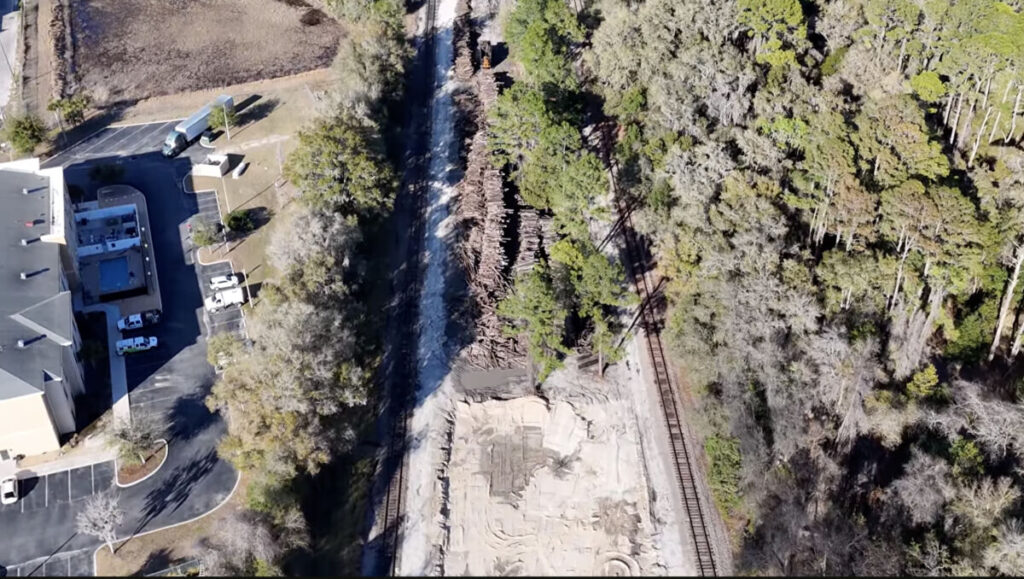
Fill dirt is shown in this Sunday, March 1 aerial photo, where the railroad ties that burned have been cleaned up on the CSX Transportation line in Dunnellon, Florida. The fire occurred at a site adjacent to the Florida Northern Railroad line, situated near East McKinney Street and North Williams Street in the Chatmire area of Dunnellon. Tens of thousands of stored, creosote-treated ties burned on Feb. 1, 2026. The railroad ties belonged to Track Line Rail, a company that was in the process of removing them when they burned. Many of the railroad ties have been removed and the area is now filled in with fill dirt. [Bryce Hale/Special To The Ocala Gazette] 2026.
By Jennifer Hunt Murty
Crews are backfilling the site of the massive Feb. 1 Dunnellon creosote railroad tie fire after shallow soil test results showed below state action levels, but a closer look at the testing protocols leave questions about the sufficiency of the testing.
According to an update from the City of Dunnellon, 63 trucks unloaded backfill at the excavation site Monday afternoon, completely covering the eastern half of the trench. The city confirmed that “all post-excavation test results have returned below soil cleanup target levels (SCTL),” paving the way for the site to be filled and remaining rail cars to be transported out of the area.
However, an analysis of the contractor’s work plan and laboratory reports obtained by the “Gazette” shows the soil was tested exclusively for Semivolatile Organic Compounds (SVOCs), ignoring other highly mobile and toxic chemicals.
Also, the excavation only extended up to 2.5 feet deep. Given the unique chemical properties of creosote and the porous nature of Marion County’s geology, reports from other creosote clean-up sites suggest that 2.5 feet deep is only scratching the surface and may not be enough.
Perhaps the greatest concern regarding the shallow excavation is the physical weight of creosote itself. Creosote is heavier than water. Because of its high density, creosote released into the subsurface can rapidly penetrate downward through the soil and significantly below the water table, independent of the direction of groundwater flow.
What was found, and what was ignored
The Florida Department of Environmental Protection (FDEP) is the primary regulatory agency, but the physical cleanup and environmental sampling is being managed by CSX Transportation and its hired contractors pursuant to a Source Removal and Surface Water Sampling Work Plan approved nine days after the initial fire.
The collected soil samples were sent to the Eurofins Environment Testing laboratory for chemical analysis.
CSX contractor Arcadis collected confirmation soil samples from the bottom and sides of the shallow excavation trench. These samples were sent to Eurofins Environment Testing and analyzed for SVOCs using EPA Method 8270E. While the results showed that these specific heavier compounds were below the FDEP target levels, a critical category of contaminants was entirely excluded from the soil tests: Volatile Organic Compounds (VOCs).
The omission of VOCs is highly relevant to groundwater safety. Creosote contains highly soluble aromatics like benzene, toluene, ethylbenzene, and xylenes (BTEX). According to a technical report from the University of Waterloo in Ontario, if BTEX compounds are present, their dissolved concentrations in groundwater are expected to be much higher than heavier SVOCs due to their high solubility.
According to the Agency for Toxic Substances and Disease Registry (ATSDR), when testing for VOCs, “The reliable evaluation of the potential for human exposure to creosote depends, in part, on the reliability of supporting analytical data from environmental samples and biological specimens.
“Concentrations of creosote in unpolluted atmospheres and in pristine surface waters are often so low as to be near the limits of current analytical methods. In reviewing data on creosote levels monitored or estimated in the environment, it should also be noted that the amount of chemical identified analytically is not necessarily equivalent to the amount that is bioavailable.
“Current air sampling methods for semi-volatile substances employ two-stage sampling media, which includes a filter to collect particles and a sorbent material to collect vapors. Data collected historically using only a filter or a sorbent material most likely underestimated actual atmospheric levels and subsequent inhalation exposures.”
According to “Groundwater Contamination by Creosote” by researchers at the University of Waterloo, BTEX components are “much more soluble and correspondingly much more mobile in groundwater” compared to heavier compounds, which are SVOCs.
By failing to test the soil for VOCs, the current cleanup effort may be ignoring the exact compounds most likely to dissolve and travel quickly toward the drinking water supply.
Furthermore, residents explicitly requested testing for dioxins, which are highly toxic, cancer-causing pollutants. Dioxins are known to form and accumulate in the environment when wood treated with creosote and pentachlorophenol (PCP) is burned. Despite this known risk from combustion, CSX representatives confirmed at a public meeting that they were adhering to the FDEP-approved plan and were not testing for dioxins.
The danger of “sinking” chemicals in porous soil
The sinking behavior of creosote is exceptionally dangerous in Dunnellon due to the local geology. According to the Marion County Comprehensive Emergency Management Plan (CEMP), the area is highly susceptible to contamination.
The CEMP explicitly warns: “The western half of Marion County is a high recharge area of permeable sands and an ‘unconfined aquifer’ with an increased vulnerability to HAZMAT spills.” The county plan further notes the material covering the aquifer is 30 to 200 feet thick, consisting “mainly of incohesive and permeable sand.”
History provides a grim warning of what happens when creosote meets this type of porous Florida soil. According to federal toxicological profiles, a very sandy substrate at the American Creosote Works Superfund site in Pensacola allowed a massive plume of wood-preserving wastes to migrate directly into the underlying sand and gravel aquifer. At similar sites, creosote components have been found to move 20 to 60 feet vertically into the water table.
ATSR’s Toxicology Profile for Creosote discusses other creosote cleanup sites.
In Conroe, Texas, soil samples were taken at depths of up to 25 feet, and investigators found the maximum concentrations of contaminants were in the 0.7- to 1.8-foot depth range, noted that greater than 90% of the organics were retained within the first 5 feet of soil. In Slidell, Louisiana, investigators tracked PAH concentrations decreasing with depth, testing from the heavily contaminated surface deposits down to a depth of 9 feet, while four creosote manufacturing plants tracked creosote components that had moved 20 to 60 feet vertically through the soil from the impoundments down to the water table.
__________
All environmental testing obtained by the Gazette is available for viewing using this link: https://www.dropbox.com/scl/fo/vfjjfze1g0zqxwjnoax4f/AKAIIqc5TzBPR4IIFuKwTFE?rlkey=hxbnd3tsiuej6kpi2inq3kqmp&st=bm6dju81&dl=0

Support community journalism
The first goal of the Ocala Gazette is to deliver trustworthy local journalism so corruption, misinformation and abuse are not hidden from the public or unchallenged.