
Confusion over authority, air quality monitoring frustrates residents following railroad tie fire
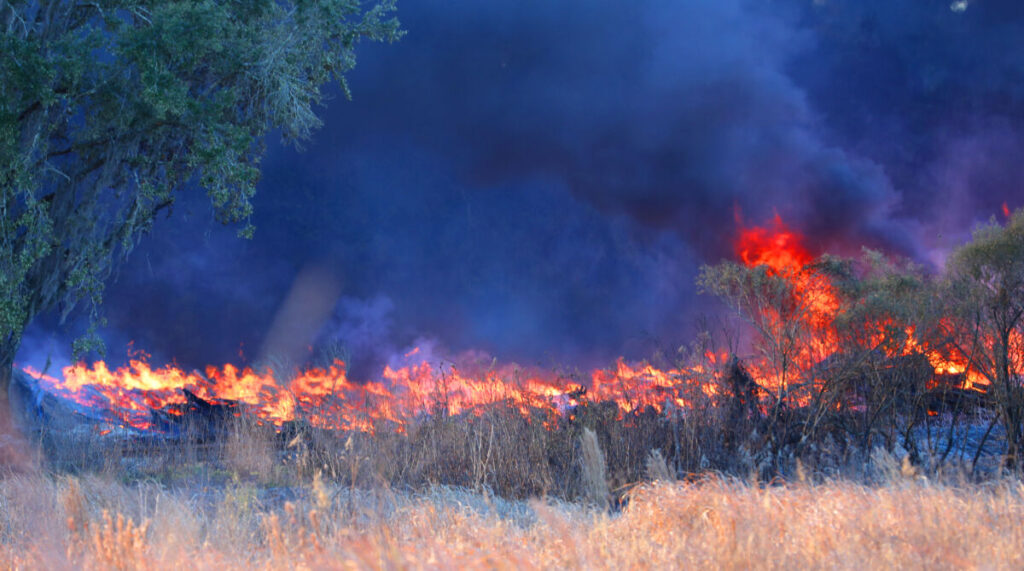
A raging inferno is shown as railroad ties burn behind the Comfort Suites in Dunnellon, Fla. on Sunday, February 1, 2026. [Bruce Ackerman/Ocala Gazette] 2026.
Editor’s note: This story was updated with additional information on Feb. 4 at 10:50 a.m.
By Jennifer Hunt Murty
In the wake of the massive fire involving thousands of creosote-treated railroad ties that started Sunday morning, residents and local officials have faced a complex web of jurisdictional questions, delayed communications and reliance on a rail operator for safety monitoring.
At the heart of the concerns are residents near the fire who face environmental impacts including diminished air quality and the harm that approximately 1 million gallons of water used to fight the fire will inflict on their drinking water and a nearby first-magnitude spring at Rainbow River.
FEMA has confirmed it’s not involved in the matter, and deferred questions to the Florida Department of Emergency Management and Marion County fire departments.
Correspondence from CSX to the city of Dunnellon obtained by the “Gazette” dated Tuesday clarifies the company’s view of its role in the aftermath of the fire. “CSX is coordinating environmental response activities with the Florida Department of Environmental Protection (FDEP),” the letter states.
“To date, air monitoring conducted by CSX’s air monitoring contractor GHD has shown no detection, and results have been shared with the Marion County Emergency Management Agency and that CSX’s environmental contractor, Arcadis, is in coordination with FDEP and evaluating next steps,” the letter adds.
Numerous visits by the “Gazette” to the site have shown the largest amount of workers once the fire was contained has consistently consisted primarily of CSX contractors.
“For questions related to environmental conditions, residents may call 1-888-479-6583. For questions regarding claims or property damage, residents should contact Track Line Rail at 312-848-1812,” the letter said.
Who is in charge?
While the blaze prompted an immediate response from local firefighters, the question of who holds ultimate responsibility for the site and the incident remains a point of contention. CSX, a major rail operator, has sought to distance itself from primary liability.
In an email dated Feb. 2 Austin Staton, the director of Media Relations for CSX, clarified the ownership structure: “Sunday’s fire involved crossties owned by Track Line Rail on a rail line leased by Florida Northern Railroad” but acknowledged that CSX personnel were deployed to the site to “offer our expertise and assist as needed.”
Although Marion County officials said the CSX Police Department is involved in investigating the cause of the fire, CSX police on scene and the corporate spokesperson deny they are taking any leadership in investigating the source of the fire. In a telephone call on Sunday with Staton, he clarified to the “Gazette” that their police department was not doing an investigation into the source of the fire.
County officials also pointed to the Florida Forest Service as being involved in the investigation, but that agency has not confirmed any role at the time of publication.
This fracturing of authority was highlighted during public comments at the Dunnellon City Council meeting on Monday, where dozens of residents expressed frustration over the lack of a unified command and with a text message from the county telling them to contact CSX with concerns.
CSX monitoring air quality
Compounding the confusion is the handling of environmental safety monitoring. After the fire was contained Sunday afternoon, residents concerned about the thick smoke were directed to a phone hotline that connected them not to county health officials but to a toxicology contractor working on behalf of CSX.
A call to this hotline on Monday revealed that air monitoring is being conducted by “third-party consultants” who compile data and present it to CSX. The rail company then shares that information with incident command and agencies.
The toxicologist on the line told the “Gazette” that “We are not … posting that anywhere” for the public to view directly, adding, “All our readings for the chemicals of concern that would be in the smoke had been below… any levels of concern.”
The “Gazette” has asked the county, city and sheriff’s office to immediately release air quality testing results either taken by the county or received from CSX’s contractor but has not received any of those public records.
During Monday’s meeting, Dunnellon Mayor Walter Green announced a shift in this protocol. He relayed a communication from Marion County Fire Chief Jamie Banta, stating that the county would begin regular “independent air quality test[ing]… starting in the morning,” or Tuesday.
Two declarations
The timeline of the government response highlights a disparity between the city and county’s actions. Dunnellon declared a state of emergency while the fire was still raging. In contrast, Marion County Commissioners waited to address the issue during their regularly scheduled board meeting on Tuesday.
Records requests submitted to the county are pending and there has been little to no information released about the amount of risk considered by the county and city and their communications with state and federal authorities.
“The railroads are controlled by the federal government and by the state. The city of Dunnellon has very little control over it,” one Dunnellon resident noted, asking, “Why isn’t the state… here and have a command center in place right now?”
There were no state or county officials at the Dunnellon meeting to explain to the residents what testing had been done and whether or not their fears were warranted.
The city of Dunnellon website does not provide any information under “Current Emergency Directives” and at the top of the page it tells residents to “link to the MCFR Facebook page for information regarding the railroad tie fire.” But the MCFR Facebook page has not provided any additional information about the fire since Feb. 1.
However, Preston Bowlin, Emergency Management director for the Marion County Sheriff’s Office, told the county commissioners on Tuesday that a representative of the Florida Department of Environmental Protection had been on scene, and he expected them to follow up and communicate their remediation plans.
Bowlin added the MCSO has notified the state watch office, which he said notifies “like 350 agencies” or “anybody who would have interest in these events, from DEP to EPA, to the governor’s office to Kevin Guthrie, our state director.”
The enforcement timeline: A history of warnings
According to a timeline presented by Green on Monday and county attorneys on Tuesday, the city and county had been attempting to address the environmental hazards posed by the railroad ties for months using code enforcement threats.
Additionally, Florida State Rep. JJ Grow told Dunnellon residents in November that he was in direct contact with CSX and expected the railroad ties would be removed in a timely manner.
Green reported approximately 16,500 ties had already been taken out of the city via rail cars, with another 1,200 moved by tractor-trailer at the end of December. However, after that initial trip no other rail cars appeared and the loader that had been on site was not seen there for several weeks. On Jan. 9, the state DEP approved Track Lines’ request to grind the ties on the site, despite residents’ objections.
The city’s efforts to coordinate enforcement and request compliance included scheduling a Jan. 13 hearing before a special magistrate. Green said no representatives of Track Line or CSX appeared. The magistrate found CSX in violation and granted the company 30 days to comply.
What’s at risk?
According to the U.S. Environmental Protection Agency (EPA):
- Creosote is a pesticide-grade wood preservative used on railroad ties and utility poles.
- It contains polycyclic aromatic hydrocarbons (PAHs)—many of which are carcinogenic.
- Creosote-treated structures near water can threaten fish and aquatic invertebrates.
- Creosote-treated wood should never be burned in residential settings.
- Businesses disposing of creosote-treated wood must comply with the Resource Conservation and Recovery Act (RCRA), including hazardous-waste determinations.
The EPA emphasizes that grinding and shredding creosote-treated wood is not standard practice outside industrial facilities designed to contain airborne toxins.
According to “2018 Railroad Tie Survey” (Journal of Transportation Technologies, 2019), “All railroads seek to manage their worn ties in ways that minimize cost and long-term liability. Often, railroads have contractors pick up all ties from a project or simply complete the whole project such that the contractor makes decisions about used tie management. The contractor seeks to maximize value, or at least minimize cost, by sorting ties by quality and potential for other uses. Better quality ties are sorted to be marketed for landscape or agricultural uses and may be sold to middlemen or retail building supply companies.
“Some railroads do not allow used ties to be used for agricultural, commercial, or residential reuse due to the long-term liability. Ties unsuitable for reuse will generally be used as fuel for energy recovery or process heat boilers.
“Processing of such ties into fuel involves metal removal and grinding. Processing may be completed by the same contractor or may involve transfer to another company that grinds and markets the fuel to end users. Processing ties can be expensive and may require a tipping fee for ties accepted. Railroads or contractors that cannot cost effectively utilize the fuel alternative generally must dispose of remaining ties in landfills, for which a tipping fee will be required.”
That survey indicated that 66% of used ties are recycled for energy through controlled combustion systems designed to handle creosote. Grinding is used primarily to create fuel chips for energy facilities—not for open-air operations in populated or environmentally sensitive areas.
The study underscores that the kind of shredding proposed by Track Line Rail generally occurs in enclosed, regulated facilities, not beside residential neighborhoods or spring-fed waters.
Cleanup status
CSX contractors have been moving debris at the site since Sunday after the fire was contained.
Green told the more than 100 city residents at the council meeting that the next code enforcement meeting for the city was scheduled for Feb. 10.
Bowlin told the county commissioners on Tuesday he expected CSX to deliver more rail cars and start loading the remaining railroad ties and to get a plan from the DEP to remediate the contaminated ground once the ties were moved.
County Attorney Matthew Minter told commissioners the county had written enough letters and he suggested they ask Dunnellon to join the county in filing a lawsuit against Track Line, LLC, which brought the ties to the parcel owned by CSX but leased to Florida Northern Railroad, which operates 104 miles of track on two separate branch lines with one CSXT interchange at Ocala and the other at Newberry.
The commission unanimously passed a motion to file a request for an injunction.

Support community journalism
The first goal of the Ocala Gazette is to deliver trustworthy local journalism so corruption, misinformation and abuse are not hidden from the public or unchallenged.