
“It’s negligence at this point”
Two Florida lawmakers aim to force counties to strengthen 911 infrastructure with bills this session
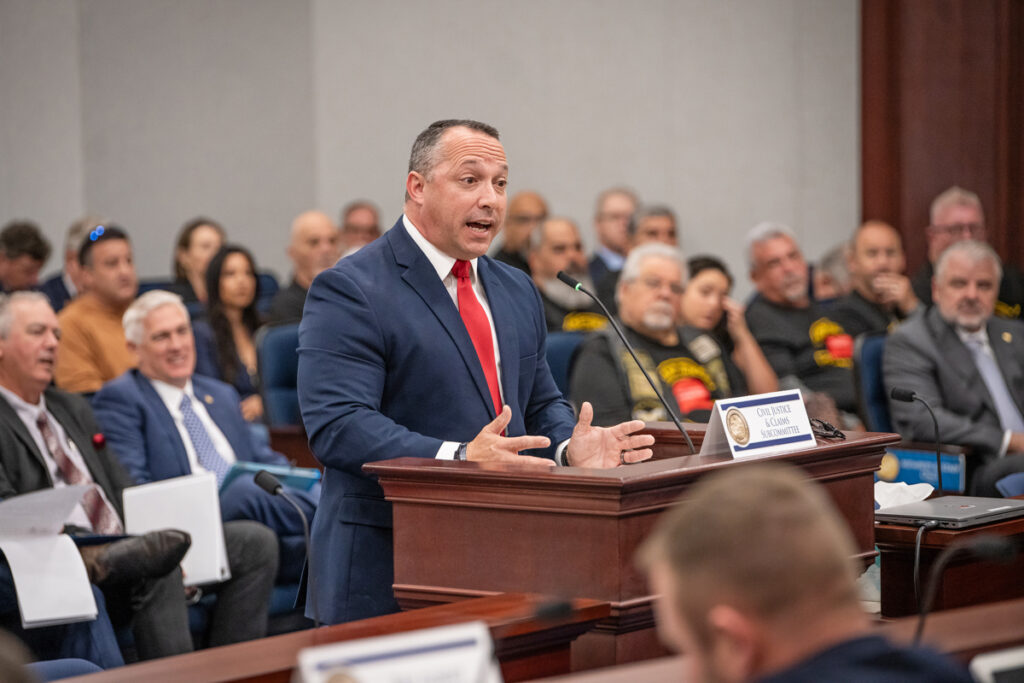
Rep. Daniel Alvarez – R, Hillsborough County, presents a bill before Civil Justice & Claims subcommittee March 27, 2025. [Meredith Geddings/Official Florida House Photo Gallery]
Two substantially identical bills filed in the Florida House and Senate propose a definitive end to the fragmented 911 system that investigators identified as a critical failure during the 2018 Parkland shooting. By mandating unified dispatch centers, the state legislators hope to override decades of local bureaucratic turf wars to prioritize speed and interoperability.
HB 1427 filed by State Rep. Daniel Alvarez, R-Hillsborough, and SB 1586, filed by State Sen. Nick DiCeglie, R-Pinellas, move beyond recommendations to strict statutory mandates. The legislation requires that by Jan. 1, 2029, every county in Florida “shall provide 911, emergency call, and dispatch services from a centralized 911 call center” operated either by the county or a regional entity.
The bills remove the ability for local disputes to stall progress. If county leadership cannot agree on a unified system by Jan. 1, 2027, the law will automatically designate the sheriff as the entity responsible for all operations. Under this “sheriff default” provision, all 911 operations “shall be integrated under the sheriff,” and state emergency funding will be redirected solely to that office.
As previously reported, the Ocala Police Department and Marion County’s two call centers work from different computer-aided dispatch (CAD) systems, and the departments’ radios are not integrated to show real-time locations for closest dispatch.
OPD Chief Michael Balken has emphatically disagreed with the need to integrate to a unified call center and work from the same CAD system.
Marion County Sheriff Billy Woods has declined to comment on the legislation or his opinion on whether counties should be forced to consolidate public safety answering call centers.
The “Gazette” has pointed out several instances over the past few years where emergency communications were impacted by the lack of a seamless CAD system for all responding agencies and a central call center.
Examples include the first 911 call during the Paddock Mall shooting in December 2023 ringing to the county’s call center instead of OPD’s center; the delayed dispatch to a fiery crash that killed two people on SE 36th Avenue in February 2024; and, more recently, the city’s inability to see a real-time location during an incident involving the threat of a gun on board a school bus.
The “Fatal Delay”
To understand the value of these bills requires revisiting the specific failures identified by the Marjory Stoneman Douglas (MSD) Public Safety Commission regarding the Feb. 14, 2018, Parkland shooting.
On that day, cellular 911 calls from the high school were routed to the Coral Springs Police Department, which did not have jurisdiction over the school. Callers had to explain their emergency to Coral Springs dispatchers, who then transferred them to the Broward County Sheriff’s Office.
The commission found this transfer process “took 69 seconds before the first law enforcement officer was notified.”
During that time, the shooter “had already shot 23 people on the first floor of Building 12.” Investigators found the call-transfer process created an information gap “adversely affecting an effective law enforcement response.”
The proposed legislation directly addresses this by mandating a unified system to ensure calls go directly to the agency capable of dispatching help.
In a “Gazette” interview, Alvarez expressed frustration that recommendations for consolidation of emergency communications following that incident were sent to the state years ago, but the vulnerability remains.
“It’s negligence at this point,” Alvarez said about local public safety agencies refusing to voluntarily follow state and federal authorities’ recommendations to centralize emergency call centers and work from the same computer aided dispatch system.
While counties like Broward have tried to bridge the divide since the Marjorie Douglas Stoneman school shooting, local politics have historically undermined the efforts.
In 2002, voters approved a charter amendment to create a countywide communications infrastructure. However, cities like Coral Springs and Plantation opted out, fearing the county’s service levels would be inferior.
The MSD Commission described the resulting regional system as suffering from “dysfunction, distrust, inefficiency, [and] poor interpersonal relationships.” Public safety leaders reported a “lack of confidence” in the system, noting that county administrators without operational expertise were making decisions that negatively impacted safety.
The bigger picture
For Alvarez, though, it’s not just about local response times; it’s about a bigger picture for Florida’s security.
The state’s “67 sheriffs and hundreds of local law enforcement jurisdictions all have differing levels of financial resources, size and abilities,” but this is our state’s fractured “front-line” defense to foreign threats and has increasingly become a vulnerable, claims Alvarez.
Even on the cyber front, the slower speed of government to respond to evolving technologies and “seemingly decentralized nature of our security apparatus makes for a very dangerous combination.”
Alvarez thinks localized public safety assets can be maintained while developing a way to connect them into a stronger first line of defense for the entire state, which he feels is exposed on multiple fronts due to its geography and state ecosystem that includes deep water ports and three of the 11 U.S. military commands.
Alvarez said foreign adversaries like China are buying land throughout the state for possible “covert surveillance or staging activities,” bringing federal and state security concerns to counties that may not have the resources to address.
Although there have been efforts to curtail Chinese entities from buying land in Florida since 2023, Alavarez pointed to Chinese firms that have secured approximately 10,000 acres of farmland in Polk County, near MacDill Air Force Base, under agricultural pretenses.
Accountability and enforcement
The new bills strip away the option to opt out. By mandating a unified center—and empowering the sheriff if the county commission fails to act—the legislation bypasses the bureaucratic gridlock that the MSD Commission identified as a threat to public safety.
Counties that do not comply with the unified mandate by 2029 face a 25% reduction in emergency funding from the state for each year of noncompliance.
A distinct component of the legislation offers financial protection for taxpayers regarding technology. Historically, integrating different computer-aided dispatch (CAD) systems has been expensive, with vendors charging high fees to allow different systems to communicate.
The bills mandate that vendors must provide the capability to interface with different CAD and radio systems “at no additional cost” and prohibits them from imposing licensing fees for integration. This removes a significant financial barrier to the interoperability that was missing at MSD.
The legislation includes high stakes for compliance. Counties that do not establish a unified 911 call center “may not receive state funds for emergency services,” with those funds being redirected to compliant entities or the sheriff’s office.
This statutory pressure aims to cure the complacency noted by Commission Chair Pinellas County Sheriff Bob Gualtieri in the commission’s initial report.
“Even after the MSDHS shooting and the implementation of new Florida law requiring certain safety measures, there remains noncompliance and a lack of urgency,” Gualtieri wrote. “We will not wait, we will be vigilant and we, like the Legislature, expect compliance and change with urgency.”
Prior reporting:
School bus gun scare highlights radio gains and continued gaps | Ocala Gazette
Questions remain about Ocala-county emergency communications improvements | Ocala Gazette
Marion County continues to get bad health grades. But who is at the helm to fix? | Ocala Gazette
Siloed agencies pose unnecessary challenges to improving public safety levels | Ocala Gazette
Can emergency personnel locate me through my cellphone? | Ocala Gazette
Providing quality observations to the community takes a lot of time and work | Ocala Gazette
The “first” of the first responders | Ocala Gazette
City of Ocala emergency dispatch continues to struggle | Ocala Gazette
Fatal crash leaves questions about City emergency communications | Ocala Gazette

Support community journalism
The first goal of the Ocala Gazette is to deliver trustworthy local journalism so corruption, misinformation and abuse are not hidden from the public or unchallenged.