
Creosote-treated railroad tie stockpile remains despite local opposition
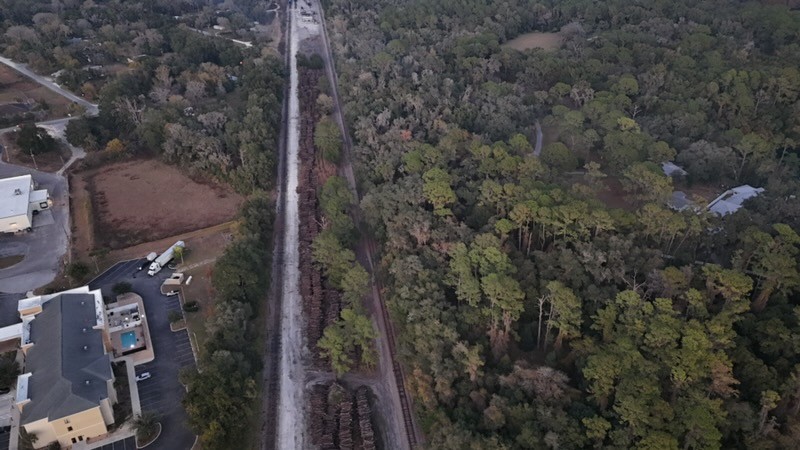
Aerial photo of a portion of the stockpile of rail ties on Nov. 17, 2025. [Photo courtesy of Bryce Hale]
Track Line Rail LLC, a Texas-based company seeking to operate a creosote-treated railroad-tie shredding and grinding facility in unincorporated Marion County, is facing escalating pressure from local government, environmental groups, and residents. Meanwhile, the Florida Department of Environmental Protection (DEP) has yet to decide on the company’s draft air-pollution permit.
The proposed industrial operation on East McKinney Avenue sits less than 1,000 feet from the Rainbow River, one of Florida’s most sensitive Outstanding Florida Waters. Mounds of creosote-treated railroad ties—stretching roughly half a mile—remain stacked along the CSX tracks and are visible from Williams Street. Nearby business employees report the piles have continued to grow and that a sharp chemical odor can be detected roughly 100 feet away.
Local environmental organizations have mounted a coordinated community campaign urging the DEP to deny the permit.
The Rainbow River Conservation (RRC) warns the project could become “an environmental disaster in the making.” According to a statement posted on the nonprofit’s website:
- The material is already “sitting unprotected on the ground,” posing risks of creosote leaching into the aquifer, soil, and surrounding community.
- If DEP approves the air permit, the shredding and grinding would release toxic chemicals and particulate matter into the air, which would then enter groundwater through rainfall.
- The project corridor runs north–south along U.S. 41, bordering residential neighborhoods in Chatmire, the city of Dunnellon and businesses along the highway.
- “The Rainbow, Dunnellon, and Chatmire communities stand united in opposition,” RRC states, noting significant mobilization among residents and volunteers.
The group emphasizes the unusual scale of the proposal and the risks posed by conducting industrial creosote processing near a spring-fed river and residential communities.
Marion County School District member Eric Cummings, who has close ties to Chatmire, where homes sit approximately 120 feet from the mounds, told the “Gazette” he was concerned that people are getting sick from the smell of the chemicals.
WUFT previously reported that Track Line Rail operated an unpermitted railroad tie grinding site in the Alachua County town of Newberry, where residents complained of toxic odors and fine dust. Regulators closed the facility, and the cleanup required removing more than 10,000 ties and contaminated mulch. The company left without paying local penalties.
It seems likely that the company moved all the rail ties to Dunnellon from Newberry.
Track Line Rail’s CEO Dave Malay declined to answer questions from the “Gazette” during a phone call. “We are all legal,” he said before ending the call.
County issued formal letter urging DEP to deny the air permit
In an Oct. 30 letter to the DEP, Marion County Commission Chair Kathy Bryant formally requested that the agency deny Track Line Rail’s air-permit application citing environmental threats, zoning violations and public-health concerns.
The letter outlines:
- Thousands of creosote-treated railroad ties improperly deposited on the property
- Violations of the Springs Protection Overlay Zone (SPOZ)
- Lack of any county-required special-use permit for industrial operations
- Risks of airborne carcinogens, groundwater contamination and wildfire hazards
Marion County Code Enforcement issued a Notice of Violation on Oct. 24 ordering the property owner and Track Line Rail to remove all used ties and cease further dumping, citing accumulation of “junk” and prohibited industrial use on agricultural land.
The code officer gave them until Nov. 11 to clear up the mess before reinspection, yet the rail ties remain and continue to be sorted to the complaint of residential neighbors.
Notes by county employees obtained by the “Gazette” indicate that a representative from either the property owner or a representative of the subcontractor running the line questioned whether the land was even subject to the county’s code enforcement.
Dunnellon issues its own violation and reiterates environmental concerns
On Oct. 28, the city of Dunnellon issued a separate Notice of Violation to CSX indicating that it was in violation of city code and state statutes. Dunnellon also ordered the ties to be removed by Nov. 14.
Dunnellon has also submitted a formal opposition letter to DEP, warning that expected emissions—including 58.77 tons of particulate matter, 67.22 tons each of nitrogen oxides and carbon monoxide, and 23.95 tons of sulfur dioxide—pose risks to nearby homes and the Rainbow River watershed.
City officials argue that spraying the piles with water, the company’s proposed dust-control measure, could instead generate contaminated runoff into the springs system.
Mayor Walter Green told the “Gazette” the city was exploring every avenue it could to put pressure on the landowner, CSX, the subcontractor they use to manage the Florida Northern Railroad, as well as Track Line Rail.
Green told the “Gazette” he was worried about the fire hazard the stockpile created. He indicated that a fire would be dangerous for residents and firefighters who would have to respond to the emergency.
EPA: Creosote contains carcinogenic PAHs and poses risks to waterways
According to the U.S. Environmental Protection Agency (EPA):
- Creosote is a pesticide-grade wood preservative used on railroad ties and utility poles.
- It contains polycyclic aromatic hydrocarbons (PAHs)—many of which are carcinogenic.
- Creosote-treated structures near water can threaten fish and aquatic invertebrates.
- Creosote-treated wood should never be burned in residential settings.
- Businesses disposing of creosote-treated wood must comply with the Resource Conservation and Recovery Act (RCRA), including hazardous-waste determinations.
EPA emphasizes that grinding and shredding creosote-treated wood is not standard practice outside industrial facilities designed to contain airborne toxins.
What are industry standards for recycling ties?
According to “2018 Railroad Tie Survey” (Journal of Transportation Technologies, 2019), “All railroads seek to manage their worn ties in ways that minimize cost and long-term liability. Often, railroads have contractors pick up all ties from a project or simply complete the whole project such that the contractor makes decisions about used tie management. The contractor seeks to maximize value, or at least minimize cost, by sorting ties by quality and potential for other uses. Better quality ties are sorted to be marketed for landscape or agricultural uses and may be sold to middlemen or retail building supply companies.
“Some railroads do not allow used ties to be used for agricultural, commercial, or residential reuse due to the long-term liability. Ties unsuitable for reuse will generally be used as fuel for energy recovery or process heat boilers.
“Processing of such ties into fuel involves metal removal and grinding. Processing may be completed by the same contractor or may involve transfer to another company that grinds and markets the fuel to end users. Processing ties can be expensive and may require a tipping fee for ties accepted. Railroads or contractors that cannot cost effectively utilize the fuel alternative generally must dispose of remaining ties in landfills, for which a tipping fee will be required.”
That survey indicated that 66% of used ties are recycled for energy through controlled combustion systems designed to handle creosote.
Grinding ties is used primarily to create fuel chips for energy facilities—not for open-air operations in populated or environmentally sensitive areas.
The study underscores that the kind of shredding proposed by Track Line Rail generally occurs in enclosed, regulated facilities, not beside residential neighborhoods or spring-fed waters.
Environmental groups say they are prepared to call for an administrative hearing if DEP moves forward with approval.
County Commissioner Kathy Bryant said the county was currently “going through the motions and waiting on timelines imposed,” but hoped to give another update soon.

Support community journalism
The first goal of the Ocala Gazette is to deliver trustworthy local journalism so corruption, misinformation and abuse are not hidden from the public or unchallenged.