
CSX promises to move dumped rail ties in Dunnellon
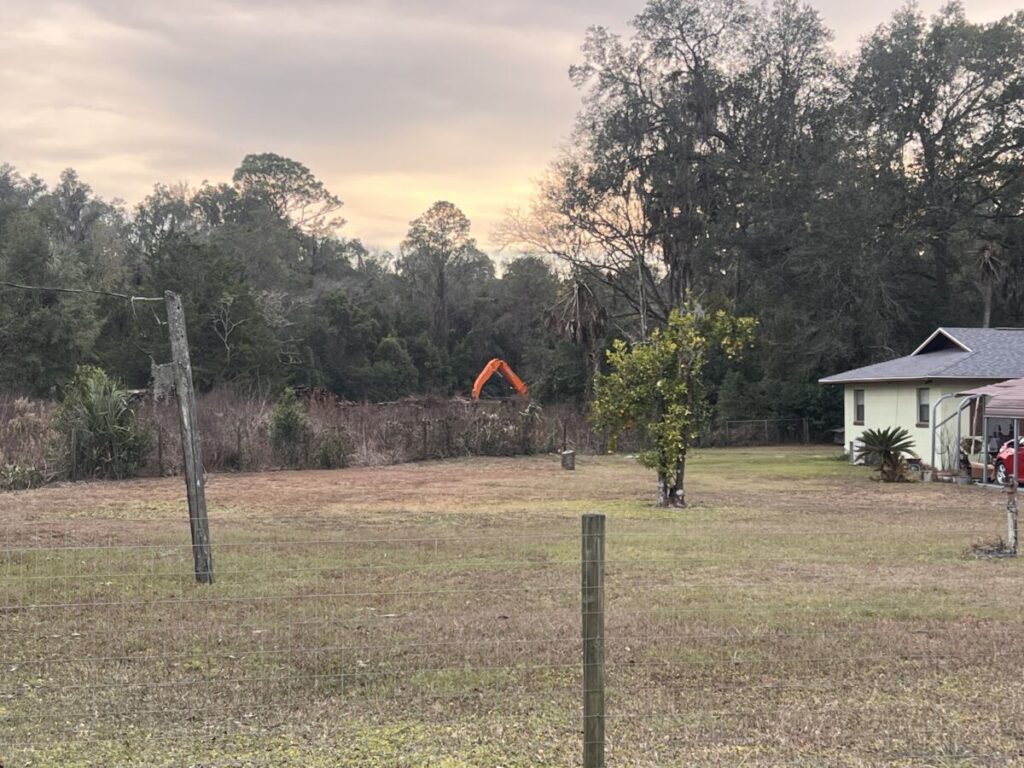
Residential dwelling in Chatmire with crane and dumped rail ties on Dec. 4, 2025. [Jennifer Hunt Murty/Ocala Gazette]
Hours before a packed community meeting in Dunnellon Thursday, railroad giant CSX told local officials it will remove thousands of creosote-soaked railroad ties stored near homes and the Rainbow River — a reversal that came only after Marion County commissioners and the city prepared to go to court against the company, the property owner and Track Line Rail LLC, a Texas-based company disposal firm.
At the meeting, state Rep. J.J. Grow told residents the company “made the decision to remove all the railroad ties from Dunnellon” after weeks of pressure from citizens, the city, Marion County and state lawmakers.
“I think we all appreciate the fact that the railroads built this country, but we need them to be responsible citizens of the country as well,” Grow said, recounting how his office was first alerted Oct. 23 by a Dunnellon resident who saw the ties being offloaded along CSX tracks.
Grow said CSX blamed the situation on Track Line Rail, which had applied to the Florida Department of Environmental Protection (DEP) for an air permit to grind old ties in Dunnellon and sell the material as fuel to a cement plant.
The DEP didn’t stop the permit, but locals raised opposition.
“It was really a bad decision by a big company,” Grow said, adding that a CSX employee who handled the arrangement “no longer works at CSX because of that.”
Threat of legal action
Grow told the crowd that Marion County and Dunnellon jointly sought an injunction to stop the operation and were prepared to sue CSX, the property owner and Track Line if the company did not act. As of Thursday afternoon, he said, the county agreed to hold that injunction “for one week, which means they need to be in here within a week getting stuff done.”
CSX is now developing a plan to move the ties “as quickly as possible,” Grow said, though he cautioned it would take time given the number of rail cars needed. He promised to stay in daily contact with the company and DEP.
Despite criticism from residents about lack of support from DEP opposing the permit, Grow defended CSX’s response once the controversy became public.
“There’s no way in the world these people call me today and lie to a state representative,” Grow said. “They truly are a good company, dealing here in Florida and all over the country … but they’re only doing this because we spoke up and because we made them aware.”
Mayor: ‘I am one happy boy’
Dunnellon Mayor Walter Green, who worked for CSX early in his career, told residents the company’s commitment to remove the ties came to him in a phone call as he was leaving work.
“Gentlemen, I am one happy boy,” Green said. “I know you can imagine how many hours and anguish have been devoted to this.”
Green said he had written a letter to CSX President and CEO Stephen F. Angel appealing to the company’s stated commitments to safety and environment Angel wrote back on Nov. 18, thanking Green for his 17-year railroad career and promising that CSX leadership would “closely monitor this situation” and “ensure that everyone involved cooperates fully with state and local guidelines.”
“We take our responsibilities of environmental stewardship and being a good community citizen seriously,” Angel wrote, while also stressing that “the disposal and repurposing of crossties is a necessary operation.” He assigned Craig Camuso, CSX’s senior director of state relations, as Green’s direct contact on the project.
Green told residents Angel “referred to their commitments to environmentand safety and our community well-being. And he followed through with that.”
The mayor pledged the city and county “are not going to rest until it’s all put back in the natural state as it was before this.”
Fire chief: safest fire is the one prevented
A separate letter to Green from Marion County Fire Rescue Chief James Banta laid out why local officials pushed so hard to get the ties off the site.
Banta warned that a fire involving creosote-treated ties “is not a standard wood fire,” writing that creosote behaves “more like a petrochemical, burning extremely hot, producing heavy black smoke and generating contaminated runoff capable of polluting soil and waterways,” including the Rainbow River watershed.
Banta wrote firefighters would face a “series of challenging tactical decisions” if the ties ignited: whether to aggressively extinguish the blaze using large volumes of water and foam — creating contaminated runoff — or allow it to burn under control, which would mean “prolonged toxic smoke” over nearby homes and businesses. “Neither option is favorable, and both carry significant environmental and public-safety consequences,” he wrote.
The letter noted the nearby dwellings to the stacked rail ties which would further exacerbate the hazard.
“From strictly a fire service perspective, the safest and least damaging fire is the one prevented,” Banta concluded, calling the continued storage of the creosote-treated ties an “unnecessary risk” to property, the environment and firefighter health.
DEP blasted for ‘rubber-stamping’ permit
While many speakers applauded the removal plan, some warned that the episode exposed deeper regulatory problems. Burt Eno, an engineering professor, criticized DEP for initially approving Track Line’s permit request.
He said the agency is sometimes called the “Department of Environmental Pollution” and argued that in this case, DEP “essentially rubber stamped a request to have an air permit to be allowed to do this” without adequately examining potential water and aquifer contamination.
“They don’t apply science as they should,” Eno said, faulting DEP for favoring industry “against science, against the environment and for developers.”
Neighbors describe health concerns, fear
Residents living near the stacked ties say the decision to move them comes after weeks of them having to breathe chemical fumes and worry about a fire.
Deborah Coy, who lives on the same street as the railroad ties in the Chatmire community, told the “Gazette” she has experienced asthma-like symptoms since the ties arrived. She said she believes the odor and smoke-like haze from the site have worsened her breathing.
Another resident, Jerry Taylor, said he drove to the yard with his two dogs to see the site for himself. When he opened the truck door, he said, the animals refused to get out — which he took as a warning.
“They know when something isn’t right,” Taylor said, adding that he believed the dogs recognized the smell as dangerous.
Husband and wife Latanga and Clyde Briggs said neighbors organized quickly, going door to door with flyers and using social media to make sure people understood what was being stored near their homes and the river. They credited environmental advocates for helping them keep up the pressure.
“The community came together,” Latanga Briggs said. “But we really appreciated Bill White keeping residents informed about what was at stake.”
White, vice president of the Rainbow River Conservation, a Dunnellon nonprofit with a stated mission in part to “protect and preserve the water quality, the natural beauty, the riverbed, and the flood plains of the Rainbow River,” was among the organizers who helped connect residents with state and local officials and rallied environmental groups to oppose the project for the environmental threat it posed to the river.
‘We’re not done yet’: Concerns persist about where the ties will go next
Even with CSX’s promise to remove the creosote-soaked ties from the Dunnellon site, residents pressed officials about the next step: Where will the material be taken, and will another community face the same threat?
Several residents said they were alarmed after learning Track Line has a contract in Alabama, raising fears the ties might simply be shifted from one vulnerable community to another. Dunnellon officials said they had not been told where the rail ties would go.
Those concerns were amplified by Track Line’s recent history. As reported by WUFT, the same company was forced out of Newberry in Alachua County earlier this year after it began grinding old railroad ties without a permit, drawing complaints of fumes, dust, and environmental harm. It is likely that those Newberry ties were moved to the Dunnellon.
By contrast, in Dunnellon the grinding operation never began — a distinction residents credit to the speed of community organizing and rapid involvement by the city, Marion County, and state lawmakers once the story became public.
Still, residents urged local leaders to demand transparency about the destination of the ties, calling it unacceptable for one rural community to be spared only for another to inherit a hazardous, industrial-scale waste operation.
Green said he will push CSX for post-removal soil and groundwater testing at the Dunnellon site and emphasized that full remediation remains nonnegotiable.
“The first determination … is the removal of the ties, and it’s going to take place,” Green said. “But I can assure you, the city of Dunnellon and Marion County is not going to rest until it’s all put back in the natural state as it was before this.”

Support community journalism
The first goal of the Ocala Gazette is to deliver trustworthy local journalism so corruption, misinformation and abuse are not hidden from the public or unchallenged.