
The Rains Battle: An ambush, wounded soldiers, a moment that changed history
On March 28, “Fort King’s most desperate hour” will come to life at the national historic landmark in Ocala.
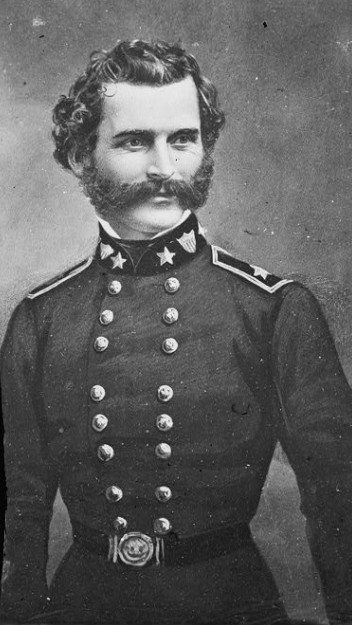
Capt. Gabriel James Rains, who invented land a sea mines, was chief of the Confederate Torpedo Bureau during the Civil War. A “Rains Battle” reenactment will take place at the Fort King Historic Landmark in Ocala on March 28. [Photo courtesy Library of Congress]
Fort King has a long history in Ocala and Marion County, and the Fort King National Historic Landmark remains a vibrant site for ongoing programs, historic reenactments, festivals and more.
The national landmark, which includes a reconstructed fort, walking trail, welcome center and archaeology resource center, is owned jointly by the city of Ocala and Marion County, and is supported by the Fort King Heritage Foundation, Inc.
The city of Ocala website notes that Fort King played a pivotal role in the Second Seminole War, the longest and most expensive conflict between the United States and Native American tribes.
“It tells the powerful story of a young nation expanding into Florida and the Seminole people’s fight for survival. This historic site offers a deep look into the complex history of U.S. expansion, Native American resistance and the shaping of the state of Florida,” the site states.
On March 28, history will come to life during the reenactment of the “Rains Battle: Fort King’s Most Desperate Hour.”
According to Scott Mitchell, coordinator of the Silver River Museum & Environmental Education Center, which is a program of Marion County Public Schools, the infamous “Rains Battle” took place on April 28, 1840.
“Capt. Gabriel James Rains went on a mission to the Ocklawaha River with 16 other soldiers. As they were returning, they were ambushed by a Seminole war party. It was a desperate fight just trying to make it back to the fort. Reports indicated that three soldiers died of their wounds and just about all were wounded in some fashion. Rains was wounded so badly his hometown newspaper in New Bern, North Carolina, published his obituary. Rains did not die. He recovered,” Mitchell noted.
“Frustrated at trying to combat an opponent that could appear, wreak havoc and then vanish into the forest, Rains had set an explosive device by a nearby spring rigged to a soldier’s jacket. It was one of the first IEDs (improvised explosive devices) in history. The Seminole discovered the bomb and detonated it, then waited in ambush for the soldiers to respond,” Mitchell continued.
“Rains would survive his time as post commander at Fort King and go on to develop what at the time were called torpedoes (known today as mines). He developed both land and sea mines and is largely credited with inventing them. The first land mines deployed in combat were in 1862, during the Peninsular Campaign of the American Civil War. Sea mines placed in Mobile Bay during the Civil War were made by Rains. When Admiral Farragut famously said, ‘Damn the torpedoes,’ he was referring to Rains’s mines. All this from a tiny action in a back woods section of Florida Territory at Fort King,” Mitchell further explained.
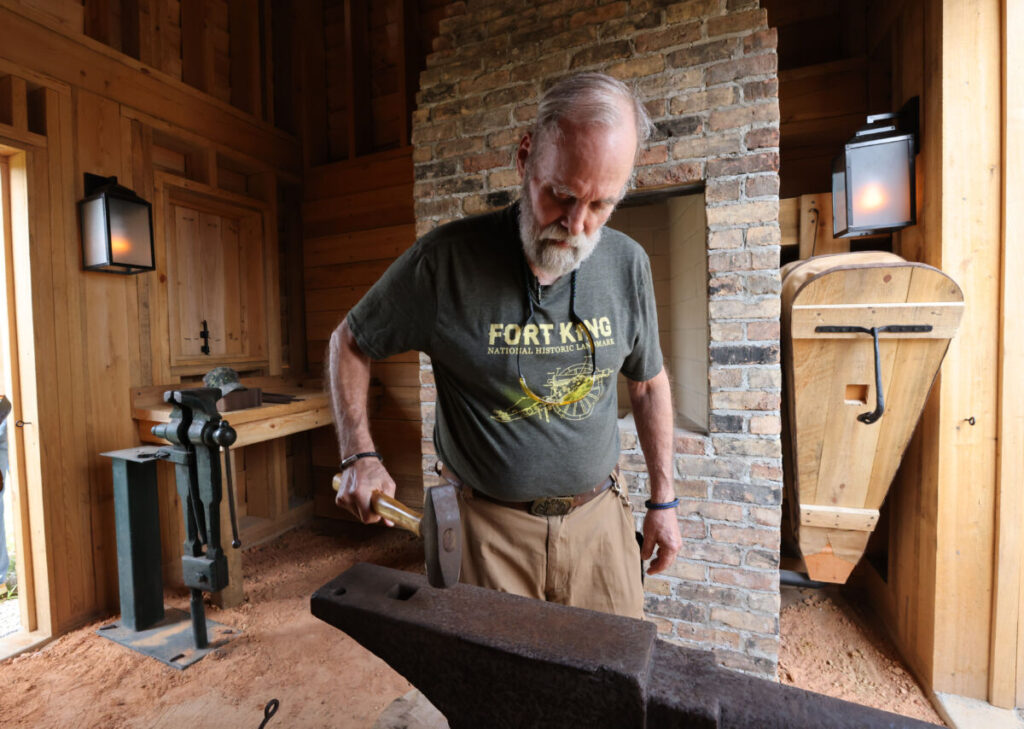
The Rains Battle event on March 28 will be the first presentation of the historic event at the landmark. It will begin with a blacksmith expo from 4 to 6 p.m., historical presentations from 6 to 7 p.m. and the reenactment beginning at 7 p.m. The reenactment is expected to last approximately 45 mins.
To learn more, the “Gazette” did a Q&A with city and Fort King staffers.
How did you learn about this battle?
We learned about this battle from Chris Kimball, who is an expert both on Seminole War and Fort King History. He produced a four-part video series about Fort King, during which he discusses this specific battle.
Why should people need/want to know the history of Fort King?
People should learn the history of Fort King for two main reasons. First, Fort King served as the foundation for what would become the city of Ocala. When it was built in 1827, neither Ocala nor Marion County existed. The fort provided protection to the American settlers moving into the area during the conflicts with the Seminole people. Even after it was decommissioned, the site continued to influence the community. Much of the wood from the fort was used to help build early downtown Ocala.
Second, Fort King played a significant role as a frontier outpost in territorial Florida. The Seminole and Miccosukee people were among the last tribes east of the Mississippi River to resist forced relocation. North Central Florida became a focal point of both interaction and conflict between these tribes, and the government and Fort King stood at that center.
Who will be involved in the battle, and in what roles?
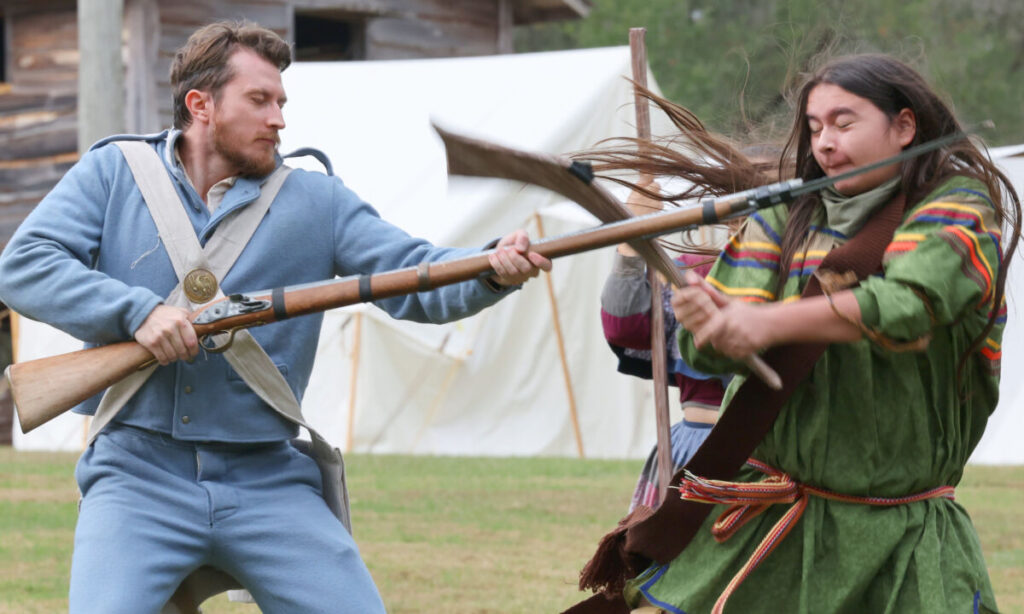
We will have two main groups of reenactors at the event. By 1840, most of the fighting in the Second Seminole War had shifted far to the south, leaving only small groups of soldiers and Seminoles active in the northern part of the territory. The first group will portray the fort’s small U.S. Army garrison, which remained at the post even as the war moved away from the area. The second group will represent a small, mobile band of Seminole warriors. A firsthand account of the battle even notes that Seminole women were part of this war party.
Tell us about the costuming, weapons, etc.
Soldiers in the reenactment will wear the light blue wool uniforms commonly used during this period. Although some troops later received white linen uniforms, those were issued far less often. The soldiers will carry historically accurate smoothbore flintlock muskets and bayonets.
Seminole reenactors will be dressed in bright, colorful clothing known as regalia, traditionally worn for formal or ceremonial occasions. Seminoles used a mix of rifled hunting muskets purchased from the Spanish or French but were sometimes armed with British smoothbore muskets.
Where will spectators be situated?
During the battle, spectators will be positioned facing east, about halfway across the open ground of the field in front of the fort. The battle will start in the east woods, where the spectators will hear it commence. The battle will draw closer and closer to the fort and end in front of the spectators.
Can people take photos and make videos?
Yes, for personal use, but outside commercial production is not permitted.
Are pets allowed on the grounds?
While our site is dog friendly to explore the trails and walk seven days a week, we do not recommend dogs attend our reenactment events due to loud cannons and gun fire.
Should attendees bring chairs/blankets, bug spray?
There will be bleachers available on first-come, first-served seating. It is recommended that attendees be seated by 6 p.m. and, if needed, there will be overflow seating on the grass behind the safety line. Attendees are welcome to bring a chair or blanket if they would like. We do suggest visitors bring bug spray.
Is there a fee to attend, or for parking?
The program and parking are free to attend.
What about parking?
Parking will be onsite at the fort, and the overflow will be at the Klien lot. We will have directional signs leading to the overflow parking.
Will there be any concessions?
We will have the Grill n’ Chill Food Truck on site with their loaded fries and specialty drinks.
Will there be any music, entertainment, etc.?
Prior to the main event, our museum and gift shop will have extended hours as well as blacksmith demonstrations between 4 and 6 p.m. The blacksmiths will have hand-forged items available for purchase. We will also have a Vandall Samuels, a Seminole flute player, playing throughout the evening prior to the reenactment.
The Fort King National Historic Landmark is located at 3925 E. Fort King St., Ocala.
To learn more, go to fortkingocala.com and ftking.org

Support community journalism
The first goal of the Ocala Gazette is to deliver trustworthy local journalism so corruption, misinformation and abuse are not hidden from the public or unchallenged.