
The legacy of Ocala Stud
The oldest active Florida thoroughbred operation turns 70.
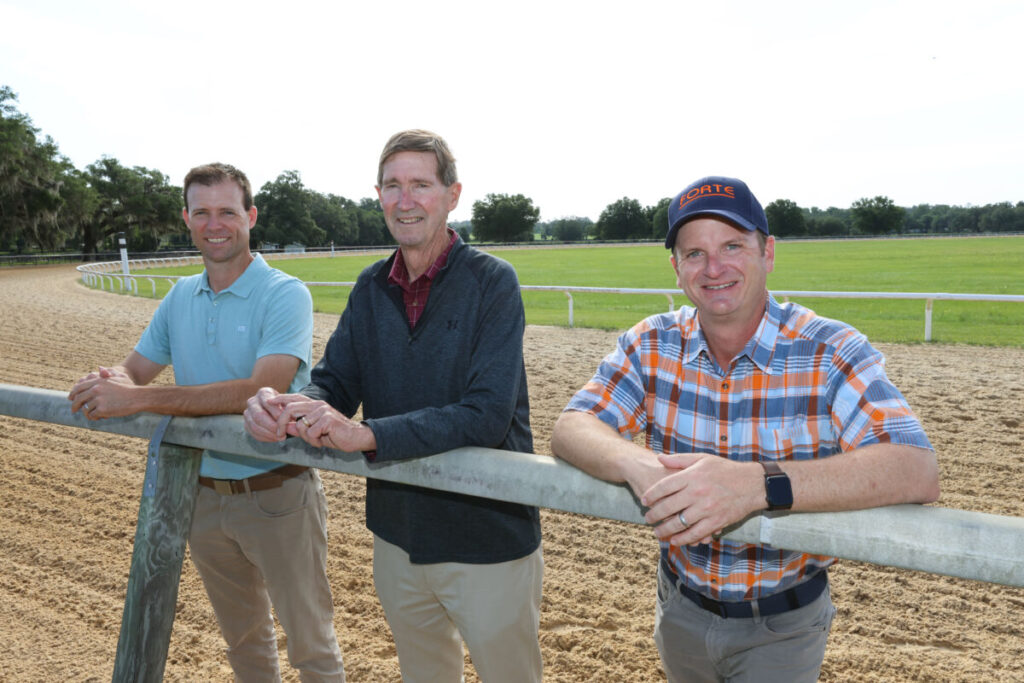
Ocala Stud is celebrating 70 years as a leader in the thoroughbred industry. David, Michael and Joe O’Farrell, left to right, are shown on the track at the farm in Ocala. [Bruce Ackerman/Ocala Gazette file photo]
Call it a milestone purchase in Florida thoroughbred industry history.
On Jan. 16, 1956, Maryland horseman Joe O’Farrell and his brother, Tom, were part of a nine-person syndicate headed by Bruce Campbell that paid $700,000 for 800 acres of what had been Ocala-based Dickey Stables. Included in the deal were the farm’s 16 broodmares, two of which were Noodle Soup and Iltis. Those two broodmares would play key roles in the newly christened Ocala Stud’s quick start to historic success.
A photo of Joe O’Farrell is shown at the home of his son, Mike O’Farrell. [Bruce Ackerman/Ocala Gazette file photo]
Joe O’Farrell, in his role as the Ocala Stud’s managing partner, wasted little time in taking advantage of Ocala’s newly found fame. With Needles’ dam Noodle Soup as a centerpiece, he quickly built up a broodmare band and filled the training barns with young horses. The stallion barn was soon anchored by Rough’n Tumble, who had stood at the O’Farrells’ Maryland farm. By Free For All out of Roused, by Bull Dog, Rough’n Tumble would go on to become one of the foundation stallions of the Florida thoroughbred industry. With 14 crops of racing age, Rough’n Tumble had lifetime progeny earnings of $6.2 million, siring 24 stakes winners and 20 stakes-placed runners. Among his stakes winners were Florida-bred national champions My Dear Girl and Dr. Fager.
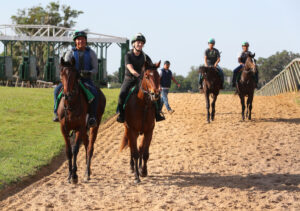
Thoroughbreds and their exercise riders come back on the track from their workouts at Ocala Stud Farm. [Bruce Ackerman/Ocala Gazette file photo]
The majority of the horses in that initial Ocala Stud consignment had been Maryland-breds brought to Florida from the previous O’Farrell farm. But in1958, the first juvenile crop of horses foaled and raised at Ocala Stud were sold at public auction. That crop went on to record a national best mark of 12 winners which won 27 races. Part of that Ocala Stud consignment included Wedlock, by Rough’n Tumble, who sold for $4.500. Wedlock became the first registered Florida-bred filly to win a classic race when she won the 1959 Kentucky Oaks. Just that quickly, Ocala Stud’s reputation as a leading juvenile consignor was established. O’Farrell would go on to become one of the founding members of the Florida Breeders’ Sales Company (1958) and later the Ocala Breeders’ Sales Company (1974). And Florida was on its way to becoming the country’s prime 2-year-olds in training market.
Remember Iltis, one of the broodmares that had been part of the original land purchase? When bred to Rough’n Tumble, she produced Florida-bred My Dear Girl, the 1959 champion 2-year-old filly and the first national champion bred by Ocala Stud. By 1960, Ocala Stud had bred or sold winners of more than $1 million. Already considered the leading commercial breeder in the country by that time, Ocala Stud finished 10th that year on the list of leading breeders in North America. Adding to the farm’s accomplishments, Ocala Stud bred and sold Roman Brother, who in 1965 became the first Florida-bred to be named North American Horse of the Year.
SOLID FOUNDATION
That phenomenal early success laid the foundation for Ocala Stud becoming not only the oldest active thoroughbred operation in the state, but also one of its perennial leaders for seven decades. In fact, Ocala Stud has been represented by at least one Florida-bred stakes winner every year since 1959. Additionally, Ocala Stud has been named the Florida Breeder of the Year five times. At this writing, that honor includes three consecutive years, 2010-2012, 2014 and 2018. In 2012, Ocala Stud was named the TOBA National Breeder of the Year.
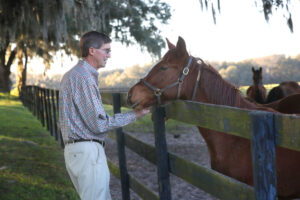
Mike O’Farrell spends some time with a yearling in a paddock at the Ocala Stud Farm Annex on Northwest 95th Street north of Ocala. [Bruce Ackerman/Ocala Gazette file photo]
Ocala Stud also has connections to three Kentucky Derby winners. That trio includes Florida-breds Carry Back (1961 Kentucky Derby) and Unbridled (1990 Kentucky Derby), as well as Kentucky-bred Street Sense (2007 Kentucky Derby). Carry Back, bred, owned and trained by Jack Price, was foaled, raised, broken and trained at Ocala Stud. Unbridled, bred by Tartan Farms and owned by Mrs. Frances Genter, and Street Sense, bred/owned by James Tafel, were broken and trained at Ocala Stud.
Rough’n Tumble, who was the dominant Florida sire from 1959-1968, has been followed by a long list of leading sires to stand at Ocala Stud. Included on that roster are Distinctive, Explodent, Sovereign Dancer, On to Glory, Mighty Appealing, Pentelicus, Saint Ballado, Notebook, Montbrook, Concerto, Trippi, High Cotton, Kantharos, Adios Charlie, Win Win Win and Khozan.
FALLING AND RISING AGAIN
Joseph Michael O’Farrell Jr. was 8 years old when his father Joe moved the family from Maryland to Ocala. At 22, and just a semester away from an agriculture business degree from the University of Florida, the younger O’Farrell was thrust into a leadership role. Following his father’s heart attack in 1971, Ocala Stud’s syndicate partnership was dissolved, and the farm was foreclosed on by the bank that held the mortgage. All the horses were sold. Mike O’Farrell took over the farm’s financial reorganization, working alongside his father to rebuild Ocala Stud. The main 185-acres of the farm, which included the office, training barn, racetrack and stud barn, were bought back. A longtime client sold the O’Farrells a package of 10 broodmares, seven yearlings and sent a stallion to stand at the farm. The Ocala Stud revival was well underway.
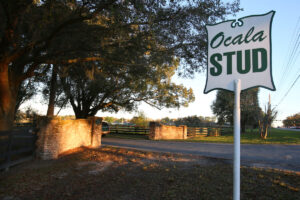
The iconic Ocala Stud sign is a popular spot for photo ops. [Bruce Ackerman/Ocala Gazette file photo]
Over the decades, the landscape around Ocala Stud has changed. Ocala Stud, Glen Hill Farm and Red Oak Farm are the only three remaining major thoroughbred operations in the Shady Road area that was once the epicenter of the industry in Ocala. A mall, a community college, medical offices, restaurants, shopping strips, car dealerships, a high school, apartments and housing developments have overtaken the land where there were once thoroughbred farms.
It was that inevitable development encroachment that brought a new chapter to Ocala Stud’s history. In 2011, the O’Farrell family sold the 185-acre original main site of the farm on Shady Road (SW 27th Avenue) for $9 million to developer and thoroughbred horseman John Brunetti. The latter, who died in 2018, founded Red Oak Farm. At this writing, Ocala Stud continues to operate on the property under a lease agreement with the Brunetti family. Mike O’Farrell shares ownership of the farm with sisters Susan Greiner and Anna O’Farrell; brother-in-law James Lewis and nieces Claire and Meghan Lewis, the husband and daughters of O’Farrell’s late sister Margaret.
Mike and Judy O’Farrell’s sons Joseph Michael O’Farrell III and John David O’Farrell are the third generation of O’Farrells to be involved in the day-to-day running of Ocala Stud. Joe is the operation’s financial manager and David is the farm manager. Mike is president and general manager.
For nearly seven decades, Ocala Stud’s forest green and white barns have stood as sentinels on Shady Road/SW 27th Avenue, one of Ocala’s most scenic roads. And, over the years, the metal Ocala Stud sign at the entrance of the farm has become a local iconic road marker and popular photo op for visitors. And beyond that sign resides the Florida thoroughbred industry legacy of Ocala Stud.
Editor’s Note: Reprinted with permission from the book “Winner’s Circle: The Legacy of the Florida Thoroughbred Industry” by JoAnn Guidry.
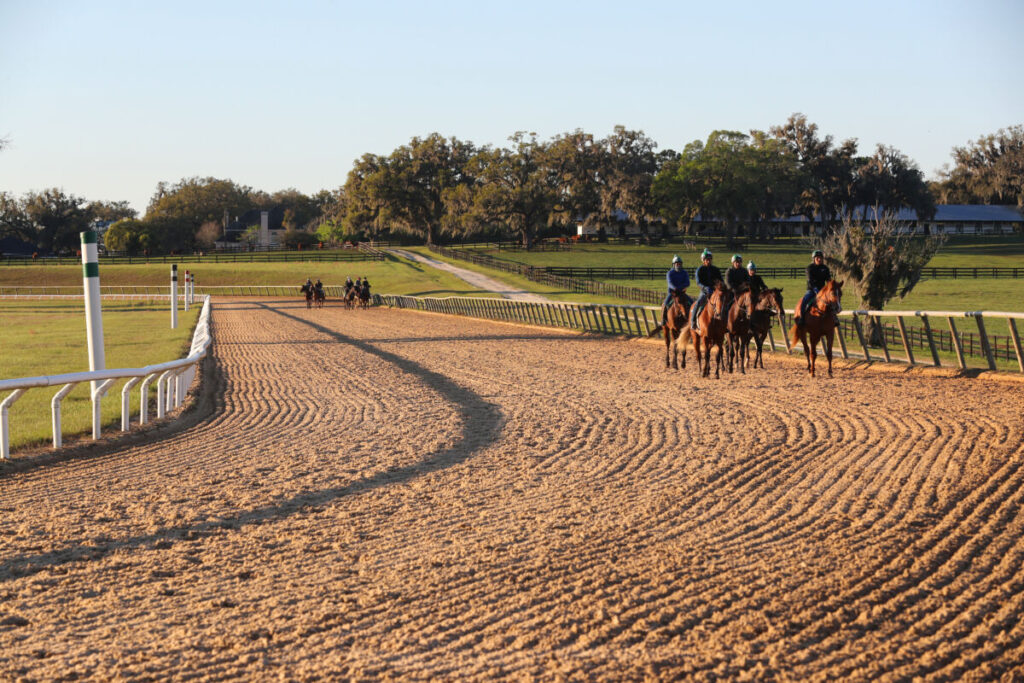
Thoroughbreds with their exercise riders walk back to the barn after workouts at the Ocala Stud Farm on Southwest 27th Avenue in Ocala. [Bruce Ackerman/Ocala Gazette file photo]

Support community journalism
The first goal of the Ocala Gazette is to deliver trustworthy local journalism so corruption, misinformation and abuse are not hidden from the public or unchallenged.