
STATE NEWS BRIEFS: Weekly roundup
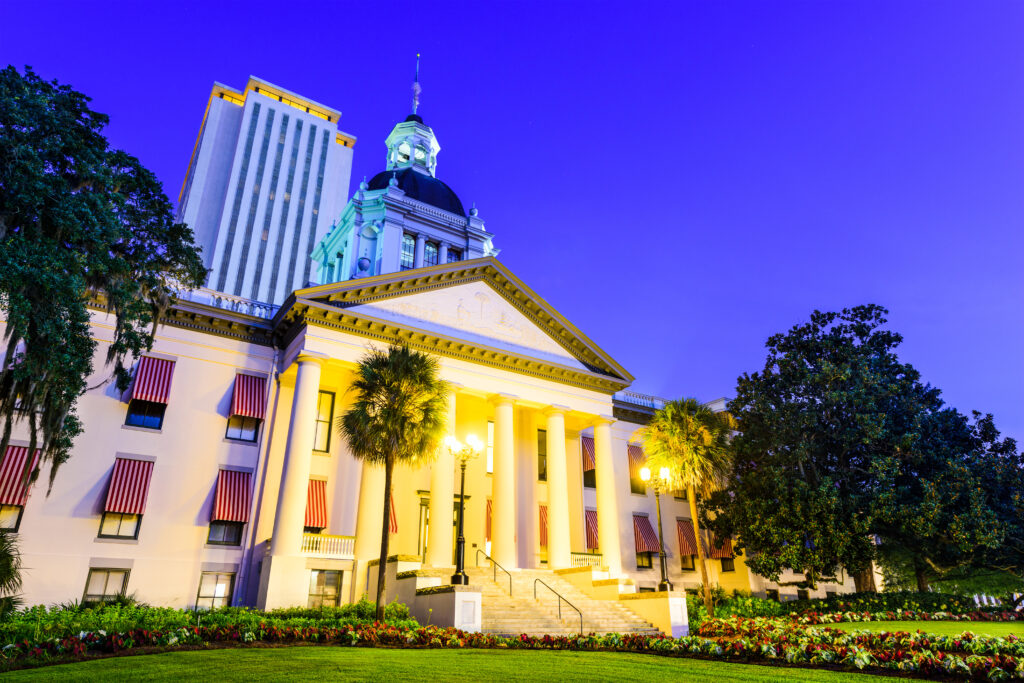
Florida Capitol building with capital complex tower behind in Tallahassee [Stock image]
Bill seeks to clarify open carry ruling
Amid confusion over the impact of an appeals court decision that overturned the state’s ban on openly carrying firearms, a House Democratic leader filed a Sept. 30 measure seeking to ensure that certain places—such as legislative meetings, jails and police stations —remain gun-free zones.
Rep. Christine Hunchofsky, D-Parkland, said her bill (HB 63) is intended to close a “perceived loophole” created by the 1st District Court of Appeal’s ruling in a case known as McDaniels v. State of Florida.
A three-judge panel of the Tallahassee-based court found that the state’s open carry ban was incompatible with the nation’s “historical tradition of firearm regulation.” The Sept. 10 ruling overturned a 1987 law that made it a misdemeanor to visibly display guns.
Part of the fallout from the ruling involves a longstanding law allowing concealed-weapons licenses. That law included prohibitions on carrying handguns into certain places but does not address long guns, such as rifles.
In an interview with The News Service of Florida, Hunchofsky said she filed the bill for the 2026 legislative session to clear up uncertainty about the ruling.
“Right now, everybody’s scrambling. We have differing opinions and we just want to bring some clarity to this, and especially given the time we’re in, we need to have this clarity,” said Hunchofsky, who is slated to take over as House minority leader after the 2026 elections.
Without a legislative fix, the ruling might allow people to openly carry rifles, shotguns and other long guns into places that are off-limits to handguns, including courthouses, legislative meetings, school board meetings, jails, police stations and bars.
Hunchofsky said lawmakers never intended to allow guns to be brought into such spaces.
House Speaker Daniel Perez, R-Miami, and Senate President Ben Albritton, R-Wauchula, have not indicated whether they intend to address the issue during the session that begins Jan. 13.
The interpretation of the ruling’s impact has sparked debate among law enforcement officials, gun rights advocates and local government officials.
Florida Supreme Court Chief Justice Carlos Muñiz issued a memo last week in response to “questions within the judicial branch” about the ruling’s effect on courthouse security. The appellate court’s “Second Amendment analysis does not address the regulation of firearms” in Florida courthouses, the Sept. 25 memo to chief judges throughout the state said. “Our (Supreme) Court believes that chief judges continue to have the authority to prohibit weapons (including firearms) in courthouses and courtrooms,” Muñiz wrote.
Immigration enforcement money backed
Gov. Ron DeSantis and the state Cabinet on Sept. 30 signed off on nearly $14.1 million in grants to law enforcement agencies throughout Florida as part of a crackdown on illegal immigration.
Money for the immigration enforcement grant program came from $250 million set aside by the Republican-controlled Legislature during a February special session.
Lawmakers also during the special session established the State Board of Immigration, which is made up of DeSantis and the Cabinet members—Attorney General James Uthmeier, Agriculture Commissioner Wilton Simpson and Chief Financial Officer Blaise Ingoglia.
Grants can be used for training, overtime, bonuses, equipment and other items related to immigration enforcement.
The 56 grants approved Tuesday ranged from a $10,882.50 request from Gulf County to $1.07 million sought by the Seminole County Sheriff’s Office and were the first batch approved since lawmakers created the program. Items approved in the grants include bulletproof vests, AI-assisted translation software and license plate readers.
The Board of Immigration Enforcement on Tuesday also tweaked a rule that established guidelines for the grants, changing it to allow 18 sheriffs to seek money for vans used to transport people who are in the country illegally. Thirteen county sheriffs and Jacksonville were granted money to purchase vans. In addition, sheriffs received roughly $2.7 million to cover transportation-related costs.
The approval of the grants coincided with an escalation in immigration enforcement over the past few weeks, as more state and local law enforcement officers get certified to participate in deportation efforts alongside the Trump administration.
Sheriffs and other law enforcement agencies are working with federal immigration officials to coordinate arrests, detention and transportation of people to U.S. Immigration and Customs Enforcement facilities, where they can be held and processed for deportation.
Under a plan rolled out over the past few weeks, the state is divided into 18 regions and certain sheriffs within each zone are designated with the responsibility of transporting immigrants from county jails to ICE detention centers in Florida. The Trump administration recently awarded $28.6 million to state law enforcement agencies and more than $10 million to local law enforcement agencies for participating in what are known as 287(g) agreements.
Trump foundation confirms Miami library
Hours after Gov. Ron DeSantis and the Florida Cabinet approved turning over property at Miami Dade College for the project, the Donald J. Trump Presidential Library Foundation formally announced on Sept. 30 that the Trump library will be in Miami.
“Once completed, the Donald J. Trump Presidential Library will be visible for miles into the Atlantic, a bold landmark on Miami’s skyline and a lasting tribute to the achievements my father continues to deliver for this nation,” Eric Trump, president of the Donald J. Trump Presidential Library Foundation, said in a prepared statement.
On Tuesday morning, DeSantis and the Cabine —Attorney General James Uthmeier, Agriculture Commissioner Wilton Simpson and state Chief Financial Officer Blaise Ingoglia—approved providing a 2.63-acre parcel on the college’s Wolfson Campus for the library. The site is close to the century-old Freedom Tower, which is on the list of U.S. National Historic Landmarks as it was a center for Cuban refugees.
DeSantis signed legislation in June that prevents local governments from placing restrictions on presidential libraries and gives the state authority to regulate establishing and operating such facilities.
Insurer urges justices to take up fee fight
A property insurer on Sept. 29 argued that the Florida Supreme Court should take up a battle about whether the company is required to pay a homeowner’s attorney fees because an appeals court decision conflicted with other court rulings.
Attorneys for Security First Insurance Co. filed a brief urging the Supreme Court to review a 5th District Court of Appeal decision last month in favor of homeowner Denise Blumberg. The dispute centers on a major law passed in December 2022 that shielded insurers from having to pay policyholders’ attorney fees after claims disputes.
Blumberg argued that Security First should be required to pay her attorney fees because her home was damaged before the 2022 law took effect. While Blumberg did not file a claim until January 2023—and a lawsuit until July 2023—a panel of the 5th District Court of Appeal said her policy was in effect at the time the law passed and that the law didn’t apply retroactively.
But in the brief filed Monday, Security First said it wasn’t trying to apply the law retroactively. The brief said the company was seeking to apply the law “to conduct occurring after the statute’s effective date.” It also said the appeals court decision in Blumberg’s case conflicted with rulings by the 4th District Court of Appeal and the Supreme Court in other cases.
“The question here is whether the Legislature’s withdrawal of statutory attorney’s fees occurred before Blumberg had any vested right to those attorney’s fees,” the brief said. “This (Supreme) Court’s precedents hold that … attorney’s fees vest at the time of an accrued cause of action.”
Lawsuit seeks Senate special election
The American Civil Liberties Union of Florida on Sept. 30 filed a lawsuit seeking to force Gov. Ron DeSantis to call a special election to replace former state Sen. Jay Collins, a Tampa Republican who became lieutenant governor in August.
The lawsuit, filed in Leon County circuit court, alleges DeSantis has violated a state law by not calling a special election in Hillsborough County’s Senate District 14.
“The vacancy arose over 45 days ago, when the incumbent senator resigned to become Florida’s lieutenant governor,” the lawsuit said. “The governor’s failure—inaction longer than any of his predecessors in known history—leaves the district’s half a million constituents without representation and threatens to deprive them of a voice in the halls of the Capitol during the 2026 session set to begin in January.”
The named plaintiff in the lawsuit is Cort Lippe, a resident of the district.
DeSantis appointed Collins as lieutenant governor on Aug. 12.
The 2026 session will start Jan. 13, with lawmakers beginning to hold pre-session committee meetings next week.
Special primary elections are being held Tuesday in Senate District 11 and House District 90, with special general elections scheduled Dec. 9. Senate
District 11, which is made up of Citrus, Hernando, Sumter and part of Pasco counties, opened when DeSantis appointed former Sen. Blaise Ingoglia, R-Spring Hill, as state chief financial officer. Palm Beach County’s House
District 90 opened when Rep. Joe Casello, D-Boynton Beach, died.
House District 87 and House District 52 also are open after DeSantis appointed former Rep. Mike Caruso, R-Delray Beach, as Palm Beach County clerk of the circuit court and comptroller and former Rep. John Temple, R-Wildwood, was named president of Lake-Sumter State College.
Lawmakers to eye finances, elections
As House and Senate members return to Tallahassee next week for a first round of meetings in advance of the 2026 legislative session, they will receive presentations about issues such as the state’s long-term finances, land conservation programs and elections.
The Senate on Sept. 29 published a calendar listing issues that will be addressed during committee meetings Oct. 7 and Oct. 8.
The list includes the Senate Appropriations Committee receiving a presentation Oct. 8 from Amy Baker, coordinator of the Legislature’s Office of Economic and Demographic Research, about the state’s long-range financial outlook.
On Oct. 7, meanwhile, the Senate Agriculture Committee will receive presentations about two programs that help shield land from development—the Rural and Family Lands Protection Program and the Florida Forever program.
The House on Monday had not published its full calendar for the week, but a meeting notice said the House Government Operations Subcommittee on Oct. 8 will receive a presentation from Secretary of State Cord Byrd about issues such as election security and preparations for the 2026 mid-term elections.
Lawmakers also are scheduled to hold five additional weeks of committee and subcommittee meetings in October, November and December to prepare for the legislative session, which will start in January.

Support community journalism
The first goal of the Ocala Gazette is to deliver trustworthy local journalism so corruption, misinformation and abuse are not hidden from the public or unchallenged.