
Silver River Museum postpones student field trips amid monkey concerns

A family of Rhesus macaques monkeys at Silver Springs State Park. [Michael Warren]
The Silver River Museum has suspended weekday student field trips after concerns about increased monkey activity observed in Silver Springs State Park, where the museum is located.
“Out of an abundance of caution, the museum has temporarily postponed weekday student field trips due to increased animal activity in our area,” museum director Scott Mitchell said in an email. “We expect the weekday closure to be in effect for several weeks. The museum remains open to the public as normal on weekends.”
Mitchell said the decision was precautionary and not based on official guidance.
“We’ve not received information from other agencies regarding the risk the monkeys pose,” he said. “State park management has asked that we refer questions regarding wildlife issues within the park to their office.”
The Florida Department of Environmental Protection, which oversees state parks, has not responded to questions about recent monkey incidents.
The Florida Fish and Wildlife Conservation Commission (FWC) confirmed that wild monkeys are present in Florida and can pose health and safety concerns.
“Wild monkeys, including rhesus macaques, are not native to Florida and may have negative impacts on native wildlife, ecosystems and agriculture,” said Lisa Thompson, spokesperson for the agency’s Division of Habitat and Species Conservation. “They can also carry diseases that can potentially be spread to humans, including rabies and herpes B. If you encounter wild monkeys in Florida, it is important to keep a safe distance and never feed wild monkeys. To help prevent injuries and spread of disease to people, feeding wild monkeys is illegal in Florida (Rule 68A-4.001).”
Rhesus macaques, the nonnative monkeys long established in Silver Springs State Park, are considered the most significant ecological and human health threat of the monkey species living in Florida, according to a University of Florida report.
The 2023 UF/IFAS Extension publication “Nonnative Monkey Populations of Florida: History, Status, and Potential Impacts” details how the monkeys were introduced to Florida and the damage they have made to natural habitats while preying on native wildlife and carrying diseases that can endanger people.
In the 1930s, “a commercial river boat captain, Colonel Tooey, released approximately six rhesus macaques on an island in the Silver River in an effort to increase tourism. Rhesus macaques are excellent swimmers, which allowed them to swim to the forest and begin breeding. By the 1980s, their numbers reached around 400 animals. From 1984–2012, population growth was controlled by trapping and removing macaques; approximately 1,000 macaques were removed from this population by private trappers and sold to biomedical research facilities. This removal effort was very controversial and has since been halted.”
Researchers noted that the monkeys were previously removed from the Florida Keys after destroying mangroves. In Silver Springs State Park, they were observed eating quail eggs from artificial nests placed by biologists, suggesting they could pose a threat to breeding bird populations. In Puerto Rico, invasive macaques have decreased bird numbers by raiding nests and caused millions of dollars in crop losses by feeding on agriculture, the report said.
Beyond environmental damage, macaques can affect human health. In South Carolina, where rhesus macaques are kept on Morgan Island for research, tidal creeks were found to have elevated levels of E. coli and fecal coliform bacteria traced to the animals. In their native range in Asia, they are considered sacred in some communities but also regarded as a nuisance because of their aggressive behavior when habituated to human food sources.
“Scratches and bites are fairly common when humans encounter habituated macaques; thus, caution should be exercised when encountering them in the wild in Florida,” the UF report states.
Health risks include the herpes B virus, which rhesus macaques in Silver Springs are known to carry. The virus is typically asymptomatic in monkeys but can be transmitted through saliva, feces or other bodily fluids. According to the UF/IFAS report, “There are several documented cases of this virus spreading to humans in laboratory settings, but there are no reports of a person contracting it from a wild monkey.”
The Centers for Disease Control and Prevention warn that herpes B has a high fatality rate when transmitted to humans, and anyone bitten or scratched should seek immediate medical care.
The UF researchers concluded that more study is needed to understand why wild macaques have not transmitted the virus to people in Florida but recommended that the public keep a safe distance to avoid bites, scratches or exposure.
The FWC urges the public to report sightings of monkeys outside their core population areas.
“Members of the public can report sightings of wild monkeys to IveGot1.org, which assists staff in tracking sightings and distribution of nonnative species in Florida. Members of the public can report monkeys approaching people and acting aggressively to the FWC’s Wildlife Alert Hotline at 888-404-FWCC (3922),” Thompson said.
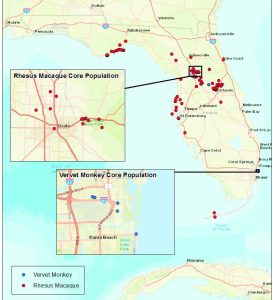
Map of monkey sightings in Florida. Source: Florida Wildlife Commission
If you see a monkey
- Do not feed them & keep your distance. Feeding or approaching monkeys increases the chance of bites, scratches, or disease transmission.
- Report sightings.
- For sightings outside core ranges: call the FWC Exotic Species Hotline at 888-IveGot1 (888-483-4681) or submit at IveGot1.org.
- For aggressive behavior or immediate threats: call the Wildlife Alert Hotline at 888-404-FWCC (3922).
- If bitten or scratched: wash the wound thoroughly and seek medical attention; follow CDC guidelines and contact the National B Virus Resource Center at 404-413-6550.

Support community journalism
The first goal of the Ocala Gazette is to deliver trustworthy local journalism so corruption, misinformation and abuse are not hidden from the public or unchallenged.