
Shaping Ocala’s future
How Tye Chighizola’s vision and leadership transformed a city over more than three decades.
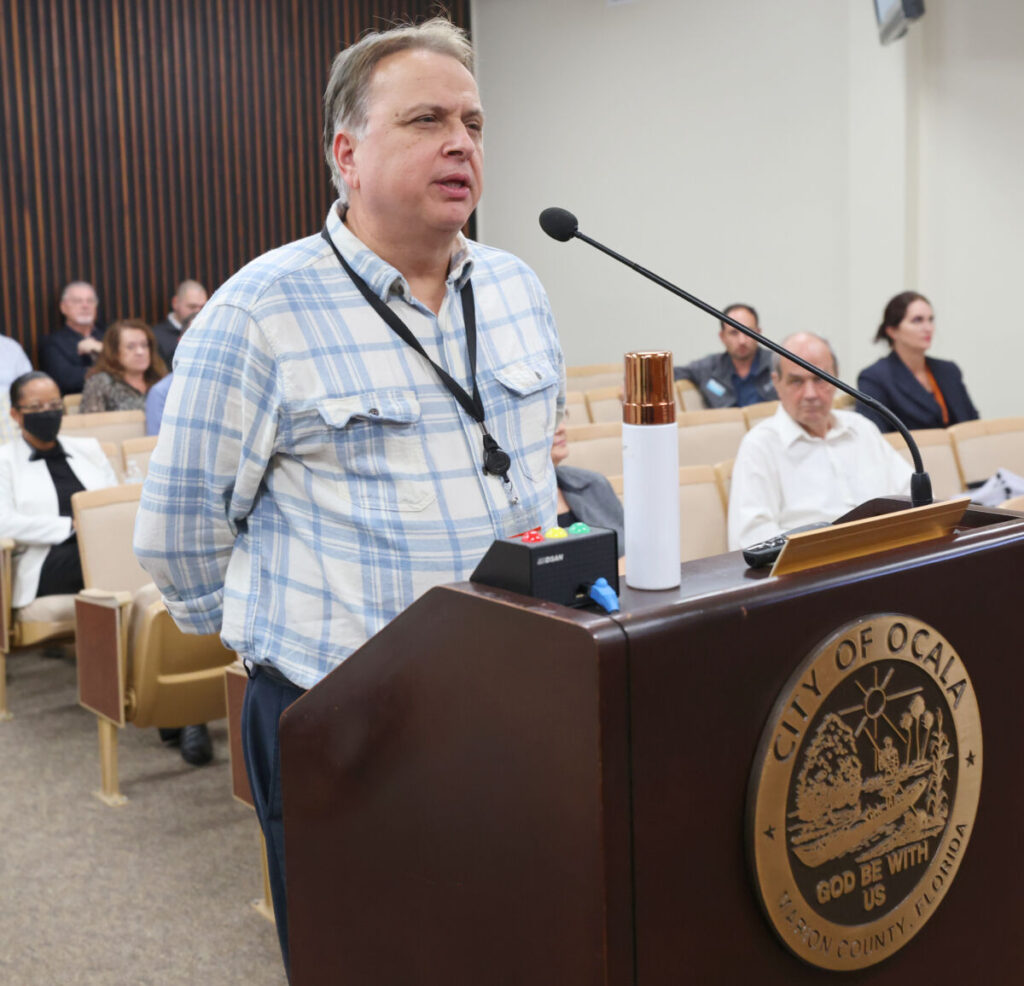
Tye Chighizola, the longtime city of Ocala director of growth management, speaks during a City Council meeting at City Hall on Jan. 4, 2022. Chighizola retired on June 6 after 36 years on the job. [File photo by Bruce Ackerman/Ocala Gazette]
When Tye Chighizola walked into Ocala’s city offices to begin his career in 1989, he was handed a yellow tablet notepad as his “computer.” At a time when the city relied on a single shared PC with a green-screen mainframe and floppy disks, Chighizola’s work depended on handwritten notes passed to an assistant for typing.
“When I first got here, I was like, ‘Where’s my computer?’ And they said, ‘We only have one.’ So, the assistant director handed me a yellow tablet and was like, ‘You write it down on that tablet,’” Chighizola said.
In an era with few personal computers and scant email, communicating for work meant phone calls or letters, and planning required patience and ingenuity. Yet, even with a yellow notepad as his primary tool, Chighizola’s vision for the city of Ocala took shape, laying the groundwork for decades of growth through meticulous planning and community collaboration.
This low-tech start marked the beginning of his 36-year journey as city projects director, helping transform Ocala from a quiet town with some empty downtown streets into a vibrant urban hub.
At the June 3 city council meeting, Ocala Mayor Ben Marciano presented Chighizola with a key to the city, honoring his lasting impact on the community as he retired on June 6. Council president Kristen Dreyer introduced a tribute video that included testimonials of fellow city employees who have worked with Chighizola and many spoke volumes about his character, grit and leadership.
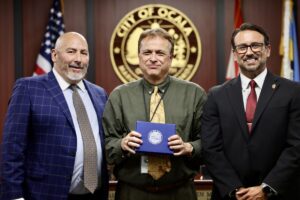
Tye Chighizola, center, who served for 36 years as the city of Ocala’s growth management director, received a key to the city from Mayor Ben Marciano, at right, on June 3, in honor of Chighizola’s retirement on June 6, with City Manager Peter Lee, at left. [Photo courtesy city of Ocala]
“He followed me, and he came out to the crash site. And he said, ‘What can I do to help?’ It’s little things like that. His heart, that means a lot,” she said.
Mary Sue Rich first met Chighizola when she became a city councilwoman.
“My first impression was that he was a nice young man. When I first started, there were a lot of things that I didn’t know anything about and I could always go and ask him things that I really didn’t know,” she continued.
Rich, the first Black woman on the Ocala City Council, served for 24 years before she decided to not to seek re-election in 2019.
Patti Hitchcock, the city’s growth management planning director, reflected fondly on Chighizola’s management role.
“I met Tye in 2008, when I was interviewing for an entry-level position. I got the job and they told me it might not lead to anything more, but it did. I was hired in 2023 as the planning director. So, I worked with Tye for 15 years. Tye was a very empathetic manager. He also has a memory that is legendary in the city,” she said.
Gerald Ergle, a former mayor of Ocala, described Chighizola as straightforward and honest.
“He’s the perfect professional. And more importantly, he was patient. So, I always appreciated the fact that he was a very patient professional,” Ergle said.
According to Lang, Chighizola was always thinking about Ocala.
“You know, we used to joke about him going on vacation. We would tell him to focus on his vacation and he couldn’t. He would always do something and come up with these really brilliant ideas from someplace else and say, ‘Wow, that would work for Ocala.’ So, he was always thinking about Ocala,” Lang said.
“I don’t think he sees himself that way, but he is a leader,” offered Jeff Shrum, the city’s growth management director. For me, he’s a mentor, and a friend.”
According to former city manager John Zobler, Chighizola was ahead of the curve, plotting moves in the way you might place chess pieces on a chess board.
“I always told Tye that he’s really a plotter, not a planner. He’s always moving these chess pieces around to get to the end game. You don’t know what the end game is, but he does,” Zobler said.
“The city of Ocala is really going to miss Tye Chighozola. Tye has been here a long time, he’s done a lot of good things, I know I’m going to miss him,” said Jimmy Gooding, assistant city attorney.
TRANSFORMATIVE PROJECTS
In his time as director of city projects, Chighizola adapted to technological leaps and led transformative projects such as the 2004 Downtown Master Plan and 2035 Vision Plan.
“I never talked about it too much, but the 2035 vision was a great opportunity and the Downtown Master Plan. The 2035 vision was, I think, the catalyst to get things moving. And a lot of that happened during the downturn, that period between 2009 and 2012, we were able to concentrate on more of the planning, because we didn’t have many permits,” Chighizola said.
He said the 2035 Vision Plan’s high-level focus on Ocala’s future includes its role in expanding community redevelopment areas for West and East Ocala.
“It was a vision plan. It was a higher-level plan addressing where Ocala wants to be in the next 25 years, in terms of various aspects of it,” Chighizola said.
“Tye’s had an incredible role in a lot of very, very important, high-profile projects through the years. And you know, if you’re of the opinion that I am, Ocala has become a different place. His fingerprints are on a lot of the plans and a lot of the projects that have been completed over those 35 or 36 years,” said City Manager Peter Lee.

Former Ocala City Councilwoman Mary Sue Rich, fourth from left, and community advocate Ruth Reed celebrate during the ribbon cutting ceremony for the Mary Sue Rich Community Center at Reed Place in Ocala on Jan. 10, 2023. [File photo by Bruce Ackerman/Ocala Gazette]
“Ruth Reed was one of those persons who wouldn’t let her dream die and that was one of the things that we always wanted to see happen. We were able to get that community center. And it’s called the Mary Sue Rich Community Center at Reed Place and it’s a great facility,” Chighizola said.
Chighizola was known as the “historian” for recalling most any date asked of him.
“He’s just been invaluable in terms of knowing where everything lies and how and what occurred. He has an uncanny ability to recall. He remembers where everything is,” Lee said.
“I met Tye in 1994 when I started work. I can’t remember what date, but I’m sure that Tye knows what day it was, he might know what time it was, and he might know what I was wearing,” Lee shared in the tribute video.
“If I had to describe Tye in three words, it would be intelligent, creative and, most of all, caring,” he added.

The Marion Theatre is a downtown Ocala gem and serves as a venue for movies, entertainment and community events. [File photo by Bruce Ackerman/Ocala Gazette]
“That’s always been my pet project, to always continue the restoration and the operation of the Marion Theatre but there were many people before me that had just as much passion,” Chighizola said.
“Tye did a lot with the Marion Theatre. That was one of his really important projects that he kind of took the lead on. There were a lot of people in the community who backed him up. But there was a chance that we could lose the theater and Tye played an integral part in saving it,” Lee said.
SHAPING DEVELOPMENT
According to Chighizola, his initial role with the city of Ocala in 1989 was a two-year position specifically focused on drafting the city’s first modern comprehensive plan, distinguishing it from earlier, less structured plans.
“I was only originally hired for two years, and they had comprehensive plans here, but they were kind of different. So, this was the first true modern comprehensive plan,” Chighizola said.
The comprehensive plan is a strategic framework mandated by the 1985 Growth Management Act, directing the city’s long-term development in areas including land use, housing, transportation and historic preservation. It ensures sustainable growth while preserving Ocala’s charm, serving as the backbone for projects championed by Chighizola.
Lee praised Chighizola’s mastery of the plan.
“He understood why we were doing different projects and the comprehensive plan, which is why he came here in the first place. He took it upon himself, really, to understand that from the foundational levels,” Lee said.
“It was a big undertaking Florida wise. And so that’s why Ocala got some money from the state, to hire planners to do it.The comprehensive plan was kind of like the basis for my career, starting and then building off of that,” he said.
Chighizola emphasized the 2004 Downtown Master Plan’s effectiveness as a guiding tool that was actively implemented, shaping downtown’s development.
“I think that it’s been a successful plan. A lot of times people put plans on the shelves. I know we have done it in the past. And then you never use it, you go back and look at it 20 years later. But the Downtown Master Plan, everything had to be revolving around that. I think it was a great tool to get everything moving,” Chighizola said.
“He’s had an incredibly important role in downtown, and ruling every zoning decision that there has been for those 30 years, at least,” Lee said.
The 2004 Downtown Master Plan sparked a renaissance, enabling the Institute for Human and Machine Cognition facility, the Sovereign Building’s (Marion Hotel) current boutique hotel conversion and residential projects such as Watula South.

The Institute for Human & Machine Cognition opened in downtown Ocala in 2010. [File photo by Bruce Ackerman/Ocala Gazette]
“All the growth on the other side of I-75 with the Fore Ranch and the Heath Brook projects, you know, there was a lot of passion there, because they were agricultural uses turning into shopping centers and residential development. So, there were challenges there,” Chighizola said.
“I say the big part of my career, in the middle part of the career, was dealing with road issues on State Road 200, getting that project from a two-lane to a six-lane, and a lot of the concurrency road issues that we had with that growth,” he continued.
According to Lee, Chighizola’s collaboration with local attorneys and developers shaped ordinances and growth while solving some of the city’s problems.
“I’ll miss his ability to help solve our problems, the deep, foundational kind of understanding that he had with state statutes and local ordinances. And working through different ordinances that we’ve written through the years, his ability to work with engineers and attorneys and developers and staff and citizens. He understood; he was diplomatic, and he knew how to get from point A to point B on things in a meaningful way, get things done without a lot of undue emotion, typically on either side,” Lee said.
Chighizola’s final years focused on SunTran, with plans for a trolley and electric vehicles. The city is the administrative agency for SunTran, which provides fixed-schedule transportation service on seven routes in Marion County, mostly centered in Ocala.
“Hopefully we’ll have our trolley starting in the next few months, and then some of the other changes that are coming. So, we’ve been excited about that, you’re going to see a lot of things coming down, especially with diversifying our fleet to having some electric vehicles,” Chighizola said.
According to Lee, Chighizola was a self-starter with a strong work ethic and was a servant leader.
“Nobody had to tell him what to do. His work ethic was unquestioned. I mean, he never didn’t get something done. He always knew what had to be done, and he got it done. He worked across department lines easily. He helped coordinate things and get things done. He’s an example of how to work from beginning to end on projects,” Lee said.
“He cares about people. He’s got a very empathetic and moral compass that allows him to do the right things as it relates to people. He really is a part of the culture that I stress being a servant leader. He serves the people that he works with, the people who work for him,” Lee added.
“I hope that he stays active and does the things that he wants to do. Life’s not that long; life is short. I hope that he chases whatever his passions are,” Lee noted. “I’m sure that some of those will be helping people. He’s philanthropic and he’s liable to pop up anywhere on our landscape, working for the nonprofit or nonprofits that he believes in and doing something like that. I hope that he stays in touch with us, and I’m sure he will. But I also hope he chases his passions.”
“I’ve been blessed. I love this. I love the community, I love the job, and I love the people I worked with. We’ve had great city council members over the years that supported us, and we can’t do it without them, without their support. So, I made a lot of lasting friendships with people I got to know through this job over the years, met a lot of different great people and worked with a lot of great people,” Chighizola said.
“The hard part is leaving that behind. It’s a big part of my life. It’s going to be a little difficult. It’s hard to leave, but I think it’s time,” he added. “I think at some point, things change. You’ve got to go with the change.”

Support community journalism
The first goal of the Ocala Gazette is to deliver trustworthy local journalism so corruption, misinformation and abuse are not hidden from the public or unchallenged.