
Second bear trapped in two days in Ocala
The juvenile bears, which were rummaging around residential neighborhoods, have been released into the Ocala National Forest.
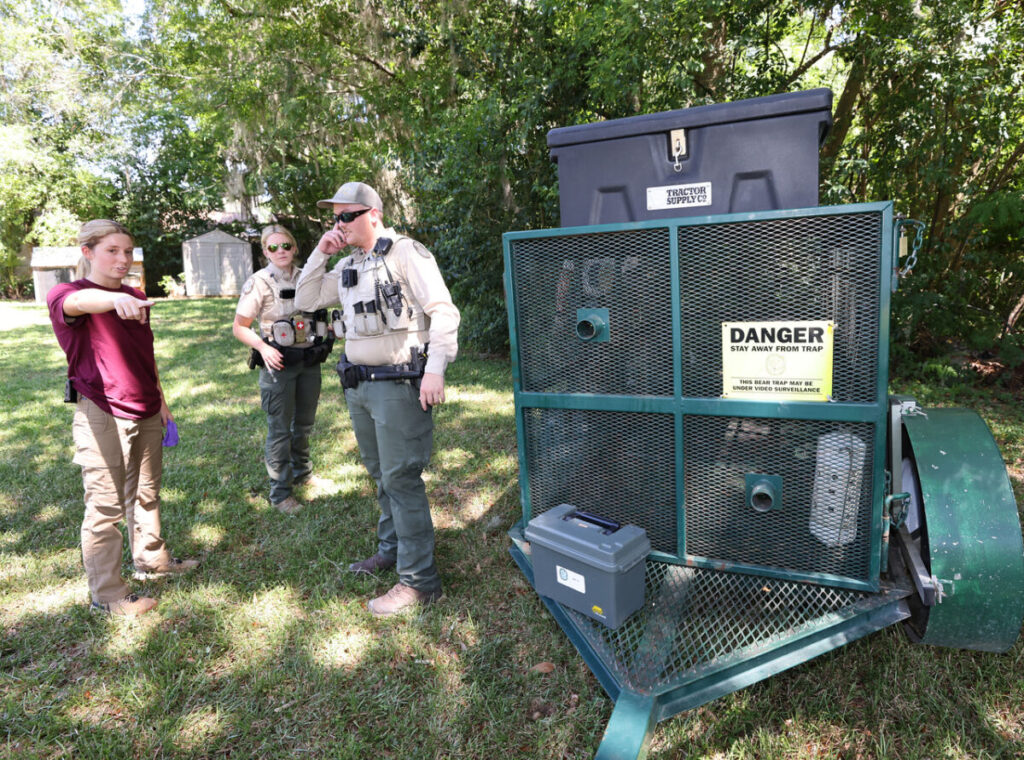
FWC Bear Biologist Paige Parks, left, talks with FWC officers Lauren Dickson, center, and Cody Lambert, right, about the best location for a non-lethal bear trap in the backyard at the home of Chris and Wendy Davy in Ocala, Fla. on Monday, June 10, 2024. [Bruce Ackerman/Ocala Gazette] 2024.
Two juvenile bears were recently trapped in a residential neighborhood close to the duck pond on Southeast 17th Street by members of the Florida Fish and Wildlife Conservation Commission’s Bear Management Program and relocated to the Ocala National Forest.
Publix donuts and cherry turnovers, the bait for a Florida Black Bear, is shown in a non-lethal bear trap placed by the FWC in the backyard at the home of Chris and Wendy Davy in Ocala, Fla. on Monday, June 10, 2024. [Bruce Ackerman/Ocala Gazette] 2024.
Jeffrey Walczak, public information officer with the Ocala Police Department, stated in a June 10 email that OPD had received 11,911 calls in the last two weeks about bear sightings, although OPD “rarely” gets 911 calls regarding bears and that typically bear calls go to FWC.
Kristen Turner, public information director for the FWC Northeast Region, confirmed in an email that the first bear, a female juvenile, was trapped and released on Sunday, June 9, but the exact location in which it was trapped was not given.
Turner said young bears, 1 1/2 to 2 1/2 years of age, often leave mama bear in spring to establish their own home base and again move about in fall seeking food to bulk up for hibernation. She said female bears may roam a territory from 10 miles to 25 miles and a male from 50 to 120 miles.
“Seeing a bear in a neighborhood is not necessarily cause for alarm. However, it is important that residents secure food attractants so that bears do not linger in the area. If a bear is not able to find food and is given space, it will move on. Feeding bears can make them lose their natural fear of people,” Turner wrote.
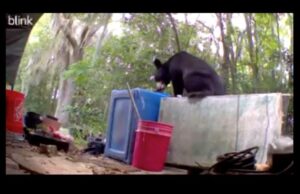
This still from a video security camera was captured by Chris and Wendy Davy and shows a Florida Black Bear going into a bait tank in their backyard at their home in Ocala, Fla. on Monday, June 10, 2024. [Courtesy Chris and Wendy Davy]
Wendy Davy said the first bear was trapped about two blocks from her home on Saturday, June 8. The bear scaled and bent a chain link fence, broke through screening and hauled a new bag of sealed dry dog food into their backyard. It also ate some shiners from a bait tank kept outside by Chris Davy, a fishing charter boat captain.
On Monday, June 10, around 3 p.m., FWC Bear biologist Paige Park and Marion County-based FWC officers Wade Constance, Cody Lambert and Lauren Dickson placed a roughly 4-foot by 8-foot cage trap, designed to close when a bear ambles inside to grab the bait, in a corner of the Davys’ backyard, along with a motion operated camera.
By 8 p.m., the sweet treat bait had attracted bear number two, according to a text from Wendy Davy, who described the bear as a male juvenile that was “calm” until caught.
“He literally went in and out of the cage five times, grabbed donuts and laid on the ground and ate them. We watched for about an hour from our porch then he finally tripped it to close. FWC came back and took him for relocating,” she wrote.
For a bear sighting map, visit app.myfwc.com/fwri/blackbear/locations
To report a bear conflict or if you see one that is injured, call the FWC’s Wildlife Alert Hotline at (888) 404-3922 if or go to myfwc.com/contact
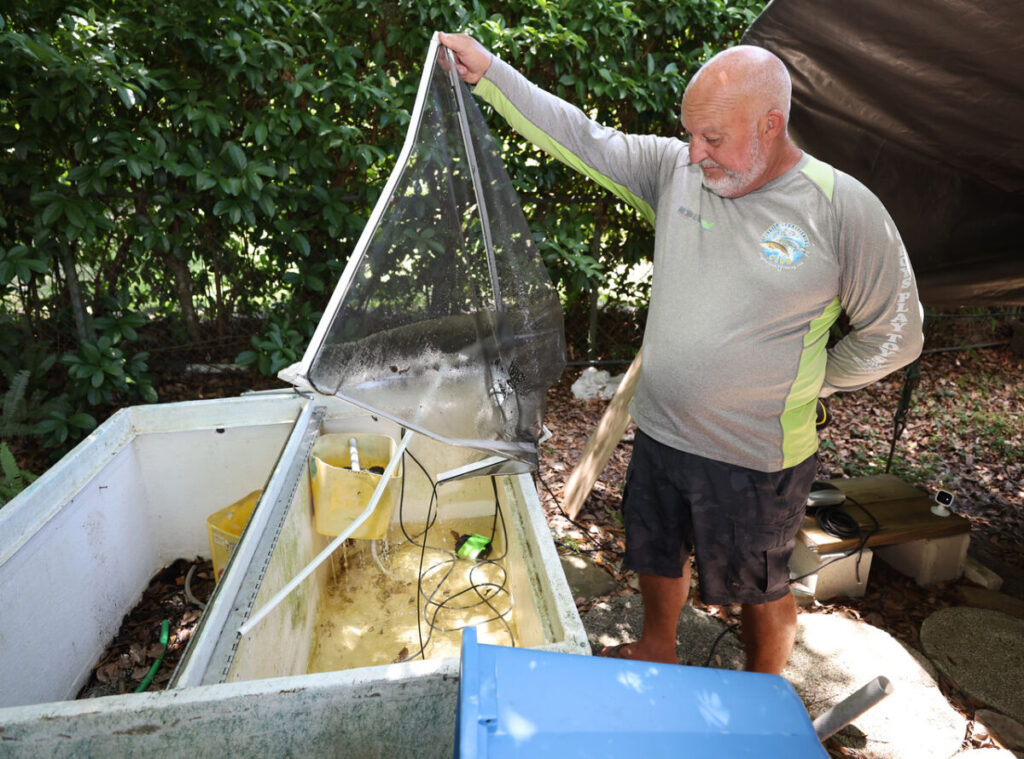
Chris Davy looks over damage to the covers to his bait tank caused by a Florida Black Bear in his backyard in Ocala, Fla. on Monday, June 10, 2024. [Bruce Ackerman/Ocala Gazette] 2024.

Support community journalism
The first goal of the Ocala Gazette is to deliver trustworthy local journalism so corruption, misinformation and abuse are not hidden from the public or unchallenged.