
School construction cost scrutiny
School board approves Belleview Elementary contract for Ausley amid transparency concerns.
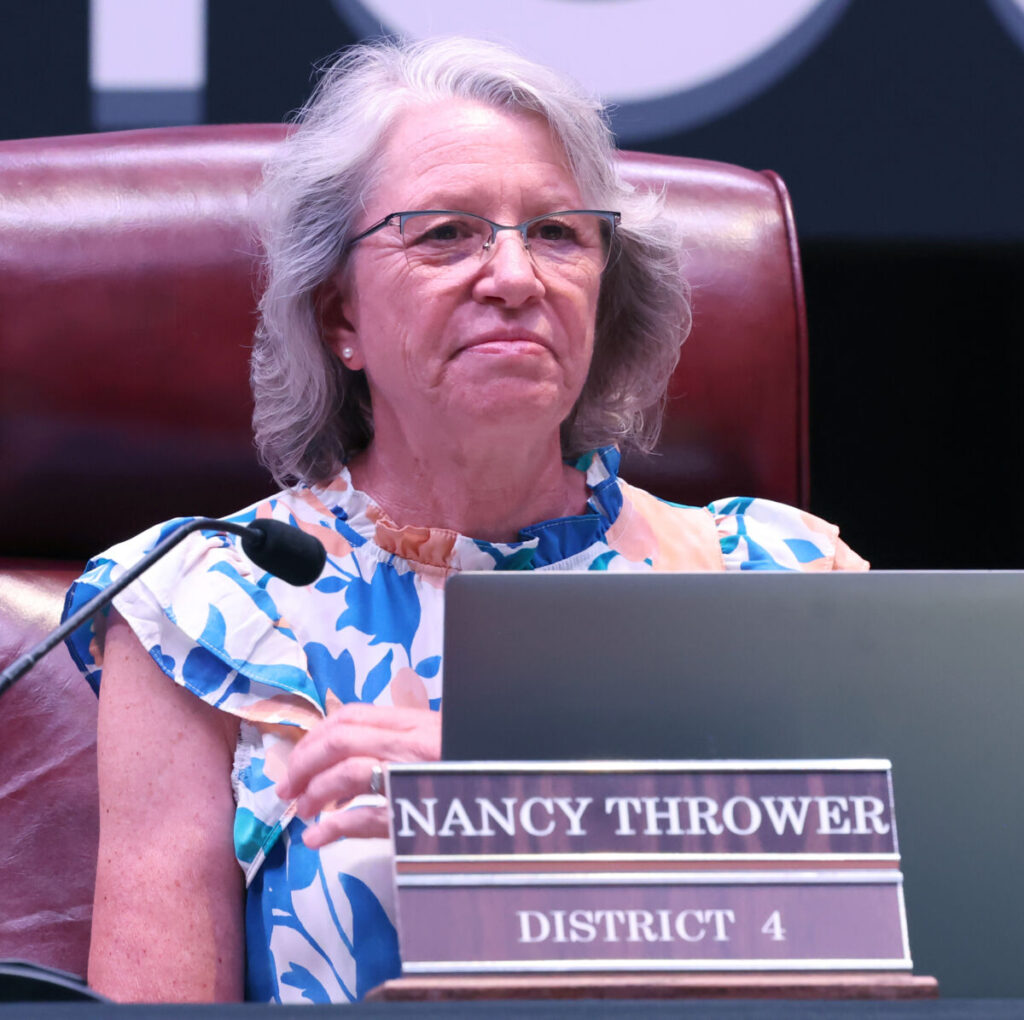
Marion County School Board member Nancy Thrower raised transparency concerns during recent meeting. [Bruce Ackerman/Ocala Gazette file photo]
The Marion County School Board this week voted 4-1 to award the construction management contract for the Belleview Elementary School Replacement project to Ausley Construction Co., LLC, following a selection process that drew both praise for supporting local business and criticism regarding transparency.
Board member Allison Campbell cast the lone dissenting vote.
“Dr. James, my only comment is that I will not be recommending this contract this evening,” Campbell said.
In contrast, board member Lori Conrad strongly supported the decision stating, “I’m happy to see that this is going to a local firm and that all of the work money is going right back into our community.” She added that using local contractors as often as possible has been a priority for her since she joined the board.
The new school is expected to cost approximately $65 million, which is higher than other recent elementary school builds (Winding Oaks and Ross Prairie) because the new Belleview campus will be designed larger in order to combine two separate schools (Belleview Elementary and Belleview-Santos).
The approval came with some scrutiny. Board member Nancy Thrower raised transparency concerns regarding the Shortlist Interviews Tabulation document. She criticized the district for using “very small” writing and listing only the initials of the selection committee members rather than their full names, comparing it unfavorably to past transparent practices.
“It’s important to maintain the public trust, and I think one way to do that is to just make sure that our paperwork documentation is very transparent so anyone can look and know who has participated,” Thrower noted.
Despite her critiques of the process and a general warning about individuals serving on both high-level oversight committees and selection committees, Thrower offered high praise for Ausley Construction’s capabilities.
“I have absolutely no doubt that we’re going to get a quality build and that the school is going to open on time,” she said, acknowledging the company’s record of building.
Thrower expressed appreciation for community members who volunteer their time on high-value district oversight boards like the Independent Citizens Referendum Oversight Committee (ICROC) and the Sales Surtax Committee. However, she raised significant concerns about the potential for conflicts of interest when the same individuals or parties are involved in both funding oversight and district procurement.
Specifically, Thrower argued that it is a “common sense best practice” to maintain strict separation between individuals serving on committees that oversee large amounts of public money and those participating on construction selection committees. Acknowledging that prohibiting this kind of overlap “may not be in board policy” currently, she framed her concerns as a necessary step toward “continuous improvement” to maintain the public trust.
Ausley Construction frequently bids on and wins large district construction projects, yet its CEO, Ken Ausley, simultaneously serves as the chairman of the ICROC, which oversees how the district spends its funds. He was nominated to this oversight position by board member Sarah James, who had previously been investigated for inappropriately trying to influence the scoring process to favor Ausley Construction during a $120 million high school bid.
By pointing out this procedural blind spot, Thrower highlighted the need to scrutinize and potentially update board policies to prevent overlapping influence between those awarding district contracts, those receiving the contracts and those overseeing the district’s money.
The selection process
Here are the members of the Belleview Elementary School Replacement project selection committee: Christian Spaulding, Eric Ostanik, David Assumpcao, Triste Smith, Dennis McFatten, Debra Riedl, Matt Fabian, David Tillman and James Johns.
The committee members were tasked with evaluating the firms’ qualification submittals, which were capped at 20 pages and included professional references, proof of licensure, bond ability and detailed responses to the district’s criteria. Following a submittal review and shortlist interviews, the evaluators individually graded each competing construction firm based on a 100-point rubric.
They evaluated the proposals across five specific categories:
- Project Team: Maximum of 25 points
- Approach and Methodology: Maximum of 25 points
- Timeline and Quality Control: Maximum of 15 points
- Cost Controls/Value Engineering: Maximum of 15 points
- Knowledge of Site and Local Conditions: Maximum of 20 points
Once all nine committee members submitted their individual scores, the highest and lowest scores given to each firm by the committee were dropped and the remaining scores were averaged to get the final ranking.
However, a closer look at the bidding tabulation reveals the specific scoring dynamics that led to Ausley’s win, including notable outlier scores.
Evaluator Tillman (listed as “DT” on the documents) submitted heavily skewed scores that uniquely favored Ausley Construction and were distinctly different from the rest of the committee because he was the only evaluator to create a 25.5 to 30-point scoring gap between his first choice and the other competitors. Most committee members evaluated the four firms within a much tighter margin; Tillman’s scoring pattern drastically penalized the competitors while keeping Ausley near perfect.
While Tillman awarded Ausley a near-perfect score of 99.000, he graded the other three competing firms drastically lower: 69.000 for Charles Perry Partners, 70.500 for The A.D. Morgan Corporation and 73.500 for D.E. Scorpio Corporation.
In fact, Tillman’s score of 69.000 for Charles Perry Partners was the lowest total score awarded by any committee member to any firm. He was also the only member to grade three out of the four firms in the 60s and low 70s.
At the time of publishing, Tillman has not responded to “Gazette” questions about the differences in scoring.
Prior bad blood not mentioned
Transparency and bidding concerns expressed by Thrower at the meeting are not isolated. As previously reported, Ausley Construction has a documented history of bidding disputes and allegations that the company uses aggressive tactics to win bids.
A 2024 independent investigation by the GrayRobinson law firm substantiated that Ausley Construction violated the district’s “cone of silence” procurement policy while bidding for a massive $120 million high school project.
The company’s leadership was also scrutinized in a 2002 Florida Auditor General report, which challenged an “informal,” “penciled-in” scoring system used by the district to award the Forest High School contract to ACA Construction Group—a firm led by Ken Ausley and his then COO, Todd Duffy.
The 2024 investigation into the $120 million high school bid brought to light threats and forms of intimidation directed at school district leadership. During that dispute, former Superintendent Diane Gullett reported that she, board members and multiple district employees were subjected to “threats and forms of intimidation both internally and externally.”
The investigative report detailed how Duffy contacted Fred Thrower, the husband of then-board chair Nancy Thrower, and warned that he “wouldn’t want things to go badly for chair Thrower’s political career” over the high school contract. Fred Thrower publicly categorized the interaction as a political threat meant to hold school funding over the board’s heads.
Furthermore, Duffy was found to have contacted a district employee, suggesting that Ausley Construction could use its influence to help the employee secure the district supervisor of facilities job, leaning on the firm’s displeasure with how the bidding process was being handled.
Thrower announced when she was sworn in for a second term, in November of 2022, after running unopposed, that she would not seek a third term on the school board.
Recent projects
Despite the internal investigation findings, the company continued to be awarded bids by the school district and complete them, albeit under scrutiny.
During the May 26 school board meeting, the ongoing debate over the cost differences between two newly constructed, identically designed elementary schools—Ross Prairie (built by the out-of-town firm A.D. Morgan) and Winding Oaks (built by Ausley Construction)—was a major point of discussion.
During the public comment portion of the meeting, Dustin (Michael) Magamoll of Ausley Construction addressed the board to defend the higher costs associated with the Winding Oaks project. He argued that while the school designs were the same, the site conditions were “far from identical.”
According to Magamoll, Ross Prairie started on a cleared site with good soil, whereas Winding Oaks required extensive site preparation that delayed the project by nearly two months. Because the district maintained a strict June 30 completion deadline, Ausley had to accelerate the schedule with a six-day workweek, which added approximately $1.4 million in overtime labor costs. Magamoll concluded that the $2.7 million in additional costs adequately explained why Winding Oaks was initially priced $2 million higher than Ross Prairie.
During that meeting, Campbell responded directly to Magamoll’s defense. While she stated she could respect the differences in site development, she pointed out that the cost gap between the two schools was widening well beyond the initial $2 million.
Campbell noted that earlier in the meeting, the board had approved a $3.2 million deductive change order (a return of unused funds) for A.D. Morgan’s Ross Prairie project. Campbell argued that the disparity warranted a much more detailed conversation than just addressing the initial $2 million difference.

Support community journalism
The first goal of the Ocala Gazette is to deliver trustworthy local journalism so corruption, misinformation and abuse are not hidden from the public or unchallenged.