
Saving Siena
The parents of a 10-year-old Dunnellon girl with a rare genetic disorder, and others like them, are collaborating with a biotech company for a drug repurposing project to find a potential treatment.
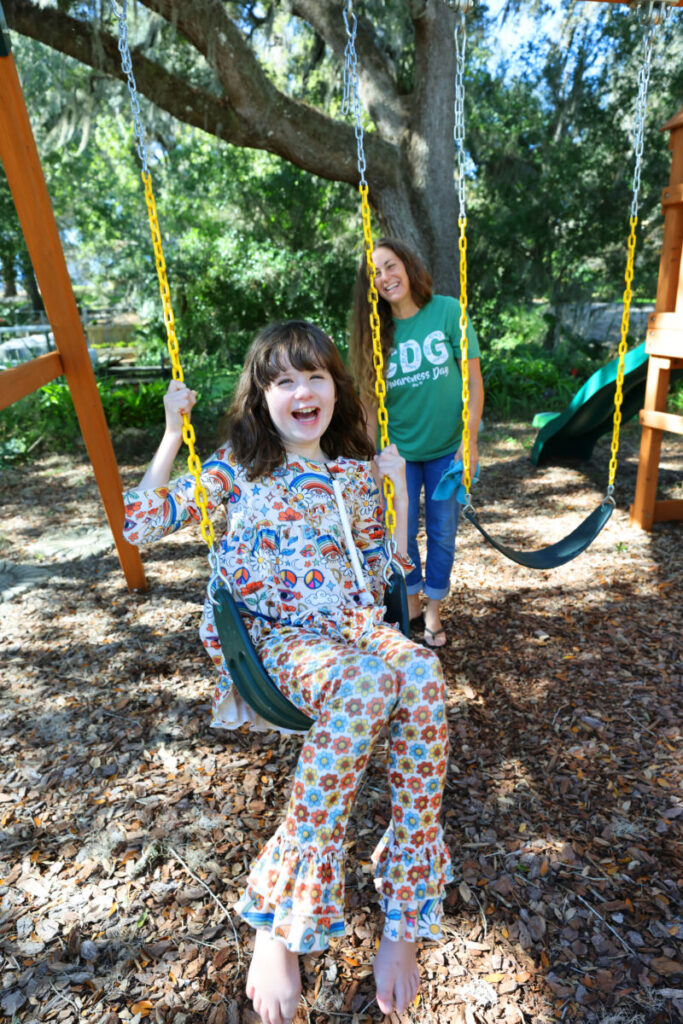
Siena Hale, now 10, gets pushed on a swing by her mother, Keszia, in the backyard at their home in Dunnellon on Nov. 21, 2024. [Photo by Bruce Ackerman]
The sweet smile on Siena Hale’s pretty face melts the hearts of those she encounters. Her inquisitive eyes quickly scan the visages that enter her orbit. She might extend her delicate hands to touch someone, but she cannot have a conversation with them.
Siena seems to be like millions of other 10-year-old girls, but she is one of fewer than 100 children in the world with a rare genetic disorder called ALG13-CDG, one type of a group of metabolic diseases known as congenital disorders of glycosylation, or CDG. ALG13-CDG is caused when a mutation arises spontaneously in someone’s ALG13 gene or is inherited. In Siena’s case it was spontaneous.
Nearly all children with ALG13-CDG experience neurological and developmental delays, muscle tone disorders, gastrointestinal problems, cortical visual impairment and seizures. There is no cure for ALG13-CDG, so parents of children like Siena are raising money to collaborate with the biotech company Perlara PBC on a drug repurposing project to find a potential treatment to improve the quality of life for their children. Siena’s mother, Keszia Hale, is the project director for Finding a Cure for ALG13-CDG.
Keszia and her husband, Bryce Hale, are among the parents working to raise $150,000 to complete the first phases of the project.
She recently announced that, “We have raised over 70% of what we need to complete the first two phases of the drug repurposing research project with Perlara.”
The donation page on June 3 showed that $61,933 of the $150,000 had been raised.
The Journey
Keszia moved to Inverness in 2010 and commuted to work in Ocala at Collier, Jernigan & Goedert as their lead CPA auditor.
“My husband and I built our dream home in Dunnellon and moved in January 2015. Siena was born on March 18, 2015, at Monroe Regional Medical Center in Ocala,” she shared. “When Siena was 6 months old, a daycare worker saw her eyes roll while they were giving her a bottle and they called me in and said take your baby to the hospital right away. We went to the pediatrician, and they said, ‘Oh, that’s nothing, that’s something that they do. Within two days I was like, ‘Okay this is not nothing.’ She had lost hearing and vision. She was like a ragdoll. She was hospitalized and they tested her for a million things and they couldn’t figure anything out.”
“The first step was to stop the chaotic brain waves with a nine-week steroid treatment of ACTH (adrenocorticotropic hormone), which cost over $32,000 per 5 milliter vial,” Keszia said. “Next, we attempted to gain seizure control. At barely 6 months old, Siena went through an array of tests—EEGs that burned her head, MRI’s, ultrasounds, EKG’s, spinal tap and an epilepsy panel.”
The steroid treatment worked for about two months. Keszia said doctors with UF Health tried anticonvulsants, which seemed to make things worse. At some point, “I said, I’m not disrespecting your opinion but I’m going get a second opinion and they said please do. We don’t know what’s going on.”
“We flew to Boston Children’s Hospital. They said to stay on the regimen and try to max it out. If that doesn’t work, try a ketogenic diet,” Keszia explained. “That was in September and by October I said this is not working.”
The Hales learned about Dr. Peggy Borum, research director of the precision ketogenic therapy program at UF Health, who advised them to put Siena on a keto diet.
“We did that on December 4th by December 8th the seizures were gone,” Keszia said.
Adhering to the PKT diet required an extreme effort from Siena’s family
“Every one of her meals is measured to the 10th of a gram. It is 90% fat, 7% protein and 3% carbohydrates,” Keszia explained. “We have been in the program since December 2016 and feel as if it gave Siena a better life than was expected.”
They did have to make some adjustments to her diet along the way.
“At the end of 2024, we adjusted Siena’s keto ratio to better control her seizures. Siena hasn’t had a seizure since Jan. 16. She turned 10 in March, and we went to Adventure Island for her birthday as she loves anything to do with water.”
In addition to working with medical experts, Siena tried occupational, speech, physical, aqua and other kinds of therapies.
“Needless to say, between all the doctors’ visits, therapy and counseling, I quit my job at the CPA firm to provide the best care possible to Siena. And, finally, a whole exome sequence genetic test led to her diagnosis at 22 months old,” Keszia noted.
The Hale family lives on the Rainbow River in Dunnellon. Their home is a safe and fun haven for Siena and her sister Zenika, 7, who was not born with ALG13-CDG.
“The Rainbow River bonds us all together as we all love the water. I think Siena enjoys the water more than any of us,” Keszia said. “Bryce, Zen and Siena have started paddle boarding more frequently now that the weather is warming up.”
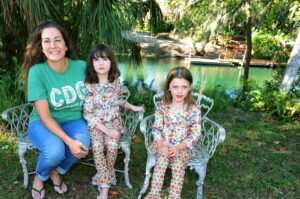
Siena Hale, center, spends some time with her mother, Keszia, left, and sister, Zenika, 7. [Photo by Bruce Ackerman]
The CDG CARE (Community Alliance and Resource Exchange) nonprofit 501(c)(3) was founded in 2014 by parents like the Hales.
“Our mission is to promote greater awareness and understanding of CDG, to provide information and support to families affected by CDG and to advocate for and fund scientific research to advance the diagnosis and treatment of CDG,” said Executive Director Andrea Miller, whose daughter Bianca, 14, was diagnosed with PMM2-CDG as an infant.
“I witnessed firsthand the challenges of navigating a rare diagnosis and the critical gaps in care, resources, education and research. This inspired me to build an organization that empowers families, connects them with experts and drives advancements in treatment and quality of life for all children and young adults diagnosed with CDG,” she said.
“Children with ALG13-CDG often face significant neurological and developmental challenges. Tragically, many lives have been lost to this medically complex disorder, making the pursuit of research not only essential but deeply personal for affected families,” she explained.
Research is key
Perlara PBC launched in 2014 as the first biotech public benefit corporation. Researchers and clinicians share expertise to guide cure and treatment paths.
“The research will use Perlara’s yeast-based screening platform to discover existing drugs that could be repurposed to treat ALG13-CDG. We begin by working with an ALG13 yeast patient avatar, an off-the-shelf yeast model engineered to mimic the disease. Yeast is an efficient and cost-effective research model for drug discovery, as it’s easy to grow in the lab and shares many genetic similarities with humans,” explained Kristin Kantautas, Ph.D., CDG Program Director for Perlara PBC.
“We’ve discovered potential treatments for over 25 rare genetic diseases. Congenital disorders of glycosylation (CDG), including ALG13-CDG, are one of our core research areas,” Kantautas noted. “We currently have 13 active drug-repurposing programs focused on different types of CDG. So far, every screen has uncovered promising candidates, and in many cases, we’ve advanced to patient studies within a year. We’re optimistic that the ALG13-CDG program will follow a similar path to success.”
In mid-May, Kantautas spoke about the fundraising effort and the beginning of trials in early June.
“For a limited time, we’re able to offer the first two phases at a reduced cost to the ALG13 community. That’s because we can share some research costs with another unrelated drug repurposing project currently underway at Perlara, as long as we run them in parallel. In Phase 1, we’ll measure how the ALG13-CDG yeast model grows compared to healthy yeast and optimize the experimental conditions for screening. In Phase 2, we’ll screen a library of ~8,400 compounds to identify any that improve the growth of the ALG13 yeast model. This is the first step in identifying potential drug repurposing candidates for ALG13-CDG,” she wrote.
“The research with Perlara would help identify a treatment that would improve quality of life for ALG13-CDG kids,” Keszia offered. “This could mean Siena may be able to grow up, she may be able to make friends, she may be able to communicate her needs and express her feelings without so many tears. She may be able to avoid the pain and suffering that her peers experienced later in childhood. This research could be life changing to almost 100 families who don’t fit into any single group large enough for the FDA to notice they desperately need help to save their children from constant pain and suffering without any relief for their supporting families. This research is hope.”
“As you can imagine, Siena is my world,” Bryce said. “She is the sweetest child you have ever met and does not want for anything but just to be happy. Finding a cure for this disease and giving her the ability to speak and communicate with us would be life changing. Everybody who meets her says she is the most wonderful, happy child they’ve ever met. She is a positive influence on everyone she meets.”
To donate to help Siena’s family and others, go to secure.givelively.org/donate/cdg-care/finding-a-cure-for-alg13-cdg
To learn more, visit findingacureforalg13-cdg.org, cdgcare.org and perlara.com
Editor’s note: This article originally appeared in the “Gazette’s” sister publication, “Ocala Style” magazine. It has been updated for the newspaper.
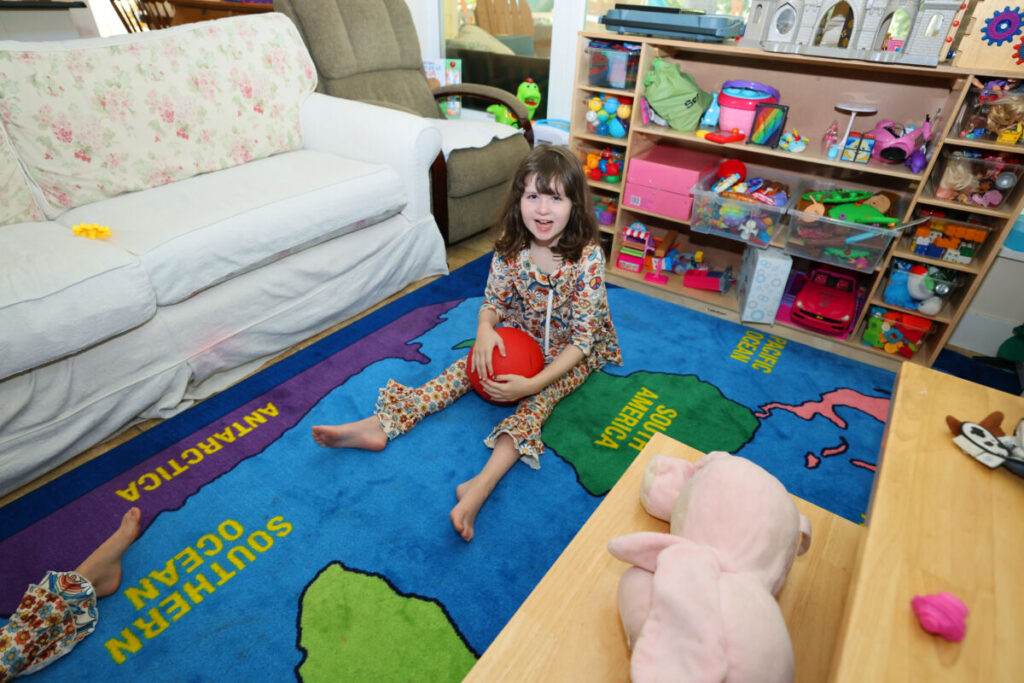
Siena Hale plays at her home in Dunnellon. [Photo by Bruce Ackerman]

Support community journalism
The first goal of the Ocala Gazette is to deliver trustworthy local journalism so corruption, misinformation and abuse are not hidden from the public or unchallenged.