
Saluting an American icon
Local students are honored for their essays on “What the American Flag Means to Me” during event that included a proper flag retirement ceremony.
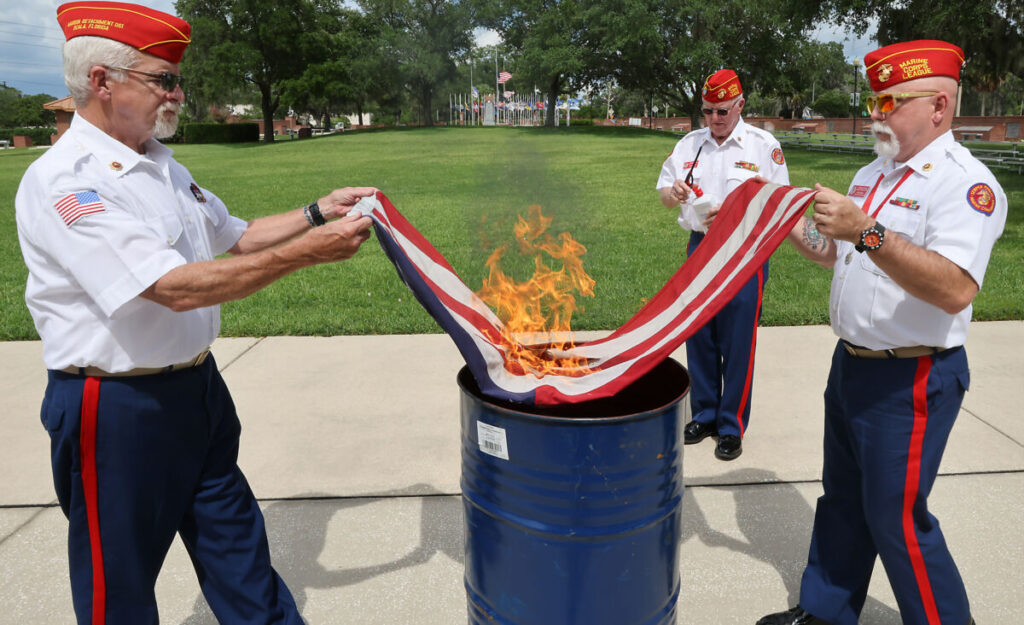
Earl Allison, Gary McCleery and Chris Farley, left to right, of the Marine Corps League Marion Detachment 061 Honor Guard, retire an American flag by burning it during a Flag Day ceremony at the Ocala-Marion County Veterans Memorial Park in Ocala, Fla. on Sunday, June 14, 2026. [Bruce Ackerman/Ocala Gazette] 2026.
More than two dozen local youth were recognized for their essays on “What the American Flag Means to Me” at the annual Flag Day ceremony at the Ocala-Marion County Veterans Memorial Park.
Upwards of 85 people, including members several local veterans’ organizations, gathered at the event, which included a tribute to “Old Glory” during a flag retirement ceremony.
This year, 27 student essay writers were recognized with a framed certificate. Students Tobi White, Joesph Sorrentino, Foster Owen, Blake Lewis, Jacob Lopez and A’Layah Powell read their entries at the June 14 event.
Blake, 10, said after the event that he learned about “bravery and courage” when some veterans spoke at his Marion County Public Schools elementary school.
The event was hosted by the Marion County Veterans Council and presented in cooperation with the Marion County Veterans Service Office and the Friends of Marion County’s Veterans Park. The Marion County Memorial Honor Guard supplied a color guard, ceremonial flag folding and, along with the Marine Corps League, performed a ceremonial flag disposal.
The essay program, spearheaded by MCVC Secretary Suzanne McGuire, involves selecting winning essays from 4th and 5th grade classes in local elementary schools following talks in their classes by American military veterans.
MCVC President Charles Calhoun said the essay program has been expanded with groups of veterans visiting local schools, such as six veterans visiting Eighth Street Elementary School before the essay were submitted.
Calhoun said the visiting veterans shared their experiences and the program included a discussion on the American Flag and flag etiquette. He said students asked about the three-corner ceremonial style flag folding and he explained that the shape resembles the tri-corner hat worn by the Revolutionary Guard.
George Meyer, a U.S. Navy veteran who served from 1968 to 1975, with service as a submariner, was one of the visiting veterans. Calhoun said the students asked Meyer the most questions.
Meyer, a member of the Veterans of Foreign Wars and the U.S. Nautilus Base of Ocala submarine group, said students asked the greatest depth the sub was submerged and related questions.
Essay winner Jacob Lopez, 12, was accompanied by his mother, Maria Borgen, at the event. He said submariner Meyer was a speaker at his school. Jacob said he learned “a lot” from the veteran’s talk.
Shannon Johnson, an ESE (exceptional student education) teacher at Sunrise Elementary School, said the veterans’ visit to her class was impactful and inspired her class to work hard and complete their essays
The commander of the local U.S. Nautilus Base, Joe Civiletti, was on hand for the ceremony as were members of the American Legion, VFW and Marine Corps League.
Christine Brewer with the Marine Corps League recited a flag retirement ceremony while an American flag was displayed and then retired by proper burning.
The flag retirement ceremony included phrases like the flag “led soldiers…and watched over them” through wars and conflicts and flew over 9/11. The flag stands as a “symbol of freedom” and is flown at half-mast over fallen service members, the ceremony stated.
THE AMERICAN FLAG
The National Flag Foundation, which educates the “next generation of Americans on the heritage, etiquette and stories of the US flag,” offers this information:
History and evolution
When the flag was first recognized by Congress in 1777, it did not have the familiar 13 stripes and 50 stars it does today. Since independence, it has been revised 27 times, a living record of a nation that kept growing.
The U.S. flag in 1777 – A flag for a new nation: On June 14, 1777, the Continental Congress resolved that the flag of the United States be 13 stripes, alternate red and white, with 13 white stars on a blue field, one for each of the original colonies.
The U.S. flag in 1795 – Fifteen stars and stripes: With Vermont and Kentucky joining the Union, the flag grew to 15 stars and 15 stripes, the version that flew over Fort McHenry and inspired “The Star-Spangled Banner.”
The U.S. flag in 1818 – Return to 13 stripes: Congress restored the 13 stripes to honor the original colonies and provided that a new star be added for each new state on the Fourth of July following its admission.
The U.S. flag in 1960 – Fifty stars: With Hawaii’s admission, the flag reached its familiar 50 stars.
Flag etiquette
Care, handling and respect: Know how to properly care for, handle, display and respect your American Flag per the U.S. Flag Code. Appropriate etiquette is the responsibility of every American.
Displaying the flag: When displayed flat or hung vertically, the union (the field of stars) is always uppermost and to the Flag’s own right, the observer’s left. The flag should be lit if displayed at night.
Raising and lowering: The flag should be hoisted briskly and lowered ceremoniously. It is customarily displayed from sunrise to sunset and may fly 24 hours a day if properly illuminated.
The flag at half-staff: To place the flag at half-staff, first hoist it to the peak for an instant, then lower it to the half-staff position. Before lowering for the day, raise it again to the peak.
The flag in mourning: Half-staff is reserved for occasions designated by the President or a state’s governor. On Memorial Day, the Flag flies at half-staff until noon, then is raised to full staff.
Folding the flag: The flag is folded lengthwise twice, then folded in triangles from the striped end to the union, until only the blue field shows, a reminder of the soldiers who served under it.
General care: A weathered flag may be washed or dry-cleaned and mended. Keep it clean and dry, and never let it touch the ground, the floor, water or anything beneath it.
Retiring a flag: When a flag is no longer a fitting emblem of display, it should be destroyed in a dignified way, preferably by burning. Many American Legion and VFW posts hold retirement ceremonies.
The flag at events: During the national anthem or pledge of allegiance, face the flag and stand at attention; those in uniform render the military salute.
ESSAY HONOREES
The student essay writers and their sponsors, who helped guide them through the process, were:
- Lincoln Johnson / Marion County Veterans Council
- Giorel Lugo-Torres / Kinesiology Institute of Florida, Bruce Gonseth
- Jamie-Lynn Hillman / Lt. Col. Carol Walker, USN
- Matthew Bower / Marine Corp League MCL 061
- Luke Lawrence / Kinesiology Institute of Florida, Bruce Gonseth
- Kynslee Stepp / Bruce Gillett, USAF
- Fabiola Ruiz Delgado / Marion County Honor Guard
- Lily Washington / Lt. Col. Carol Walker, USN
- Tobi White / George and Doris Meyer
- Kailee Williams / American Legion Post 354
- Jacob Eisel / US Nautilus Submarine Base (Ocala)
- Joseph Sorrentino / Kingdom of the Sun Chapter, Military Officers Association of
America, Carolyn Smith - Jakayla Basine / Todd Belknap, USMC
- Foster Owen / Lt. Col. Carol Walker, USN
- Julia Clymer / Bruce Gillett, USAF
- Benjamin Bascom / MCL 061
- Claire Hetzel / Bruce Gillett, USAF
- Riley Ferguson / Bruce Gillett, USAF
- Rice Yug Pate l / Elias Knott and Family
- Blake Lewis / American Legion Ocala Memorial Post 27
- Colton Graybill / Mike Crimi, US Army
- Riley Lyons / American Legion Post 354
- Jacob Lopez / Marion County Honor Guard
- Gunnar Slade / Kingdom of the Sun Chapter, Military Officers Association of America Carolyn Smith
- A’Layah Powell / US Nautilus Submarine Base
- Alexander Thibodeau / Lt. Col. Carol Walker, USN
- Renton Major / Marion County Veterans Council



Support community journalism
The first goal of the Ocala Gazette is to deliver trustworthy local journalism so corruption, misinformation and abuse are not hidden from the public or unchallenged.