
RELIGIOUS COLUMN: Writing a novel with first-hand experience
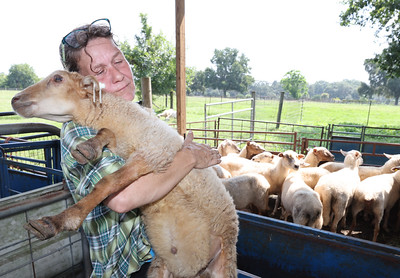
Cherokee Vadala, the farm manager, cradles a lamb as other sheep are shown gathered in a pen at the Fairmeadow Florida Cracker Sheep Farm on Northwest 60th Avenue north of Ocala, Fla. on Thursday, August 8, 2024. Writer Marian Rizzo recently visited the farm to do research for her 11th novel, “The Shepherd’s Walk, from the Manger to the Cross.” [Bruce Ackerman/Ocala Gazette] 2024.
After spending 30 years in the newspaper industry, I retired and started writing novels. The truth is, works of fiction also require a certain amount of factual information. Most of my written projects involve about 60% research and 40% writing. This point brings me to my current project, my 11th novel, “The Shepherd’s Walk; from the Manger to the Cross and Beyond.”
I got the idea for “The Shepherd’s Walk” while listening to a Back-to-the-Bible broadcast by radio host Dr. Woodrow Kroll. It was Christmas time, and Dr. Kroll said he would love to read a novel that takes a shepherd from the manger to the cross. I decided to give it a try.
My research involved books and other reading materials, of course, plus an internet study about shepherds in biblical times. But one thing was missing. I didn’t know what it feels like to be around a flock of sheep. Fortunately, I found a sheep farm right here in Marion County.
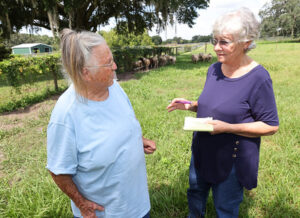
Marian Rizzo, right, interviews farm owner, Carol Postley, left, in a pasture with sheep nearby at the Fairmeadow Florida Cracker Sheep Farm on Northwest 60th Avenue north of Ocala, Fla. on Tuesday, July 30, 2024. Writer Marian Rizzo recently visited the farm to do research for her 11th novel, “The Shepherd’s Walk, from the Manger to the Cross.” [Bruce Ackerman/Ocala Gazette] 2024.
Carol’s sun-freckled face beamed with delight as she talked about her sheep. At 91 years of age, she still works the farm with the help of two full-time employees, Clay Meyers and farm manager Cherokee Vadala, who strolled among the sheep like she’s one of them. If they left her side, she drew them back with a clap of her hands or by shaking a container of corn. The rattle of the kernels got mamas and babies “flocking” around her. Cherokee also gathered up a 6-week-old lamb and held onto him while I got to pet his soft wool
Carol and her husband, the late Brooke Postley, purchased the Marion County acreage in 1989. For a short time they had a cattle business, but in the ’90s Carol started her sheep farm by purchasing 10 sheep from 4-H students at the Marion County Youth Fair. She insists the mineral-rich grass in this area is perfect for raising sheep.
“When you have this much grass, you gotta do something with it,” said Carol. “It’s wasted on horses. These are ruminant animals. They were made to live on grass. We separate them in small pastures. Then we move them around to give the grass a chance to grow.”
Carol estimates she currently owns about 100 ewes, an equal number of lambs, plus 20 rams, including a “teaser,” whose sole job is “to get the girls interested,” said Carol. “He looks like a ram, he smells like a ram, he baas like a ram, but he’s had a vasectomy. We put him in with the ewes and he runs around and they think he’s delicious. They all cycle, so the lambs are all born at one time.”
Until breeding time, Carol keeps her handful of rams separated from the ewes. Though this breed doesn’t have horns, it doesn’t stop them from butting heads now and then.
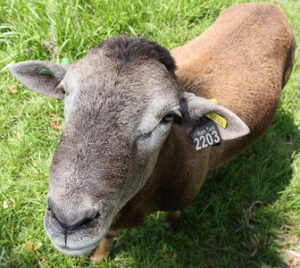
A sheep looks on in a pasture at the Fairmeadow Florida Cracker Sheep Farm on Northwest 60th Avenue north of Ocala, Fla. on Thursday, August 8, 2024. Writer Marian Rizzo recently visited the farm to do research for her 11th novel, “The Shepherd’s Walk, from the Manger to the Cross.” [Bruce Ackerman/Ocala Gazette] 2024.
As we drove around, Carol often referred to verses from the 23rd Psalm. “The Bible was written, obviously, by people who took care of sheep every day,” she noted. Her repertoire went something like this:
He maketh me to lie down in green pastures: “Sheep aren’t stupid,” Carol said. “They’re all out there lazing in the shade. They’re not out playing golf.”
He leadeth me beside still water is a reminder to take them to still water, not lakes or flowing rivers, she insisted. “Sheep can’t swim because they have small, hard hooves and a heavy woolen coat. It would be like you and me trying to swim in high heels. And if their coat gets wet it’s like swimming in a heavy woolen coat.”
Yea, though I walk through the valley of the shadow of death, I will fear no evil; for thou art with me. “The shepherd is with them, and they have confidence in the shepherd,” explained Carol. “If they’re going down in the valley there could be something new that they’ve never seen before and they stop dead. They’ll stamp their feet and go “woof,” and make a funny little sound, which catches all the sheep. They’re communicating that there’s something new there.”
According to Carol, there are many different breeds and cross-breeds. She prefers Cracker sheep because they adapt well to the Florida climate and are resistant to parasites. She’s been crossbreeding her Cracker sheep with some from Maine she purchased at the University of Florida ram show. Because they have hair instead of wool, those sheep can tolerate the warmer climate and they don’t need to be sheared.
“We’ve been working on a new line for over 20 years,” Carol said. “We’re hoping to make them healthier and parasite resistant.”
It’s no different from biblical days, when cross-breeding also was common. “Who would think in the Bible they were playing genetics?” she said with a chuckle.
Of course, the sheep-raising industry has changed since the days of King David. Back then they didn’t have chutes for getting the lambs in line to check their health. Nor did they have the large electric shearing clippers in use today. Early on they used to pluck the wool, said Carol.
Ultimately, Carol straightened me out on a few misconceptions. I learned that a shepherd doesn’t castrate sheep so they will gain weight for the market. It’s done to prevent the less-than-perfect ones from breeding. I also learned that except for worming, warding off pesky flies, and watching for white eye and other diseases, little more needs to be done in the care of sheep. I had my hard-working shepherds combing, raking, bathing, and pulling burrs out of wooly coats that didn’t need it. Since sheep herding requires a lot less effort, my shepherds are going to get a much-needed rest. Most importantly, I should not have had my shepherd drive his sheep onto the plain like he would a cow or a bull. Now my shepherd leads his flock from one pasture to the next, walking before them, and they simply follow, like—well, like sheep.
Not all of my writing projects allow me such an up-close and personal opportunity. For example, when I wrote “In Search of the Beloved,” I had never been to Ephesus or Patmos, so I talked to people who’d been there. I also did virtual tours on the internet, and I interviewed by email a manager of a hotel on the Isle of Patmos. Readers told me it read like I’d actually gone there, but I only got there by osmosis.
This first-hand experience helped me to understand what it might have felt like to be a shepherd. I learned that sheep are shy, laid-back animals, and it can be very calming to hang out with them. In fact, Carol claimed she sometimes steps away from a sinkful of dirty dishes and just comes outside, leans on the fence rail and breathes in her sheep, like “tranquilizers,” she said with a smile.
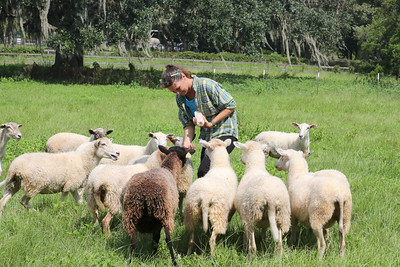
Cherokee Vadala, the farm manager, feeds ewes in a pasture at the Fairmeadow Florida Cracker Sheep Farm on Northwest 60th Avenue north of Ocala, Fla. on Thursday, August 8, 2024. Writer Marian Rizzo recently visited the farm to do research for her 11th novel, “The Shepherd’s Walk, from the Manger to the Cross.” [Bruce Ackerman/Ocala Gazette] 2024.

Support community journalism
The first goal of the Ocala Gazette is to deliver trustworthy local journalism so corruption, misinformation and abuse are not hidden from the public or unchallenged.