
A living history lesson
The “Rains Battle: Fort King’s Fort King’s Most Desperate Hour” reenactment recalled one of the events that helped shape Ocala and Marion County.
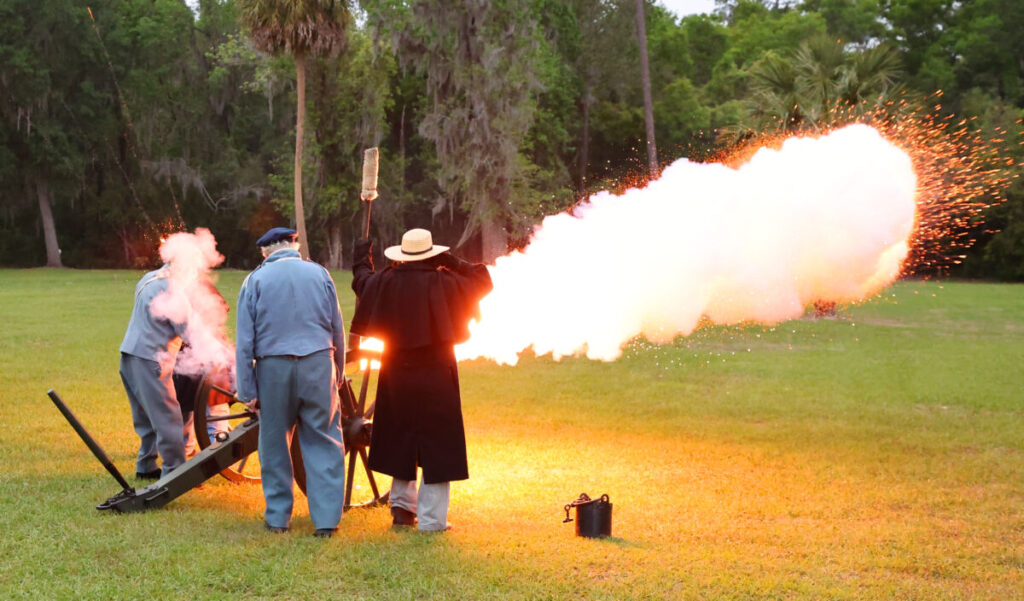
Reenactors fire an 1842 12-pound Mountain Howitzer during the ÒRains’ Battle: Fort King’s Most Desperate HourÓ battle reenactment at Fort King National Historic Landmark in Ocala, Fla. on Saturday, March 28, 2026. The ÒRainsÕ BattleÓ brought to life the conflict between Captain Gabriel J. Rains and his troops and a small, highly mobile band of Seminole warriors, a pivotal moment in local history. On April 28, 1840, Captain Gabriel J. Rains went on a mission to the Ocklawaha River with 16 other soldiers. As they were returning, they were ambushed by a Seminole war party. It was a desperate fight just trying to make it back to Fort King. Reports indicated that 3 soldiers died of their wounds and just about all were wounded in some fashion. Rains was wounded so badly that his newspaper in New Bern, N.C. published his obituary. Rains did not die, he recovered. Frustrated at trying to combat an opponent that could appear, wreak havoc and then vanish back into the forest, Rains had set an explosive device nearby by a nearby spring rigged to a soldier’s jacket. It was one of the first IEDs (Improvised Explosive Devices) in history. The Seminoles discovered the bomb and detonated it, then waited in ambush for the soldiers to respond. Rains would survive his time as post commander at Fort King and go on to develop what at the time were called torpedoes (known today as mines). He developed both land and sea mines and is largely credited with inventing them. The first land mines deployed in combat were in 1862 during the Peninsular Campaign of the American Civil War. Sea mines placed in Mobile Bay during the Civil War were made by Rains. When Admiral Farragut famously said, “damn the torpedoes,” he was referring to RainsÕ mines. All this from a tiny action in a backwoods section of Florida territory at Fort King. [Bruce Ackerman/Ocala Gazette] 2026.
History came to life on the evening of March 28 at the Fort King National Historic Landmark in Ocala. Dubbed the “Rains Battle: Fort King’s Most Desperate Hour,” the reenactment captured the events of April 28, 1840, when soldiers were ambushed by Seminole Indians.
“Capt. Gabriel James Rains went on a mission to the Ocklawaha River with 16 other soldiers. As they were returning, they were ambushed by a Seminole war party. It was a desperate fight just trying to make it back to the fort. Reports indicated that three soldiers died of their wounds and just about all were wounded in some fashion. Rains was wounded so badly his hometown newspaper in New Bern, North Carolina, published his obituary. Rains did not die. He recovered,” according to Scott Mitchell, coordinator of the Silver River Museum & Environmental Education Center, which is a program of Marion County Public Schools.
“Frustrated at trying to combat an opponent that could appear, wreak havoc and then vanish into the forest, Rains had set an explosive device by a nearby spring rigged to a soldier’s jacket. It was one of the first IEDs (improvised explosive devices) in history. The Seminole discovered the bomb and detonated it, then waited in ambush for the soldiers to respond,” Mitchell continued.
According to Mitchell, Rains survived his time as post commander at Fort King and went on to develop torpedoes, known today as land and sea mines.
The national landmark, which includes a reconstructed fort, walking trail, welcome center and archaeology resource center, is owned jointly by the city of Ocala and Marion County, and is supported by the Fort King Heritage Foundation, Inc. The city of Ocala website notes that Fort King played a pivotal role in the Second Seminole War, the longest and most expensive conflict between the United States and Native American tribes.
“It tells the powerful story of a young nation expanding into Florida and the Seminole people’s fight for survival. This historic site offers a deep look into the complex history of U.S. expansion, Native American resistance and the shaping of the state of Florida,” the site states.
Among the many events that take place at Fort King, such as festivals and ongoing programs, this was the first historic reenactment of the Rains Battle.
On Saturday, the event opened with blacksmith demonstrations, with hand-forged items available for purchase, and Vandall Samuels, a Seminole flute player, providing entertainment.
In an unscripted turn of events, the weather turned a bit nasty and cold.
Helping to coordinate the reenactment were the city of Ocala’s Outdoor/Historical Resource Archaeologist Samantha Jarvis and Fort King Program Coordinator Andy Warrener.
“This inaugural event was a meaningful and memorable experience for the community and band of historians. Despite the unexpected and dramatic shift in weather, dropping 20 degrees violently fast, the program ultimately exceeded expectations. While some attendees briefly sought shelter, some huddled around the forge’s warmth to learn about blacksmithing,” Jarvis noted.
“Folks returned to the stands before sunset, bundled in blankets and wool hats, creating a full and energized audience by the 7 p.m. main event. A special treat included a flute introduction performed by special guest and Seminole tribal member Vandall Samuels. This layered event was more than a reenactment; it was a vivid example of innovative outdoor recreation and public programming. Watching the spark of an idea come to life was truly inspiring,” she continued.
“We had a turnout of between 130 and 140 people, most of whom were attending an event for the first time at Fort King,” Warrener said.
“The battle scenario went exactly as planned and really wowed the audience. We had a fictional recounting of the battle by myself and Vandall Samuels, from both the soldier and Seminole points of view, combined with a reading of Capt. Rains’s actual account of the battle. It ended just as the firing in the woods commenced. It was almost perfectly choreographed,” Warrener explained.
“We were able to provide both the historical context of the battle and give the audience an up-close and personal experience of its reenactment. Embedded spectators who accompanied the soldiers on their march had the time of their lives. This is something we will try to do again in some capacity. The audience and reenactor feedback was universally positive. We were very pleased,” he added.
The more than 40-acre Fort King National Historic Landmark campus was designated in 2004. Ongoing programs there include classes in pioneer skills such as cast-iron cooking, archaeological exploration and more.
On April 11, the venue will host a Gopher Tortoise Appreciation Day from 10 a.m. to 2 p.m., featuring Second Saturday Living History demonstrations throughout the event for additional interactions with historians and educational partners, Warrener noted.
The Fort King National Historic Landmark is located at 3925 E. Fort King St., Ocala.
To learn more, go to fortkingocala.com and ftking.org



Support community journalism
The first goal of the Ocala Gazette is to deliver trustworthy local journalism so corruption, misinformation and abuse are not hidden from the public or unchallenged.