
Rails to ranches: 150 years of Anthony
From its early beginnings, this small town has been home to a diverse population and has seen many changes and challenges.
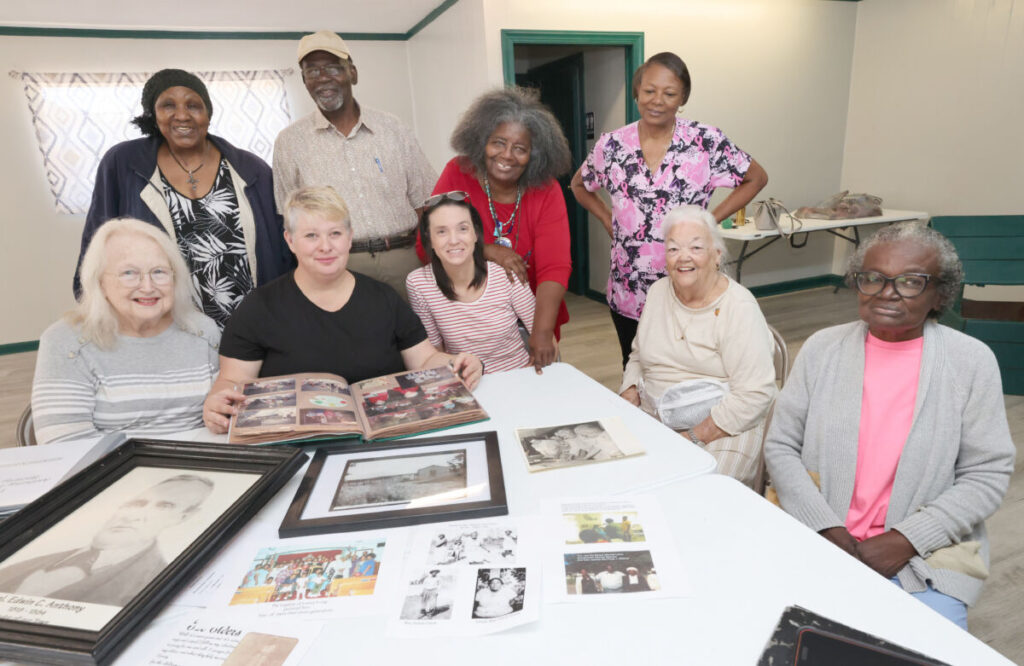
Members of the Anthony Historical Society, front, from left, Bertha Krietemeyer Flynn, Shelia Castro, Christina Scott, Joyce Hooker, and Betty Mitchell Oliver, and back, from left, Priscilla Lewis-Swinton, Lincoln Mitchell, Janet Mitchell-Silverhawk, and Djuna Poole, look over historic photos of Anthony during a meeting of the Anthony Historical Society at the Anthony Woman’s Club in Anthony, Fla. on Friday, April 24, 2026. On May 16, 2026, Anthony will be celebrating its 150th anniversary. [Bruce Ackerman/Ocala Gazette] 2026.
|
Getting your Trinity Audio player ready...
|
There is a small town in north Marion County that has a history rich in cultural diversity, is deeply rooted in agriculture, was part of the early railroad expansion in the area and has residents who share an affinity for its uniqueness.
Anthony, which can trace its beginnings to the mid-1800s, when a migration of settlers from South Carolina into Marion County began, will celebrate its 150th anniversary this year.
The Anthony Historical Society will host a Founder’s Day Celebration from 10 a.m. to 4 p.m. May 16, with the theme Rails to Ranches, 150 years of Anthony, Florida. The event, which will take place at the Anthony Community Park and the adjacent Anthony Woman’s Club, will include historical memorabilia, vendors, live music, food trucks and more.
According to historical information online, in 1883, the Florida Southern Railway extended through the area and connected Anthony to markets in Ocala and beyond. In addition to its agriculture and cattle farms, a late 1880s phosphate boom accelerated growth in the area. Anthony was incorporated as a town in 1892. In the 1930s, the town faced financial challenges that were too steep to overcome and residents voted for dissolution, after which the town transitioned to unincorporated status within Marion County.
Today, notable town entities are Anthony Elementary School, several small businesses, the Jumbolair Aviation Estates, of which noted actor John Travolta is a resident, and numerous equine and agriculture related properties.
According to Bertha Krietemeyer Flynn, who was born in Munroe Memorial Hospital, which is now AdventHealth Ocala, and was raised in Anthony, it was almost two years ago that she and Shelia Castro, who was raised in Anthony until age 11 and moved back seven years ago, began to talk about the history of the town.
Materials provided by Flynn note that they sat together with a shared worry: that the stories of Anthony — its pioneers, farms, railroad days and families — might fade if no one stepped forward to protect them. That concern, and the love behind it, became the spark that created the Anthony Historical Society.
Among this area’s pioneering families were the Leitners, who settled in several communities within Marion County. According to Annabelle Leitner, who lives with her sister Nancy on the family’s pioneer heritage farm in Shiloh, in northwest Marion County, and who is a noted local historian, the name of Anthony can be traced to Col. E. C. Anthony from Muncie, Indiana.
“Jacob Leitner and his wife Charlotte Souter Leitner were my great-great-grandparents. Jacob is the one who, according to Leitner family tradition, sold one of his plantations to Col. Anthony for what was to become Anthony Place, then later Anthony,” Leitner wrote via email.
“Jacob and Charlotte’s eldest son, George Wesley Leitner, who was born circa 1835, was my great-grandfather and moved with his parents and his siblings to Marion County in the 1850s. When he married Caroline Lavinia Geiger in May 1866 at the Central Lutheran Church, he moved to the Shiloh area, where Caroline’s family had been since 1827, when the area was known as Wanton. My grandfather, Benjamin Franklin Leitner, knew his Anthony relatives but we did not. The Anthony Cemetery started as the original Leitner burial ground in Marion County,” she wrote.
Flynn, who is president of the Anthony Historical Society, also is a descendant of Jacob Leitner. During a recent interview with her and several other society members, inside the Anthony Woman’s Club, of which she also is a member, she noted that, “I think the property that we are standing on, Jacob Leitner got in a land grant. Some of his children had moved on to Oak so he sold part of his land grant to Mr. Anthony and that’s how Anthony got started.”
Flynn said that not long after she and Castro started working together, word spread through the community and people began sharing photographs, letters and more.
“Longtime residents sat down to record memories of citrus groves, train whistles and the rhythms of small‑town life. Meetings filled with people eager to help — some researching, some organizing archives, all united by pride in the place they call home. What began as two founders soon became a community effort,” she offered.
“The sesquicentennial is more than a date on a calendar; it is a tribute to resilience, to the agricultural and railroad roots that shaped the town, and to the pioneer families whose determination built a community that still thrives. The Anthony Historical Society stands at the center of this celebration, not as an observer, but as a guardian of the legacy being honored,” Flynn shared.
Flynn attended elementary school in Anthony and graduated from Anthony High School in 1961, then briefly attended Central Florida Community College (now the College of Central Florida). She became a bookkeeper at Seminole Feed and Sun Bank, then started Frank Flynn Studio with her husband Frank Flynn in 1973.
“I am a sixth generation Marion County resident and a direct descendant of Gabriel Priest, who was the first senator who founded Marion County,” she said.
Flynn has two children, who both live in Anthony. She said it is important to preserve local identity.
“Small communities often don’t get much attention, so their stories, from families who lived there for generations, local traditions and even hardships, can be lost if they aren’t acknowledged. Keeping that history alive helps residents stay connected to their roots,” she said.
CONNECTED COMMUNITIES
Among those also in attendance at the recent interview session were Castro, Joyce Hooker and her daughter Christina Scott, Betty Louise Mitchell Oliver, Djuna Poole, Lincoln Mitchell Jr., Priscilla Lewis-Swinton and Janet Mitchell-Silverhawk.
“I am related to Jacob Leitner, who got a land grant from Spain. They came from South Carolina and he had 10 kids. Bertha Flynn is related too. There’s a lot of us,” Scott said later in a phone conversation.
“My dad owned a bar in Eureka. When he came to get his hunting license, my mom was there to sell them and that’s how they got together. When my dad retired in the ‘60s, they built a general store near Lake Kerr and Salt Springs. When my grandmother died, my dad moved to our property in Anthony. I was born in the hospital in Ocala and raised here on this property. This farm has been handed down through the generations, from Jacob Leitner’s daughter to her daughter to my dad and now to me and my kids,” Scott explained.
“My dad often said he thought it was the second oldest homestead in the county, but I don’t know that for sure. It’s been called Springhill farm since the 1800s and at one point was called Keeney Hill after my great-grandmother, who was born here and lived here her whole life,” Scott added.
As for why history should be preserved, Scott offered, “You ought to know who you are.”
“And I think it’s important because of what they had to do to settle this area back then, the risks, the struggles, for us to have a great life,” she added. “Our forefathers really struggled. Life was not easy. We’re just spoiled.”
Mitchell-Silverhawk said members of her family settled in the Mt. Olive community adjacent to Anthony pre-1845.
“We are part Muskogee and Cherokee and Shosone. Mt. Olive was here in the beginning. Everybody knew the Anglo people lived in Anthony and the Black and Native people lived in Mt. Olive,” Mitchell-Silverhawk said. “I was born in 1956, but I grew up with people born in the 1870s who gave us oral history and said never forget who you are.”
She said that Black and indigenous people did not receive the Spanish land grants that were given to many of the early settlers.
“Grandpa George had to go through Paynes Prairie because he wasn’t allowed to ride the ferry from Micanopy to Gainesville, so he had to pay for his land. Black people didn’t get the grants, they had to buy the land, and that’s how we got ours,” she stated.
Mitchell-Silverhawk was raised in Anthony/Mt. Olive and Tampa. She attended the two-room Mt. Olive School for a time. She continued her education in Tampa and later worked in commercial advertising art with the Work-Color Corporation of America. She returned to Anthony in 1988 and worked with the US Postal Service from 1989-2013.
“I love history. Your first history lessons come from listening to your elders as they tell their life stories,” she said.
Mitchell-Silverhawk said Mt. Olive African Methodist Episcopal Church, of which she is a member, will have a booth at the upcoming Founder’s Day event.
Lewis-Swinton also attended Mt. Olive Elementary School, as well as Fessenden High School, Bullard-Haven Technical School in Connecticut and the Connecticut Business Institute. She had a career in commercial banking.
She said her family bloodline “reached from France to Sugarhill, which was known as the Negro side of Anthony. The area where the school currently is, was uptown for us to shop on Saturdays at Mrs. Nell Baskin’s store.”
As for some of her favorite memories of living in the Anthony area, she mentioned “going to school every day. Working the fields, orange groves, picking up work hands, which gave us opportunities to meet various types of people.”
“I loved the outdoors, working with flowers and enjoying the chickens, cows, hogs and horses sometimes. We passed our time playing horseshoes, volleyball, softball, hopscotch, marbles and jacks. We had the Sunshine Band on Saturday for all the children in the communities of Mt. Olive, Sugarhill and Irvingville,” she recalled.
“Church on Sunday was a must,” she added. “One of my grandmothers was Methodist, one Baptist and my mother was Holiness. We had to attend every one of those services when we did not have services at the Holiness church. I had the best of three worlds, the Father, the Son and the Holy Ghost, which prepared me for many trials and failures, but through them all, I’ve learned to trust in God.”
Castro attended elementary school in Anthony, then moved away at age 11. She attended Union University in Jackson, Tennessee. She returned to Anthony seven years ago and currently is the manager of the Dollar General store. She and her husband, Alfredo, have five children.
She said some of her favorite memories of the town were “climbing on Philip Woods’ fence while he fixed our family cars, and eating off the side of the road, whether it was oranges, pecans, honey suckle or green onions.”
She believes local history should be preserved, “So it doesn’t die. So many towns fade away, but Anthony is 150 years strong and we’d like to keep going.”
Mitchell was born and raised in Anthony. He attended Mt. Olive School from first through eighth grade and graduated from Fessenden High School in nearby Martin. He joined the U.S. Army on July 1, 1964, and retired as a sergeant major in 1994. He later worked with Marion County Solid Waste, from which he also retired. He said he joined the Anthony Historical Society because he wanted to learn more about the history of the area.
Betty Louise Mitchell Oliver said she was born in 1941 and was “raised in the Mt. Olive settlement, now known as Anthony.”
She attended Mt. Olive School and Fessenden High School. She worked at Morriston Cafeteria and in contracted field work, and attended New Hope Baptist Church, originally located in the fork of the road where Olson Car Repair is now, which later relocated to 86th Lane.
“I come from a large family, and I feel it is important for our next generation to know the history of Anthony before it became Anthony,” Oliver said.
FOUNDER’S DAY
The event on May 16, from 10 a.m. to 4 p.m., will include a number of vendors and displays of memorabilia.
“We will have local bands and our friend, Brian Canyon, who is a hometown boy from Anthony, will be playing, and he has lined up some other people for the day,” Castro said.
She said the day will include food, games and activities, and that the Ocala Model Railroaders has two set-ups of the Anthony area and will bring one of them to be displayed inside the Anthony Woman’s Club building.
“We will have information about our history and have items out that people can see,” Flynn added. “We’ll have books calendars and T-shirts for sale.”
Flynn noted that the group would like, at some point, to find a space in which they could permanently display their collected memorabilia.
“We have a lot of we have items from the old Anthony High school that was here and items dating back to that. We have old guns and stuff from used to be a jail here,” Castro said.
“I have my white sweater with my leather A on it I got in basketball,” Flynn said with a big grin.
The Anthony Woman’s Club is located at 2120 NE 95th St.; the Anthony Community Park is at 2150 NE 95th St.
To learn more about the group, email [email protected] or find them on Facebook.



Support community journalism
The first goal of the Ocala Gazette is to deliver trustworthy local journalism so corruption, misinformation and abuse are not hidden from the public or unchallenged.