
PTSD summit planned in Ocala
The event, set for Oct. 28, is geared toward veterans and their families.
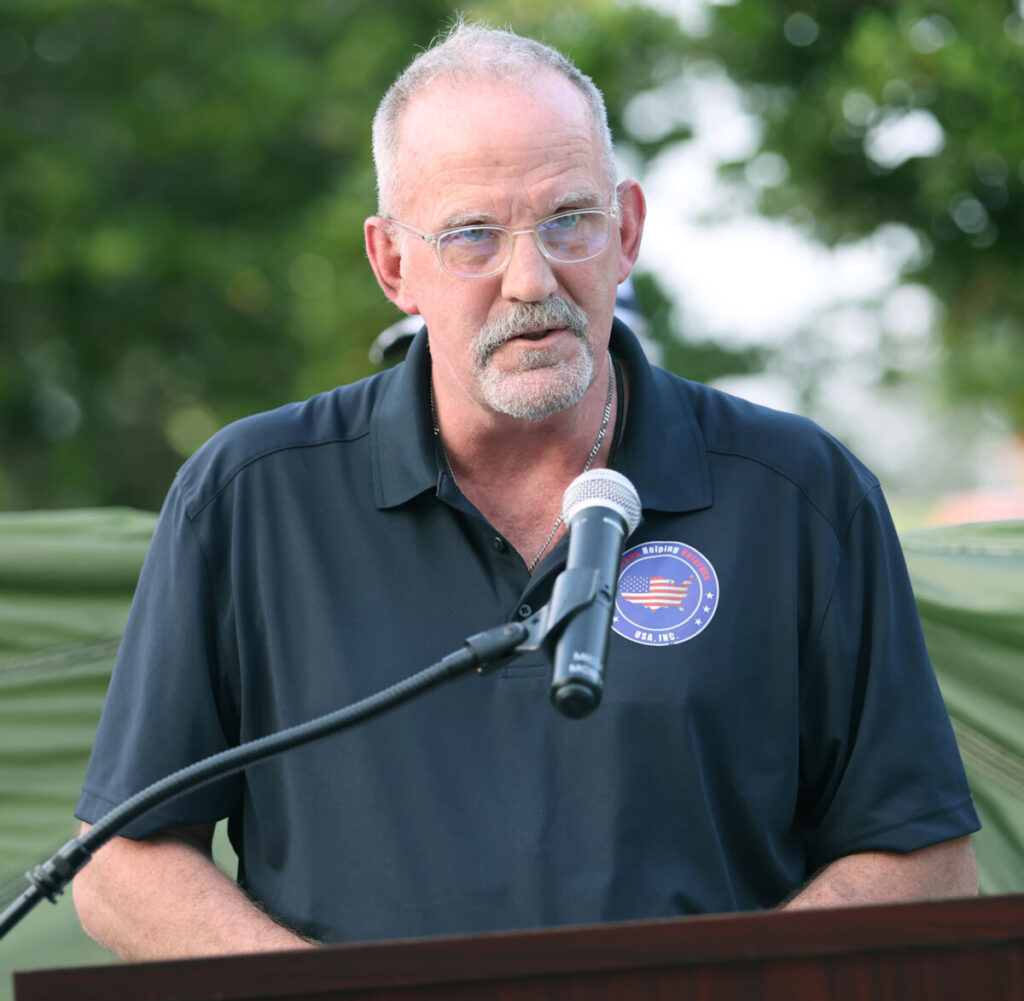
Todd Belknap, executive director of Veterans Helping Veterans of Marion County, speaks during an event at the Ocala-Marion County Veterans Memorial Park in Ocala on Nov. 10, 2024. [Bruce Ackerman/Ocala Gazette file photo]
Veterans Helping Veterans USA of Marion County will host A Call to Action: Veteran PTSD Summit for veterans, first responders who are military veterans and their families on Oct. 28 in Ocala.
VHV wants to give local veterans a chance to voice their concerns about post-traumatic stress disorder related issues and discuss if their concerns are being “effectively addressed” by veteran help agencies, according to a statement released by VHV.
The summit will take place at the Elliot Center at 3231 SW 34th Ave.
Todd Belknap, executive director of VHV, has spearheaded the effort to launch a “grassroots based listening tour” to be sure each of Marion County’s 32,968 veterans, according to the Department of Veterans Affairs website, va.gov, can have their opinion heard.
“At Veterans Helping Veterans USA, we welcome hundreds of veterans and their families through our doors every month. In August we served 368 veterans,” Belknap stated.
“Some veterans are satisfied with services provided by the VA but many other veterans, along with their spouses and families, have shared with me that there is a growing disconnect between the respective issues they seek help with, and the actual care provided,” stated Belknap.
“We’re going to anonymously track their complaints and take a hard look at trends and patterns. Then, the findings are going to the Secretary of the US Department of Veterans Affairs for review and action,” he added.
Belknap indicated the comments and concerns would be delivered to VA Secretary Douglas Collins by a representative of U.S. Representative Kat Cammack.
“We’re not just sending the complaints and suggested remedies up and chain and washing our hands. We’ll be following up to ensure our veterans are not being ignored,” Belknap stated.
Belknap stressed the importance of the summit and roundtable in light of two recent mass shootings reportedly allegedly carried out by military veterans.
“Since the summit announcement my phone has been ringing away with RSVP calls from veterans and their spouses alike. This is proof positive that a summit on PTSD is direly needed,” he said.
Belknap recently had a Vietnam War veteran in his office who was referred to VHV and accompanied by a fellow church member. The 70-plus year-old veteran had likely been isolated in his residence as he lacked reliable transportation. Belknap put him at ease with conversation and introduced him to a VHV staff member veteran who has “been there” and could share experiences with the client.
Belknap claimed if proper care is not sought, or is interrupted or delayed, the “already hurting psychologically” veteran can go into a “tailspin” from which families and nonprofits have to “pull them out of—over and over again.”
VHV is a private nonprofit not connected to the federal government’s Department of Veterans Affairs. According to vhvusa.org, the organization, established here in 2002, provides case management with financial assistance for rent and utilities, a fully stocked pantry and clothing, and information and access to a host of veteran help and support agencies, which can include housing assistance.
The VA’s National Center for PTSD provides a history of PTSD at ptsd.va.gov
“VA’s National Center for PTSD was created in 1989 by an act of Congress. We continue to be at the forefront of progress in the scientific understanding and treatment of PTSD,” the website states.
“Exposure to traumatic experiences has always been a part of the human condition,” the website states and “research about veterans returning from combat was a critical piece to the creation of the diagnosis. So, the history of what is now known as PTSD often references combat history.”
The website reviews the history of veterans and PTSD from “soldier’s heart” symptoms including anxiety and breathing difficulties of the Civil War era to panic and sleeplessness related to “shell shock” of World War I and the weariness and exhaustion of “battle fatigue” or combat.
The Diagnostic and Statistical Manual of Mental Disorders by the American Psychiatric Association has studied PTSD, according to the website. Edition five, DSM-5 of 2013, indicates “that PTSD is no longer an anxiety disorder,” the website states. “PTSD is sometimes associated with other mood states (for example, depression) and with angry or reckless behavior rather than anxiety. So, PTSD is now in a new category, trauma-and stressor-related disorders.”
The VA offers specialty PTSD care, including inpatient, and Vet Centers that are “often staffed by veterans, for support,” the website states. “These community-based centers focus on counseling and services to help with the transition from military to civilian life or after military trauma.”
The VA Performance Dashboard website states that in September, VA Health Care had 641,878 signed in users online, an increase of 39% since September of 2024. The material indicates that in September, 17,255 activities were completed related to applying for health care benefits online, with 89.2% of survey responders satisfied. In 69,099 activities related to scheduling and viewing appointments online, 69.3% of users were satisfied.
James Hilty Sr., a member of the Ocala City Council and VHV chair, and a combat veteran U.S. Marine of the Vietnam War, said he supports and will attend the summit.
Hilty said the VHV summit could help reach veterans who feel isolated and gather local leaders to discuss the PTSD issue in the wake of mass shootings in Michigan and North Carolina allegedly involving veterans.
“If we reach just one veteran perhaps one who didn’t seek help or who has had difficulty getting treatment, the summit will be worthwhile,” he said.
For information on the Oct. 28 PTSD Summit, call Veterans Helping Veterans USA of Marion County at (352) 433-2320 and visit vhvusa.org
To learn more about PTSD and help for veterans, call the Department of Veterans Affairs info line at (800) 698-2411 and the VA benefits line at 800-827-1000. Access the crisis line by dialing 988 and pressing 1, or texting to 838255.
To reach the Ocala Vet Center, call (352) 237-1947; for the Marion County Veterans Service Office, dial (352) 671-8422.

Support community journalism
The first goal of the Ocala Gazette is to deliver trustworthy local journalism so corruption, misinformation and abuse are not hidden from the public or unchallenged.