
Protecting seniors from fraud
About $1 million is stolen every month from local victims of elder fraud and several agencies are working to educate citizens about scams.

An 82-year-old Ocala woman lost $7,300 in cryptocurrency in an internet and phone-based scam last year and nearly lost $160,000 in cash, which she had converted to gold for pickup by the scammers.
The gold theft plot was foiled by a well-placed tip and diligence by detectives from the Marion County Sheriff’s Office Major Crimes Unit and officials from the Homeland Security department.
The scam began with a computer hack and an on-screen message to call a number to reach a technician to fix the hack, according to an arrest affidavit.
Soon after the hack and “repair,” a “bank officer,” supposedly from a major bank, called and informed the victim that her bank account had been compromised and that funds from new accounts opened in her name were being used to purchase child pornography and other illegal material, the affidavit stated.
The victim was told to withdraw $7,300, convert it to cryptocurrency and send it to a given location, which she did. She was then told to convert $160,000 in cash to gold to “safeguard” the funds and standby for instructions to give it to a “federal agent,” later identified as Jiann Cao, who appeared at her Ocala Palms home in northwest Ocala where deputies were waiting.
The owner of the gold exchange company in Jacksonville had altered law enforcement about the transaction.
MCSO Deputy Calvin Pope was the first deputy involved in the case and Det. Silas Caruthers served as investigator.
The phone scammer told the victim to send a photo of the gold and then seal it up and look outside her home for the “federal agent.” Cao,33, of Fontana, California, was arrested after he was seen with a backpack in the victim’s driveway and then approached the home and appeared to be working “in concert” with the phone scammer, according to the affidavit.
Coa was booked into the Marion County Jail on Dec. 12, 2024, on a no bond basis. He faces a charge of fraud or swindle for an amount in excess of $50,000.
MCSO Crime Prevention Cpl. John Remington offers a piece of long-standing advice that still applies to myriad types of modern internet fraud. Remington says post an imaginary “No Solicitors” sign at your internet door by not responding to unrequested emails and texts. He suggests to always verify the authenticity of the party, especially if you did not originate the communication.
Remington said that about $1 million is stolen every month from victims of elder fraud in Marion County.
A brochure detailing the presentation “Protecting Our Seniors from Fraud,” given by 5th Judicial Circuit State Attorney Bill Gladstone, states that common types of scams aimed at seniors include phone imposters, identity theft, investment and romance.
The most frequent, in order, according to 2023 FBI statistics are tech support scams, personal data breaches, confidences and romance scams, non-payment and non-delivery scams and investment scams, according to Gladstone’s presentation.
The State Attorney’s Office presentation includes a local money to gold exchange case as an example and discusses possible prevention, recovery of potential loses and possible arrests when an internet or phone crime is reported.
The role of the SAO, according to the presentation, includes investigation in cooperation with law enforcement, prosecution of offenders, helping victims understand the legal process and their rights, and advocacy for protective laws and improving the legal response to crimes.
The State Attorney’s Office for the 5th Judicial Circuit has also published the “Elder Fraud Resource Guide” in partnership with Marion Senior Services, Elder Options, the Ocala Police Department and the MCSO.
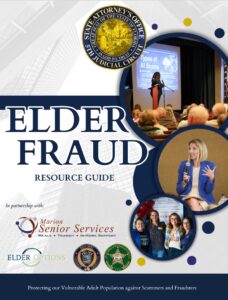 The resource guide identifies and discusses many of the types of scams aimed at seniors, how to protect and monitor your credit, the mental and emotional effects of scams like shame and guilt, safeguarding loved ones in ways like checking their finances for unusual amounts paid out and who to call for help.
Common scams against seniors include IRS imposters, Social Security imposters, Medicare and Medicaid imposters, tech support imposters, telemarketer and robocall frauds, investment scams, romance scans, contractor and home repairs scams, employment scams and sweepstakes, lottery and inheritance scams, according to the resource guide.
The scammers use three tactics: unexpected contact, building a sense of urgency and providing specifics to pay or send money, the guide states.
Some scams come in the form of “phishing” or a “too good to be true” email or text arrives, “tricking” the victim into opening an email, pop up message or text message.
Mail fraud is also discussed in the resource guide and citizens are urged to pick up mail promptly and shred correspondence.
The Ocala Police Department made an arrest in July of 2024, of then 42-year-old Weikai Zhang, from Winter Garden, who “nearly robbed a 74-year-old (living in a southwest Ocala gated community) of her retirement savings and her way of life.”
The scheme in the OPD arrest was similar to the Ocala Palms case and involved converting currency to gold for pick up by the scammer.
According to the arrest affidavit, OPD Cpl. Luis Camacho Garcia, was deputized by the MCSO and as a task force officer for the Department of Homeland Security. Homeland Security Investigations had information that an individual here might be the victim of an “Asian call center.” HSI confirmed with the victim that a “call center” contact had convinced her that her computer had a virus, and she allowed access to her computer under the guise they would help her.
According to the affidavit, the scammers gained access to the victim’s financial records and told her that her money was at risk and convinced her to liquidate $500,000 in cash to gold. The victim was put in touch with a broker who sold her six kilos of gold for $500,000 and was told that the gold would be picked up by a federal agent and “kept under federal custody until it was safe.”
HSI agents went to the victim’s residence and learned the gold had not yet been delivered.
They said the victim was surprised about the scam but was very glad law enforcement intervened.
The victim received a call from the “call center” to verify the six kilos of gold were delivered to the residence. Information soon indicated the “courier” had arrived to pick up the gold, the affidavit indicated.
Zhang was seen driving “up and down in a suspicious manner” near a clubhouse outside the gated residence area and a check of the vehicle’s license plate found the registered owner, later confirmed as Zhang, had a driver license that was suspended in 2022 and the vehicle tag expired in 2023.
As law enforcement information indicated the “courier” had arrived, Zhang allegedly had a cell phone in operation and a map app and GPS directions to a redacted residence, the affidavit states.
The affidavit states Zhang’s primary language is Mandarin and an interpreter was provided.
He was arrested and charged. There is no statement by Zhang in response to the charges provided in the redacted affidavit.
Zhang was booked into the Marion County Jail on July 9, 2024, and released July 10, 2024, after posting a $61,000 bond, according to online records.
The three charges listed against Zhang in jail records are organized fraud ($50,000 or more), improper use of a two-way communications device and driving while license suspended (second offense).
The Florida Department of Agriculture and Consumer Services warns at fdacs.gov about another development in scams—the use of artificial intelligence (AI), which “mimics human thinking or actions” to fool victims into believing they are dealing with a different party, such as la loved one.
The website states that although AI is found in positive applications, “scammers have also found ways to twist the benefits of AI for malicious purposes.”
“Scammers can use AI technology and audio data collected online to clone the voice (consumer.ftc.gov/consumer-alerts/2023/03/scammers-use-ai-enhance-their-family-emergency-schemes) of a child, grandchild or other family member to convince a victim that a loved one is involved in a crisis and needs immediate financial assistance. This could be used in something like a grandparent scam, an emergency scam or a fake kidnapping scam,” the website states.
A recent post on the MCSO Facebook page states that a local woman was taken in by a scam similar to one involving another female victim, which is detailed in an AARP online article posted July 25, 2025. The article details how the victims began online playing the online game Words with Friends and made contact with a man who “claims to be actor Keanu Reeves.”
“While initially skeptical, the video chat and voice messages he sends eventually convince her of his identity. As the relationship deepens over three years, ‘Keanu’ will borrow thousands of dollars,” the article stated.
To see a copy of the Elder Fraud Resource Guide online, go to sao5.org/wp-content/uploads/2025/06/Marion-Elder-Fraud-Resource-Guide-2025.pdf

Support community journalism
The first goal of the Ocala Gazette is to deliver trustworthy local journalism so corruption, misinformation and abuse are not hidden from the public or unchallenged.