
OPINION: Cholera and homelessness
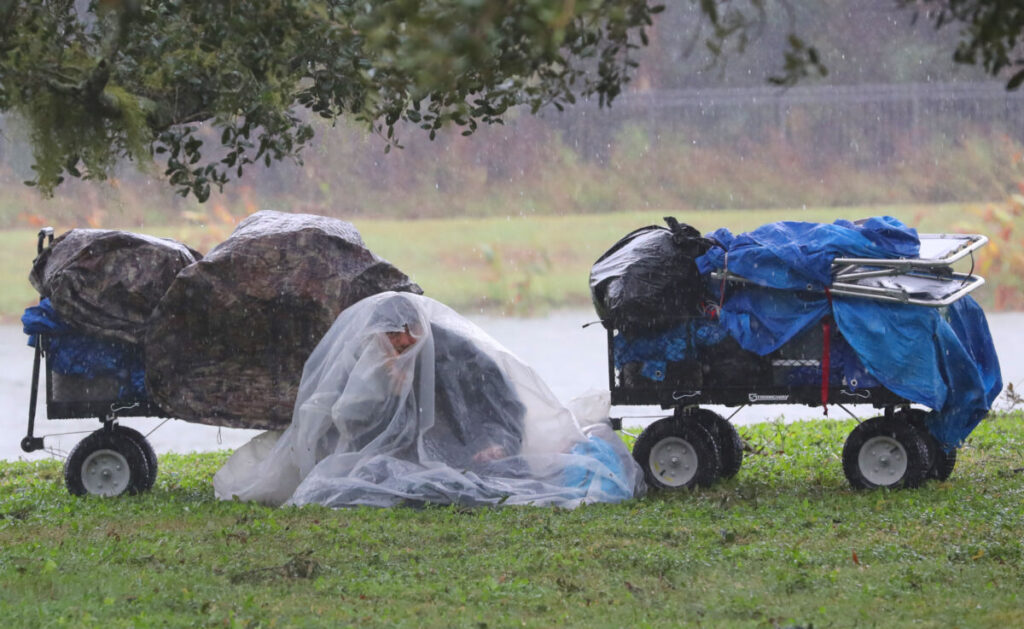
An unidentified homeless man hunkers down under a plastic tarp near Lake Tuscawilla in Tuscawilla Park in Ocala. [Bruce Ackerman/Ocala Gazette file photo]
Cholera
In 1854, London had a bad cholera outbreak. Doctors worked around the clock. They treated patient after patient — fever, cramps, dehydration. Some survived. Many didn’t. And every morning, there were new patients at the door.
Nobody stopped to ask why. They just worked tirelessly to treat the patients.
Then a doctor named John Snow (not the character from “Game of Thrones”) did something simple. He drew a map. He marked every death in the neighborhood and looked for a pattern. Every single one pointed back to the same water pump on Broad Street.
The water was contaminated. Everyone who drank from it got sick. Dr. Snow walked over to Broad Street and removed the handle on the pump. The outbreak stopped almost immediately.
Homelessness
In 2024, Veteran’s Administration (US) housed nearly 48,000 homeless veterans. That’s fantastic, right? Not so fast. The total number of homeless vets in the United States only dropped by 2,700 people.
Why is that? In the same year, about 45,300 veterans became homeless.
The math is simple:
48,000 vets left homelessness
45,300 vets entered homelessness
A total reduction of only 2,700 vets.
It is called the “inflow problem.”
About 10 years ago, I ran the numbers at the shelter where I worked. In a typical week, 16 people became homeless and arrived at our door. That meant just to keep our numbers the same, we had to get 16 people out of homelessness every single week.
Homelessness is like cholera
Our world’s approach to homelessness right now is like the doctors running around London in 1854. We are working really hard to get people out of homelessness back into homes. And we are doing a great job! So, why isn’t homelessness going down?
Because for every person we get out of homelessness, one (or more) people become homeless. How do we remove the “pump handle” on homelessness?
The research is clear: lack of affordable housing is the contaminated well.
The good news is that affordable housing is fixable, therefore, so is homelessness. The bad news is, it won’t be cheap or politically popular.
There are two realities that we cannot avoid:
- Until we get serious about affordable housing, homelessness is here to stay.
- If housing continues its current trend away from affordability, homelessness is going to get worse.
Thank you to everyone working on creating more affordable housing and thank you to everyone working on the frontline of the homeless crisis (shelters, street outreach, etc.).
Source: “What Would It Take to End Homelessness in the United States?” — Colburn et al., Housing Policy Debate, 2025
Ryan Dowd was executive director of a homeless shelter for 20+ years outside of Chicago, Illinois. He now trains organizations around the world on how to de-escalate challenging situations involving homelessness, mental illness, trauma, substance abuse and more. To find out more, visit homelesstraining.com.

Support community journalism
The first goal of the Ocala Gazette is to deliver trustworthy local journalism so corruption, misinformation and abuse are not hidden from the public or unchallenged.