
OPINION: A promise made, a trust tested
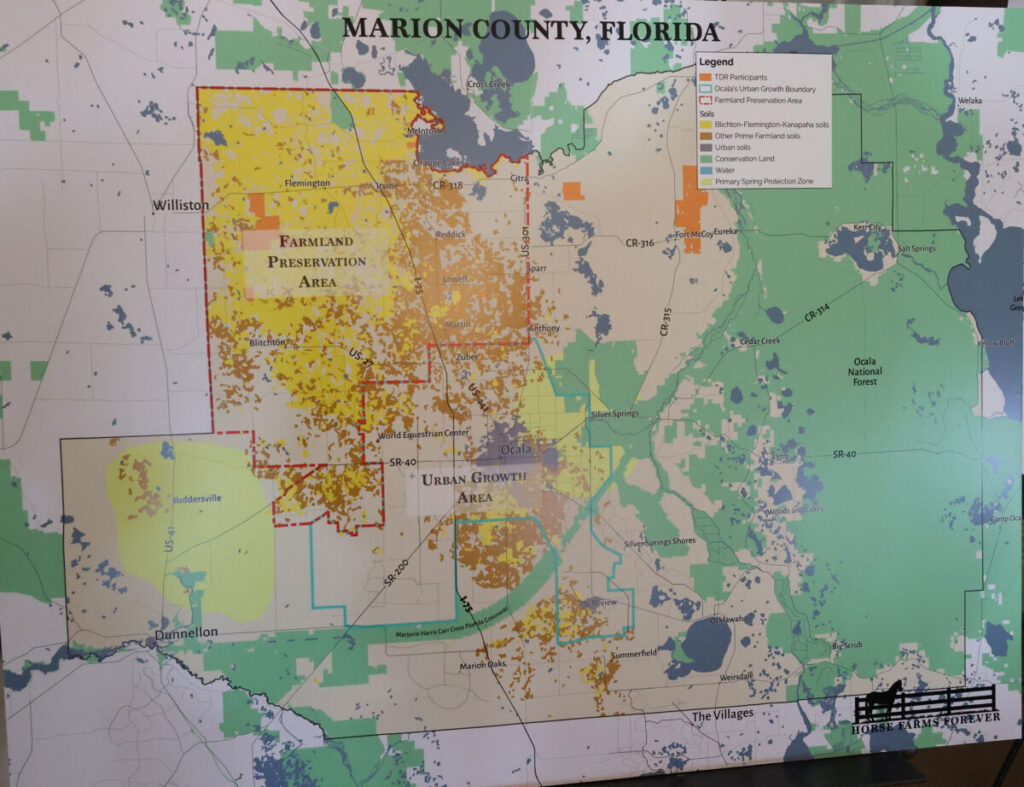
This map of Marion County, on display during a Horse Farms Forever conservation summit in 2020, shows the Farmland Preservation Area. The mission of the nonprofit HFF is to raise awareness and provide education to ensure the character and culture that horses and horse farms bring to Ocala/Marion County are protected for future generations. [Bruce Ackerman/Ocala Gazette file photo]
The Marion County Commission’s 5-0 vote to approve a large-scale sports complex and concert venue at the World Equestrian Center (WEC) is more than a major land-use decision — it marks a turning point in how seriously this community’s long-standing commitments to rural preservation will be honored.
For months, the Roberts family, which owns WEC, has acted with confidence that this approval was inevitable, moving forward with preparations on land that was, until now, understood to be protected in character and intent. Now, their confidence appears well-placed.
But for many Marion County residents, especially those who have built lives, businesses and investments around the promise of rural protection, the decision feels like something else entirely: a breach of trust.
Ten years ago, the county made a significant exception to its Farmland Preservation Area to allow 1,000 acres to be subsumed into the World Equestrian Center. That exception was not arbitrary. It was rooted in a shared understanding that equine uses, even at scale, were compatible with the surrounding rural landscape and culture. Horses, after all, are integral to Marion County’s identity.
The nonprofit Horse Farms Forever organization, which has a mission to raise awareness and provide education to ensure the character and culture that horses and horse farms bring to Ocala/Marion County are protected for future generations, expressed its disappointment in the board’s decision, writing to the “Gazette,” “When Golden Ocala Equestrian Land asked the county to move the boundary of the Farmland Preservation Area, they promised to build the World Equestrian Center. Golden Ocala kept that promise and what they have built is spectacular. It shows a passion for equestrian activities and has changed Ocala forever. We applaud their efforts and thank them for being founding members of Horse Farms Forever.
“However, the WEC Sports Complex has nothing to do with horses. Instead, it puts an intense commercial activity on property reserved for low density residential equestrian estates meant to act as a transition to the Farmland Preservation Area. Its approval corrupts the integrity of our comprehensive plan and land development code.”
Additionally, a previous settlement agreement between WEC, longtime local thoroughbred breeder Charlotte Weber of Live Oak Stud, et al, and the county clarified that the 250 acres of that part of WEC would be zoned solely for equestrian estates on 3- to 10-acre lots. The county attorney has dismissed that agreement, saying it wasn’t meant to be in perpetuity. Notably, the agreement did not specify a sunset date, either. So much for the county’s promise to area residents.
What was promised was a tailored exception. What is now being delivered looks far more like a precedent.
The newly approved project includes not only more than a dozen sports fields, but also a concert and events component — one that could grow to as many as 24 concerts per year. These are not equine uses. And these are not minor additions. They bring noise, traffic, lighting and intensity that surrounding horse farms and rural residents have long warned are incompatible with the very environment the county once pledged to protect.
To understand why this feels like a betrayal, consider this: it’s as if a community agreed to let a neighbor build a barn — because barns belong in the countryside — only to later find that same structure is being converted into an event hall hosting crowds, amplified music and late-night traffic. The structure may be the same, but the use — and its impact — has fundamentally changed.
That is the core of the concern: not the project itself, but a shifting of agreed-to terms in a special area, after the fact.
Even some who support investment in youth sports acknowledge the disconnect. School board member Nancy Thrower, a consistent advocate for preserving Marion County’s rural character, went to social media to welcome the concept of new athletic facilities — but questioned the placement adjacent to farmland. On that point, we agree.
There is also the matter of how this decision was communicated.
Within two hours of the meeting’s conclusion, Commission Chair Carl Zalak released a polished video to social media framing the vote as a “private sector win for sports” and a major benefit for local youth without mentioning the costs to participate. The full video of the public meeting itself, however, would not be made available for two days.
That sequence matters.
It created the appearance that the narrative was shaped before the public had a chance to fully review what had occurred in a nearly five-hour meeting marked by complex testimony, legal questions and substantial opposition. It was, at best, incomplete. At worst, it felt disingenuous.
And while the benefits to youth athletics are real and worth discussing, the framing obscures a key fact acknowledged even by the developer’s own consultants: this is not an altruistic endeavor. It is a business decision in the for-profit youth sports sector — one designed, in part, to drive occupancy at WEC’s hotels and activity at its restaurants during tournaments.
The spin offered by Zalak feels like gaslighting.
Marion County residents have repeatedly demonstrated that they value their rural landscape—not as an abstract idea, but as a defining feature of their community and economy. The Farmland Preservation Area was meant to reflect that intention.
When exceptions are made, they must be narrow, transparent and faithful to the original intent. Otherwise, each new exception chips away at the very foundation the policy was meant to protect.
This decision raises a larger question that extends beyond a single project: If the definition of “compatible use” can shift this dramatically over time, what assurances remain for those who rely on the county’s long-term planning commitments?
Growth is inevitable. But trust is not

Support community journalism
The first goal of the Ocala Gazette is to deliver trustworthy local journalism so corruption, misinformation and abuse are not hidden from the public or unchallenged.