
OPINION
We can disagree — but let’s care for and address the fear in our communities
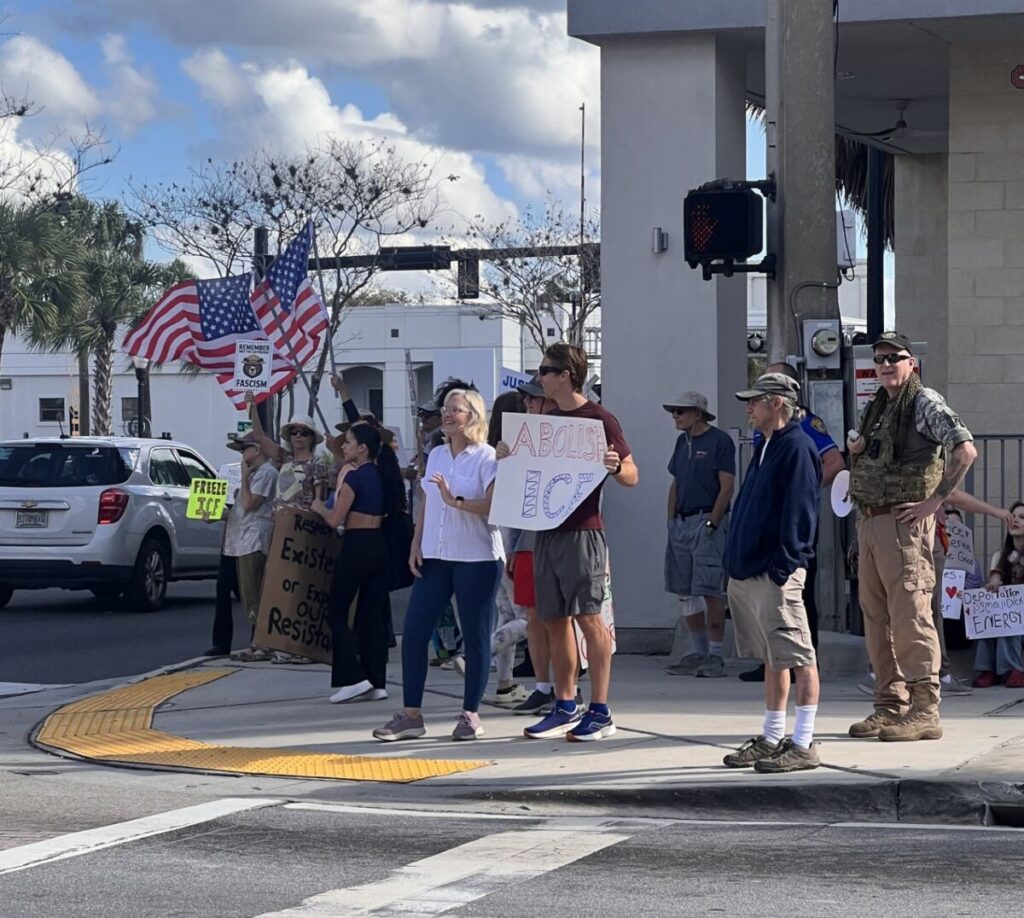
These were some of the people protesting on the Ocala downtown square on Jan. 10, 2026. [Photo by Jennifer Hunt Murty/Ocala Gazette]
On Jan. 10, I walked around the Ocala downtown square to talk with people protesting recent federal immigration enforcement actions. Some were shouting expletives about ICE, their voices raw with anger. Others — many of them elderly — spoke with quiet urgency about their fear of how federal immigration enforcement is being carried out in communities across the country.
Gary Rapisarda, an older white man who uses a cane to assist with walking and has lived in Marion County since 2014, attended the protest wearing a shirt that read, “Hate won’t make America Great,” along with the words Kindness, Peace, Equality, Love, Inclusion, Hope and Diversity. Rapisarda said he fears the federal government is using Immigration and Customs Enforcement (ICE) to “get rid of the black and brown,” and that the next targets could be “white senior citizens and handicapped” people who rely on Social Security benefits.
When I asked why he felt that way, he referenced the 1970s film “Executive Action,” which imagines powerful men orchestrating a conspiracy to eliminate people they deem undesirable while simultaneously manufacturing an alternate reality to control the public narrative. I watched the movie the following day. It is a gripping work of fiction that taps into deep anxieties about power, secrecy and who controls truth — and serves as a reminder of how “facts” can be constructed and accepted by government, media and the public alike.
Whether such fears translate to fact or fiction, it matters that people feel unsafe watching masked agents take neighbors from their homes with little public explanation. For many, that fear is rooted in real uncertainty about how our immigration system operates and whether due process is meaningfully accessible.
The U.S. immigration court system is deeply backlogged, with millions of cases awaiting hearings. Many people live for months — even years — in legal limbo while their cases wait to be adjudicated. At the end of September 2025, out of the backlog of 3,416,921 cases, 2,295,156 immigrants have filed formal asylum applications and are waiting for asylum hearings or decisions in Immigration Court, according to TRAC. These delays leave families uncertain about their futures and their rights.
Critics of current enforcement argue that due process — the right to fair treatment through established legal procedures — is being undermined not only by backlog but by structural design. Immigration courts are under-resourced and there is no guaranteed right to legal counsel for people facing deportation. Many must navigate a complex legal system alone, while government attorneys argue for their removal.
Groups such as the Heritage Foundation counter that non-citizens in removal proceedings were never intended to receive the full constitutional protections afforded to U.S. citizens, emphasizing that immigration proceedings are civil — not criminal — matters.
Yet scripture (1 Corinthians 10:23) reminds us that “all things are lawful, but not all things are helpful; all things are lawful, but not all things edify.” Legality alone does not settle the moral question.
There are strong disagreements about the enforcement actions now playing out across the country. Some argue ICE is fulfilling its mandate — enforcing federal law and protecting the integrity of U.S. borders. Others point to the human cost of expedited removals that separate families before courts have an opportunity to weigh circumstances.
Even religious leaders have tried to strike a balance. Pope Leo XIV, along with U.S. Catholic bishops (Pope calls treatment of migrants in U.S. ‘extremely disrespectful’ | USCCB), has said that no one is calling for open borders and that nations have a right to determine who enters their country. At the same time, they have acknowledged that the U.S. immigration system is deeply flawed and in need of reform so that justice can function more fairly and humanely.
And for those who argue that due process is not owed to people here unlawfully, a difficult question remains: How do we prevent racial profiling — a reality that has already led to U.S. citizens being detained or questioned based solely on appearance or ethnicity?
Fear, whether rooted in movies, history or lived experience, is real. It shapes public discourse and fuels mistrust of institutions and of one another. At the same time, demonizing entire groups — whether immigrants or federal law-enforcement officers — is dangerous. Reducing complex people and systems to caricatures deepens division and makes solutions harder to reach.
There is a larger conversation to be had — one that neither dismisses fear nor feeds it — about how our nation balances enforcement with fairness, order with compassion and law with humanity. That conversation must include accountability and transparency in enforcement, as well as accountability from elected officials of both parties who, for decades, have failed to reform an immigration system everyone agrees is broken.
Can both things be true? Yes. ICE operates under federal law and immigration enforcement is not new. But it is also true that an overwhelmed, under-resourced court system — combined with aggressive enforcement — fuels fear, distrust and real harm, sometimes separating families without regard for military service, long-standing community ties or legal compliance efforts already underway.
We must build a path forward that recognizes the shared humanity of everyone affected: communities fearful of crime and instability; citizens unsettled by masked enforcement actions in their neighborhoods; and immigrants trying to build lawful lives within a system that has failed all of us for generations.

Support community journalism
The first goal of the Ocala Gazette is to deliver trustworthy local journalism so corruption, misinformation and abuse are not hidden from the public or unchallenged.