
Ocala/Marion County PIT count numbers released
The Point in Time, or PIT, census assesses the number of homeless people in an area, with the survey taken on a single day.
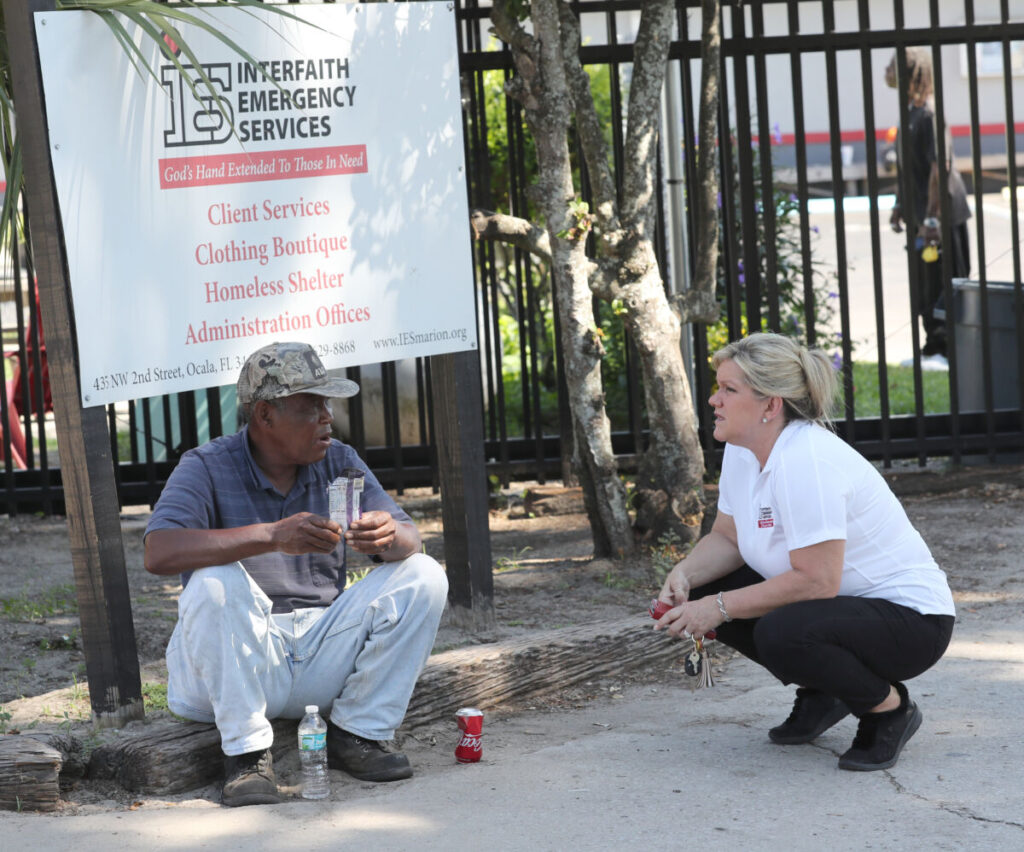
Karla Geenway, CEO of Interfaith Emergency Services, talks with Sammy Dyers, a homeless man, on Northwest 2nd Street in Ocala in 2021. [File photo by Bruce Ackerman/Ocala Gazette]
Preliminary data from the 2025 US Department of Housing and Urban Development’s required annual census of homeless people in Marion County, which is taken on one day and is known as the PIT, or Point in Time count, has been released by the city of Ocala.
According to an email released by James Haynes, director of the city’s Community Development Services, Jan. 25, 2025, count teams documented encounters with 231 people in different types of shelters and 160 people living unsheltered, for a preliminary total number of homeless persons at 391.
“We feel that the number of sheltered and unsheltered is reflective of the homeless persons and families in Marion County at that point in time,” Haynes noted in the email in part.
The PIT count was overseen by the Ocala/Marion County Joint Office on Homelessness Prevention.
According to charts available at the Florida Department of Heath website, flhealthcharts.gov, the homeless estimate total for Marion County for 2024 was 378 and in 2023 the estimate was 454. The highest count in the last 15 years was taken in 2012, at 1,032, the chart indicates.
The HUD required census data gathered on PIT count day, combined with a count of available shelter beds, known as a housing inventory count, plays a “critical role,” according to HUD, in granting awards to local nonprofits and agencies known as the Continuum of Care.
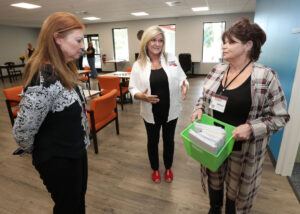
Karla Greenway, CEO of Interfaith Emergency Services, center, talks with Melissa Hanson, the case manager of the IES engagement center, right, where multiple agencies work together to help homeless people, and Robin Ford of the city of Ocala, in 2024. [File photo by Bruce Ackerman/Ocala Gazette]
People living in outdoor camps, cars, abandoned buildings, parks, airports and bus stations are considered unsheltered while those in various types of emergency shelters, staying with friends or confined in institutions or hospitals, are not considered unsheltered, according to the HUD PIT count guidelines at hudexchange.info
Rachel, 59, who chose to use only her first name, was homeless and living in a camp during the time frame of the PIT count and was not counted. She said she doesn’t believe anyone in her camp in northwest Ocala was counted, but this was not confirmed with officials.
Rachel, who has worked in the healthcare industry, has lived in the area for 25 years and been homeless three times. She said she has dealt with alcohol addiction but at the time of our conversation had been sober 67 days.
Karla Greenway, CEO of Interfaith Emergency Services, one of the area’s leading nonprofit agencies, said the PIT count is the “best method” but can be “misleading.”
“It’s self-reporting and some homeless people don’t want to be counted,” she said.
Greenway said she has seen an increase recently in the number of women with children living homeless in cars and “people in crisis with rents going up.”
The Marion County Clerk of the Circuit Court reported 157 eviction cases in December 2024, 91 in March of this year and 112 in April.
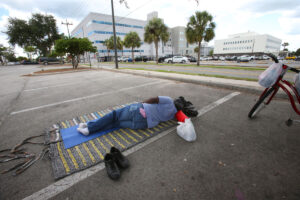
An unidentified homeless man sleeps in a parking lot near the Marion County Judicial Center and Golden-Collum Memorial Federal Building and United States Courthouse in Ocala in 2020. [File photo by Bruce Ackerman/Ocala Gazette]
Neither the Ocala Police Department nor the Marion County Sheriff’s Office report any arrests to date related to the Florida “no camping” on public property statute FS 125.0231 of 2024. There are guidelines in the statute that beds must be available before action is taken but it is unclear what misdemeanor or felony charges, if any, might be tied into the statute.
“Our Engagement Center (on North Pine Avenue) had 566 individual clients that came in for services in 2024 and of those 86 were in a shelter (but are still considered homeless). This doesn’t include those housed at Shepherd’s Lighthouse down in Belleview, most of those sheltered at Salvation Army or those sheltered at Project Hope,” Greenway wrote in an email.
“These are also the ones that come into town. There are more homeless we know of that are in the outskirts of Ocala and rarely if ever come here,” she stated.
“I think the PIT count is a more accurate count of those who are homeless for an extended period of time (most of them years) and are in this position because of additional challenges such as intellectual (cognitive) disabilities, mental illness, physical disabilities or addiction. Most have more than one of these issues going on,” she wrote
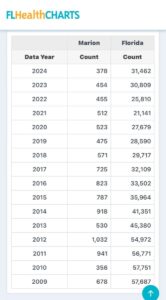
[Image from FLhealthcharts.gov]
Jessie Vega with IES said the night of this year’s PIT count was “colder than average,” which might have affected the outcome.
Jason Halstead, executive director of Brother’s Keeper, a ministry of Blessed Trinity Catholic Church, which operates ministries including a year-round downtown feeding program that serves hundreds of meals daily to the needy, said weather may have been a factor in the PIT count in 2025.
He stated in an email that “the number of homeless we see at Brother’s Keeper is about the same as it has been. Maybe slightly less.”
Meanwhile, two major projects to assist those in need of housing are open or on the horizon.
Wear Gloves, a nonprofit Continuum of Care member, provides “workforce readiness” training at its Ocala Dignity Center and participants may be involved in Dignity Roasters, a seller of locally roasted coffee.
Wear Gloves recently held a grand opening for Dignity House, a 13,000 square foot facility in southwest Ocala intended to house up to 70 homeless men in phases, with a transitional housing program. One of 12 client rooms will be reserved for emergency intake from law enforcement.
Saving Mercy, a local faith-based nonprofit that provides “wrap around services,” broke ground in December 2024 on a two-phase yearlong project that includes a 59-unit apartment building backed by Carrfour Supportive Housing of Miami and 10 duplexes funded by Marion County Community Services.
The 79 units will provide “supportive housing and affordable housing,” according to Saving Mercy Executive Director Penny Beehler.
“I’m excited about the opening of Wear Glove’s new shelter and the progress being made at Saving Mercy,” Halstead said.

Support community journalism
The first goal of the Ocala Gazette is to deliver trustworthy local journalism so corruption, misinformation and abuse are not hidden from the public or unchallenged.