
Ocala Housing Authority holds meetings
Uneasy public housing residents are concerned about possible government funding cutbacks.
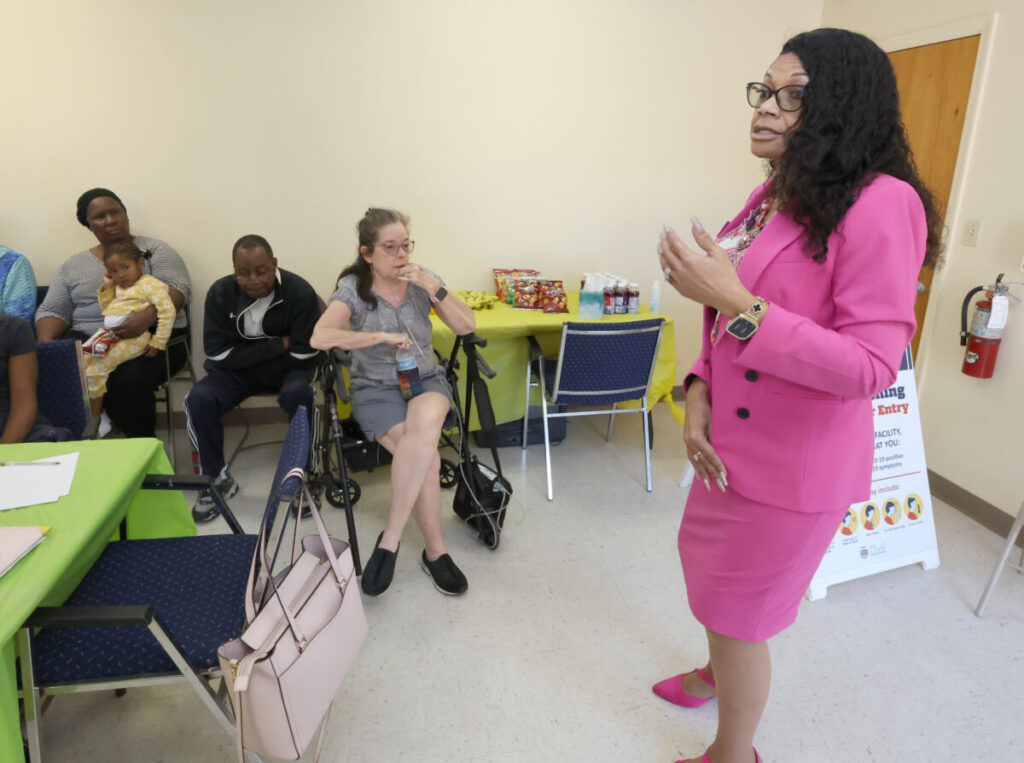
Gwendolyn Dawson, the CEO of the Ocala Housing Authority, speaks during a meeting with residents of Pine Gardens on Southwest 2nd Avenue in Ocala, Fla. on Thursday, March 13, 2025. Dawson said he held the meeting because many residents were worried about the the possible shutdown of the U.S. government, which could lead to a loss of Housing and Urban Development Department funding for the residents. [Bruce Ackerman/Ocala Gazette] 2025.
Officials from the Ocala Housing Authority hosted three public meetings on March 13 in response to a barrage of calls from residents of four public housing complexes who are concerned about the effects of possible governmental funding cutbacks.
OHA, a U.S. Department of Housing and Urban Development Public Housing Agency, operates subsidized housings for eligible families with 185 units in Ocala, at Pine Gardens at 515 SW 2nd Ave.; Shady Hollow, at 802 SW 19th Ave. Road; Pavillion Oaks, at 2203 NW 1st Ave.; and Deer Run, at 2804 NE 4th Court, according to its website. The HUD website states that public housing is “for low-income families, the elderly and persons with disabilities.”
“We do not know what the final (funding) levels will be,” OHA CEO Gwendolyn Dawson told about a dozen residents at the first of the meetings, held at Pine Gardens, a 20-unit public housing complex near the downtown post office.
Dawson, who has been with OHA for more than 25 years, indicated that HUD funding uncertainty runs throughout the system that channels finances to her agency.
“HUD in Jacksonville, they don’t know,” about future funding levels, she stated.
Dawson said although the budget that Congress will pass is yet an unknown, OHA “was not hiding” and officials wanted to hold the meetings out of “compassion and concern” for residents in the wake of a “lot of calls” and some feelings of “anxiety.” She said a second reason for the meeting was to be sure the local agency had cell phone numbers for residents to facilitate text notices.
OHA’s Deputy Director Janell Diaz and Property Manager Michelle Nelson joined Dawson at the Pine Gardens meeting.
Diaz noted in a later email that a one-bedroom flat in Pine Gardens runs $687 monthly and that the portion of rent paid by the resident varies based on a formula applied to their income. OHA oversees the amount, typically 70%, of rent paid by HUD and manages the balance of rent due from qualified residents.
“The public housing resident’s portion of the rent varies. Their portion of the rent is based on 30 percent of the monthly adjusted income, or annual income less deductions allowed by the regulations. OHA is only responsible for the management and operation of the public housing properties. If the funding is reduced, then that will mean it will impact our operations and ability to manage the properties,” Diaz wrote.
“A HUD funding reduction will not impact the portion that the resident currently pays, since their portion is based on their annual income. However, reduced funding could potentially impact the utility allowance assistance the housing authority provides residents,” she stated.
Mary, a seven-year resident at Pine Gardens, is a certified nurse’s aide by profession but, due to brain and neck surgery, has not been able to work. She has been paying her living expenses from savings.
If those funds run out, “I can live in my truck,” she said.
Romona, also a seven-year resident, recently lost her internet related job. She heard Dawson’s “wait and see” message at the Pine Gardens meeting. She said she loves living at Pine Gardens and “loves her neighbors.”
One Pine Gardens resident mused after the meeting that future funding all hinged on the Trump administration in Washington while another said she’s just “going with the flow” and that, “God’s got his hands on this.”
To learn more, go to ocalahousing.org and hud.gov



Support community journalism
The first goal of the Ocala Gazette is to deliver trustworthy local journalism so corruption, misinformation and abuse are not hidden from the public or unchallenged.