
Ocala City Council debates CEP contract after disagreement over railroad use
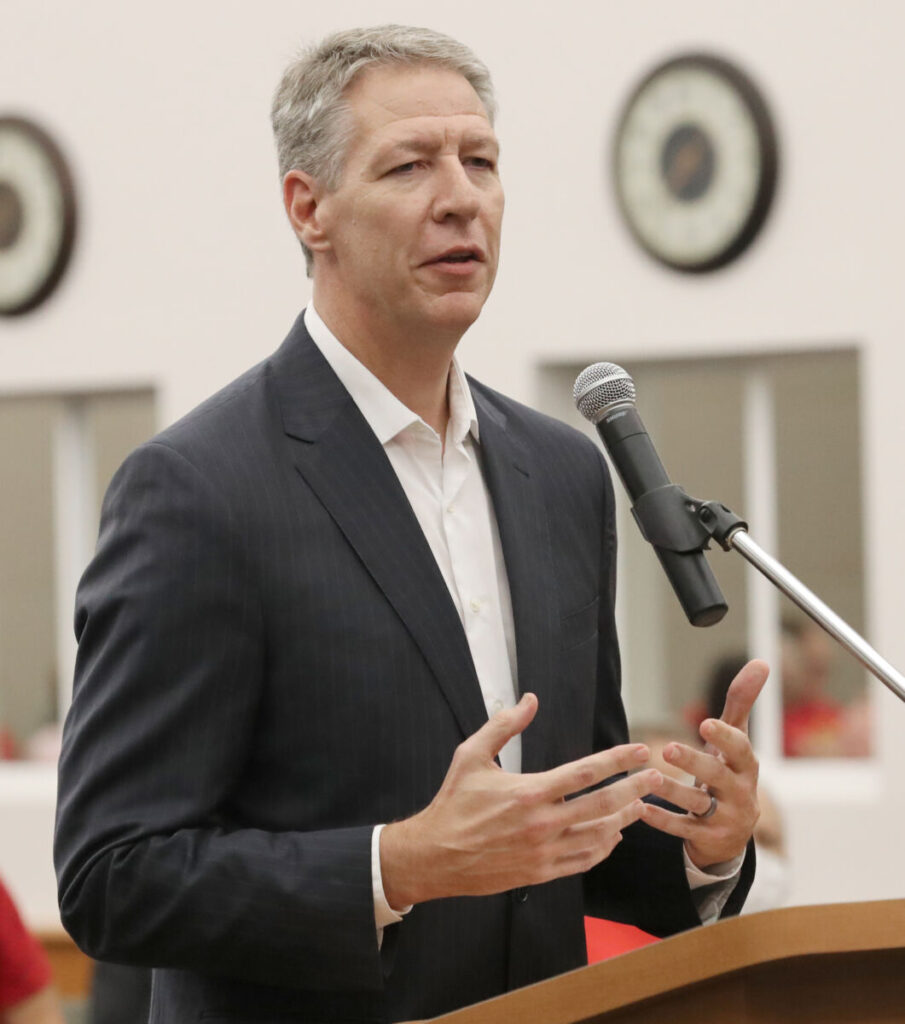
Kevin Sheilley, the President/CEO of the Ocala Metro Chamber and Economic Partnership, speaks to Florida legislators during the Marion County Delegation at the Klein Conference Center at the College of Central Florida in Ocala, Fla. on Thursday, Oct. 7, 2021. [Bruce Ackerman/Ocala Gazette] 2021.
The Ocala City Council took issue with this year’s proposed contract with the Ocala/Marion County Chamber & Economic Partnership, which for the past 12 years has been approved without a hitch.
After the CEP, against city leaders’ wishes, backed a proposal that would increase the traffic on the railroad running through downtown, the council on Nov. 5 tabled discussion on the contract. It will be revisited next month.
Ocala has had a contract with the CEP since 2013, which at the time cost $145,000, broken up into four quarterly payments. Now, the contract is up for renewal at the cost of $190,000.
“Generally, this agreement will look at some of the partnerships that will occur between the city, and it will include attraction of businesses that the CEP will do,” said Planning Director Aubrey Hale. “The city works with them on multiple agreements, such as projects including the airport logistics, Optimum RV, Averitt, FedEx, Chewy and AutoZone.”
Councilmember Jay Musleh brought up the recent endorsement of the Advanced Drainage Systems proposal to utilize the old Certified Grocers site and the railroad, which the city made clear it opposed due to the potential for disruption to downtown businesses and traffic.
“I’m a huge supporter of the CEP. I think they’ve done a fabulous job,” said Musleh. “However, I think it’s time for us to rethink how we move forward. $190,000 a year to me is too big a scope for what we’re doing now.”
Musleh said he felt the CEP served Marion County’s interests more and expressed concerns about paying the organization a hefty amount after the group’s leaders disregarded the city’s wishes.
“What I am very miffed about is that even in the CEP’s meeting agenda minutes where they endorsed the project, there was never one discussion brought up about any impact that this would have on the city of Ocala downtown. I perceive it to be a negative impact,” Musleh said.
Musleh agreed that the likelihood of converting the railroad to a multi-use trail was slim but expressed that the traffic on the rail should not have increased against the city’s wishes.
The decision to approve the ADS proposal came down to the county commission, which heard hours of public debate beforehand from stakeholders.
Musleh argued that the CEP doesn’t need such a large annual payout from the city. Since the CEP’s formation in 2013, the city has contributed $6,350,000 to the organization, including the annual contract funds, in-kind contributions and the donation of a building, Musleh said.
“I think they’re perfectly capable of standing on their own,’’ he said. “I’m not stating to totally disregard the CEP, but I think it’s time for us to take more of a sponsorship level and bypass this $190,000.”
Musleh agreed with continuing the agreements between the city and the CEP to put on the Farmer’s Market and support the Downtown Business Incubator but strongly opposed renewing the contract.
“When their goals don’t align with our goals, and we don’t even get a voice at the table…I cannot and will not support this,” Musleh said.
According to legal memos obtained by the Gazette between the city and their long-time former attorneys Gooding & Batsel (who now represent ADS), the 1881 easement for the railroad to come down Osceola between the city and CSX is missing- and the City has been trying to ascertain what rights and conditions under that easement.
CEP President and CEO Kevin Sheilley offered a rebuttal to Musleh’s comments, attempting to reassure the council that downtown Ocala remains one of the CEP’s strong priorities.
“We are strongly adamant supporters of downtown. We think we have a really great downtown and with some of the things that are on track, it could become an incredible downtown. We love that we play a role in that,” Sheilley said.
Sheilley said that the CEP issued its letter of support for the proposal well before the city expressed issue with it, while Musleh questioned why the interests of downtown development weren’t prioritized during those initial discussions.
“The vast majority of our work, the vast majorities of our companies and employment centers are in the city—but not all of them. We don’t want all of our employment centers in one spot.
That has long been a rail-serve site, that CSX repeatedly told us they had no intentions of abandoning the rail,” Sheilley said.
Sheilley referenced the city of Savannah, Georgia’s downtown area, which has a freight line running through it five times a day and poses no negative impact to the area.
Councilmember Kristen Dryer asked Sheilley if the contract could be amended to include a definitions page before approval to increase transparency and clarity.
“I think the city has a different focus (than the county) right now. So, for me, I would like to see some of this language changed in here to refocus the mission from the entire Ocala metro to downtown redevelopment,” Dryer said. “I think we need to pivot and home in on what (the CEP) can do in the city limits.”
Dryer also asked that if in the future the city expresses opposition to something that the CEP is endorsing or promoting, that the CEP agree to recuse itself from issuing a letter of support that would be contrary to the city’s wishes.
Councilmembers Jim Hilty and Ire Bethea agreed that the contract should be revisited.
Council President Barry Mansfield expressed strong support for renewing the contract, saying that from a local business perspective, it is well worth the city’s money to support its constituents.
Hale suggested that staff review the contract, consult with the CEP, and bring it back before council sometime in December.

Support community journalism
The first goal of the Ocala Gazette is to deliver trustworthy local journalism so corruption, misinformation and abuse are not hidden from the public or unchallenged.