
Ocala cinematographer worked on new NBC series
Mark Emery filmed alligators and manatees for the 10-part documentary “The Americas,” which will debut Feb. 23.

This alligator was filmed at Silver Springs, which are some of the finest springs in the world for filming underwater, according to the photographer. [Photo by Mark Emery]
On Feb. 23, NBC will air the first of “The Americas,” a 10-part nature documentary series that had a goal of exploring areas of the planet never been shown before. Among the intrepid “explorers” was Ocala’s own award-winning cinematographer Mark Emery.
Materials on the NCB website note that the co-production between NBCUniversal and the BBC marks the first time North America and South America, home to the largest variety of life on the planet, are at the center of a wildlife documentary series.
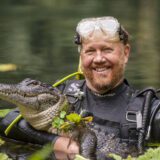
Mark Emery has worked with alligators on more than 30 films. This young gator was tired from a long day of filming, “so holding it worked out briefly,” he said. [Photo courtesy Mark Emery]
The series is narrated by actor, producer and writer Tom Hanks. It took five years to produce.
“It’s pretty ground-breaking,” Emery said of the series. “NBC has never done 10 one-hour shows on wildlife and that’s a big deal. And with the BBC behind it, they have some of the best researchers in the world. We worked on the manatee section and alligator underwater parts. Some of the folks who worked on the ‘Planet Earth’ series headed up the production.”
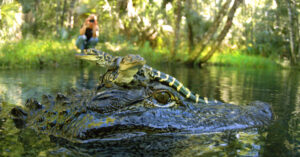
Mary Emery is seen in the background of this image with a gator mom and her young. [Photo by Mark Emery]
In addition to his filmmaking, Emery also is well known for his musical compositions, many of which have been used in films and documentaries. Composer Hans Zimmer wrote the score for “The Americas” and Emery said he believes viewers will be amazed by what they hear and see.
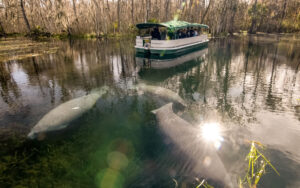
Those enjoying a glass-bottom boat ride at Silver Springs State Park may often see manatees in the winter months. [Photo by Mark Emery]
“I don’t know if they covered Cuba on this film, but Mary I went to Cuba years ago for National Geographic Television. There is a species called the Cuban crocodile in the swamps that jumps six vertical feet in the mangroves and takes animals out of trees. They are extremely rare, only 600 left in the wild. And there’s an animal you don’t feel sorry for, called a hutia, which looks a bit like a rat crossed with an opossum, and they are the main item on this croc’s menu,” Emery shared.
“As far as filming manatees, I think we took a unique approach. We contacted one of the folks who is in charge of manatee research in our area and had her come on the boat with us to show her how we were going to film, and she approved. We used a jib, a small crane in the boat and as the manatees came in view, we could film them from above. Sometimes it looked like they were swimming through clouds or whatever was reflected from the sky,” he noted.
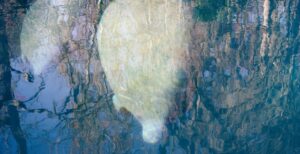
In the fall, there is a chance to see manatees chilling in the reflections of a fine autumn afternoon, almost like a painting. [Photo by Mark Emery]
“It gave us a really good look at their underwater habits and mating behavior. There are times they get up next to each other and one of them will take its flipper and put it over another one and roll them over. Sometimes they’ll play chase underwater. It’s like they are a giant golden retriever or something, they have that kind of mentality. I’ve been in the water with them and they look at you and then take off and go about 20 yards and wait on you. Their normal speed is a cruise speed of 5 miles an hour. The fastest swimmer in the last Olympic trials went between 5 and 6 mph for just a split section. There is one manatee at Silver Springs that has gone all the way to Fort Lauderdale and back twice now,” he shared.
“There were some unusual things we got to film. Tom Fitz is a multi-Emmy-award-winning filmmaker who did a lot of the underwater shots. I ran the boat for him, and later did much of the above water manatees in scenes. I was boating on some days with temps in the 20s and 30s and we were able to get some really beautiful scenes with manatees, steam and fog. The mating behavior can be six or seven animals together at one time. It’s crazy; it’s not what you think. I don’t know what they’ll use, but that’s what we filmed,” he added.
As for working with alligators, Emery said he has “done so much of that over the years. I’ve probably done more than anyone walking around, as back then there were not many cinematographers that had alligator wrestling on their résumé. I worked at Ross Allen’s Reptile Institute as a kid, milking rattlesnakes and wrestling alligators five times a day, so when you have that on your résumé, they will likely hire you to do the alligator underwater work,” he said with a laugh.
For “The Americas” series he used a “red” camera, which he described as an American cinema camera with 5,000 to 6,000 lines of resolution.
“It’s amazing what alligators look like underwater. You have to be very patient. You don’t rush them; you take a lot of time and move very slowly. You will have to be relatively close to get anything that’s usable,” explained Emery, who is 70 years old. “I was surprised that I got the opportunity to work on this at 69 and 70 years old. I didn’t think I’d get a chance to do anything like this that late in life.”
Emery also has shot footage for the BBC, PBS, Smithsonian Network and National Geographic, among others. Many times, his wife Mary goes along with him on projects and the duo also spends four or five months of each year in Alaska.
As for his favorite and least favorite animals he has worked with over the years, Emery said he enjoys working with intelligent animals.
“Alligators are actually intelligent. I love manatees to work with underwater. I like grizzly bears in the right places in Alaska. I’ve been to Africa to film; lions are interesting, and elephants are very bright. Dolphins underwater are a blast; they can even be comical,” he shared. “The least favorite would be swimming underneath a rattlesnake off of Torch Key in the ocean. I’m 18 to 20 inches under it swimming upside and backwards. I have to say, I was ready to be done with that one. I’ve been bit by a rattlesnake before and didn’t want a repeat of that experience!”
Emery recently has been filming close to home, monitoring some panthers on a tract of land between Marion and Citrus counties. The area for now is protected but, as with many areas of the state, development is edging nearer all the time. One of the things those involved with the project want to know is the genetic makeup of the big cats, which they may be able to determine through hair samples and scat if it becomes attainable.
To learn more about Emery and his adventures, go to fb.com/memerym or [email protected]
For details about “The Americas,” which debuts at 7 p.m. on Feb. 23., go to nbc.com/the-americas
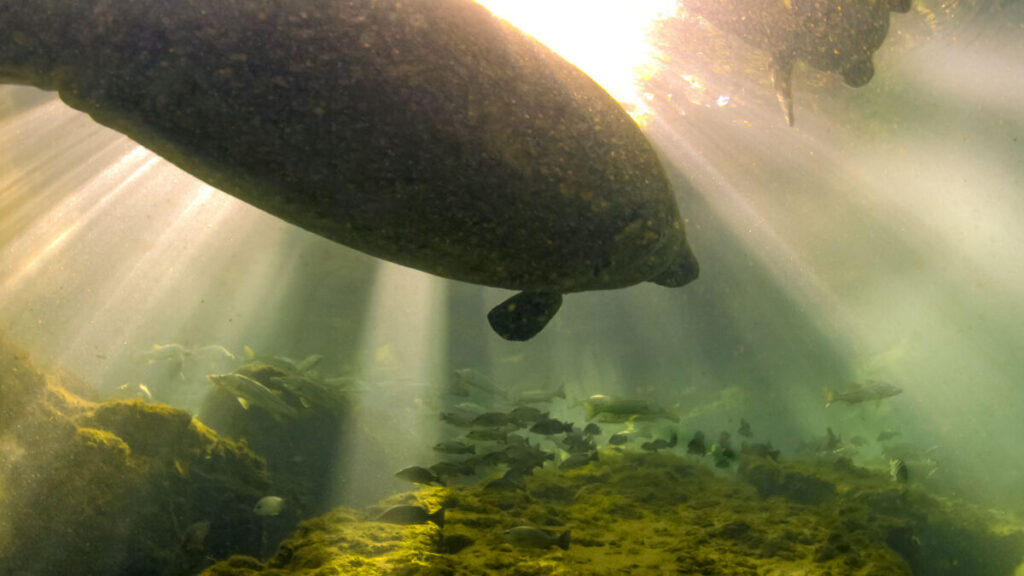
This manatee was filmed at Homosassa Springs State Park. [Photo by Mark Emery]

Support community journalism
The first goal of the Ocala Gazette is to deliver trustworthy local journalism so corruption, misinformation and abuse are not hidden from the public or unchallenged.