
Ocala advances key water infrastructure projects
The projects align with larger efforts by plugging into regional water supply planning frameworks that look decades ahead, one official noted.
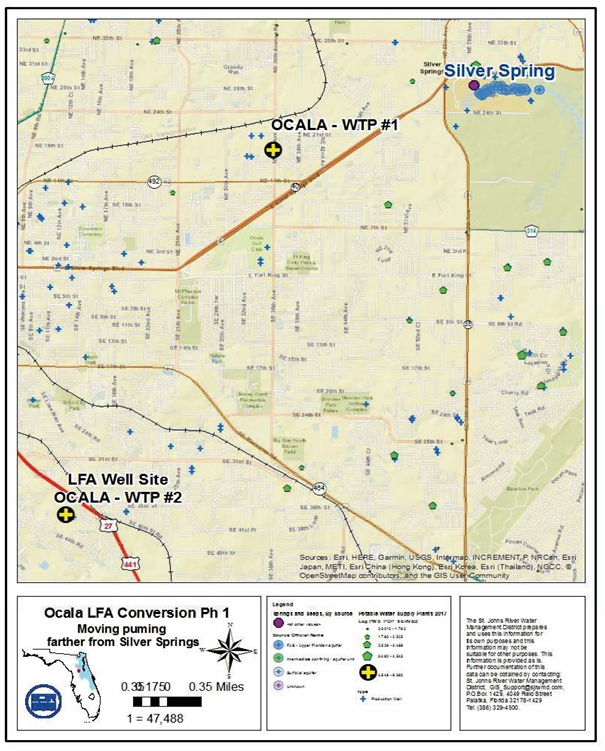
This image is part of the package tied to the Ocala Lower Floridan Aquifer Conversion Project. [Courtesy city of Ocala]
The Ocala City Council has approved two major water-related initiatives that aim to strengthen the city’s long-term water supply and infrastructure reliability amid ongoing population growth.
The council on Jan. 6 approved a $2 million cost-share agreement with the St. Johns River Water Management District (SJRWMD) for phase IV of the Ocala Lower Floridan Aquifer Conversion Project, along with the final one-year renewal of the Water Resources Improvement Program construction contract with Miller Pipeline, LLC, at up to $2 million.
According to Ocala Communications Director Darling Hill, the Ocala Lower Floridan Aquifer Conversion Project phase IV is a critical step in shifting the city’s drinking water sourcing from the more stressed Upper Floridan aquifer to the deeper Lower Floridan Aquifer.
“The new Water Treatment Plant #2 (WTP #2) will provide an alternative water supply to the current wellfield located in Northeast Ocala,” Hill said. “Population growth in Central Florida has placed significant pressure on the Upper Floridan aquifer, resulting in lowered water tables. There is abundant water in the Lower Floridan aquifer to provide potable water for the long-term future without further stressing the Upper Floridan aquifer.
“The new WTP #2 will also provide additional water supply to growing areas to the south and west of Ocala,” Hill added. “Extracting less water near Silver Springs will result in increased flows to the spring shed. Using this new water source supply is less expensive than alternative supply sources obtained through desalination or surface water.”
Phase IV focuses on key infrastructure additions.
“The (project includes) construction of one high-service pump (HSP) building and installation of one large HSP, two jockey (supporting) HSPs, and associated equipment,” she said.
The $2 million from SJRWMD covers half of the estimated $4 million project cost, with Ocala providing the match through Budget Resolution 2026-121.
As for potential cost overruns, Hill said, “If the cost exceeds the current estimate, then the department will go into the water resources reserves.”
To address environmental concerns with the shift to the deeper aquifer, she noted that monitoring wells are in place to track groundwater recharge rates.
According to the U.S. Geological Survey, groundwater recharge rates refer to the quantity or volume of water that enters the saturated zone of an aquifer per unit of time and area, typically expressed in units such as inches per year or millimeters per year, representing the downward movement of fresh water from the unsaturated zone into the groundwater system.
“Because it is so deep (1,350 feet), effects upon fluctuations in the water table will be minimal when using the Lower Floridan aquifer. This water is slightly higher in Total Dissolved Solids (TDS) than water found in the Upper Floridan aquifer. This can be treated by various methods, including membrane filtration. All potable water produced will meet stringent state and federal guidelines,” Hill said.
The council also renewed the Miller Pipeline contract (CIP 220762) for its final one-year extension through Jan. 8, 2027. The agreement, originally awarded in 2023, supports citywide repairs and upgrades to water and sewer systems.
“This contract is explicitly used for repairing and constructing water and sewer lines and related components across the city as part of the Water Resources Improvement Program,” Hill said.
According to Hill, typical work under the program includes installation of new water and sewer mains throughout Ocala for new developments or upgrading existing mains to reflect the demands of a growing city. It also includes replacing or rehabilitating aging water and sewer mains to improve reliability and reduce leaks and/or breaks, directional boring and installation of new pipe segments where needed for system upgrades and emergency water and sewer repairs when failures occur.
These are consistent with the documented scope of the contract, and the types of projects Miller Pipeline has been previously performed.
“This contract serves multiple areas across Ocala’s water system rather than a single location, including improvements to aging water distribution and sewer collection infrastructure citywide. Upgrades to critical utility lines in residential and commercial zones and repair work following system failures across all quadrants of the city. In previous years, such work has been spread across multiple projects and city areas, reflecting a community-wide benefit rather than one targeted project,” Hill said.
The renewal includes a 3% price escalation.
“The 3% increase is part of a consistent annual escalation approach built into the original contract, and its renewals,” she said. “It lines up fairly well with recent overall inflation in the U.S., though it may not fully account for construction-specific cost inflation, which is often higher than CPI (often 4–5% or more). This adjustment also mirrors the same percentage used in the prior amendments.”
Hill explained these projects align with statewide water management priorities.
“Water projects in the Ocala region align with larger Florida efforts by plugging into regional water supply planning frameworks that look decades ahead at demand vs. resource availability. (This involves) leveraging state and district funding to support alternative supplies, conservation, aquifer recharge and infrastructure that serve multiple communities as well as balancing growth with environmental health, including springs protection and water quality enhancements,” Hill said.
“By embedding local projects within these broader planning and funding ecosystems, Florida aims to ensure that population growth, including in areas like Ocala, doesn’t outpace sustainable water management,” she continued.

Support community journalism
The first goal of the Ocala Gazette is to deliver trustworthy local journalism so corruption, misinformation and abuse are not hidden from the public or unchallenged.